
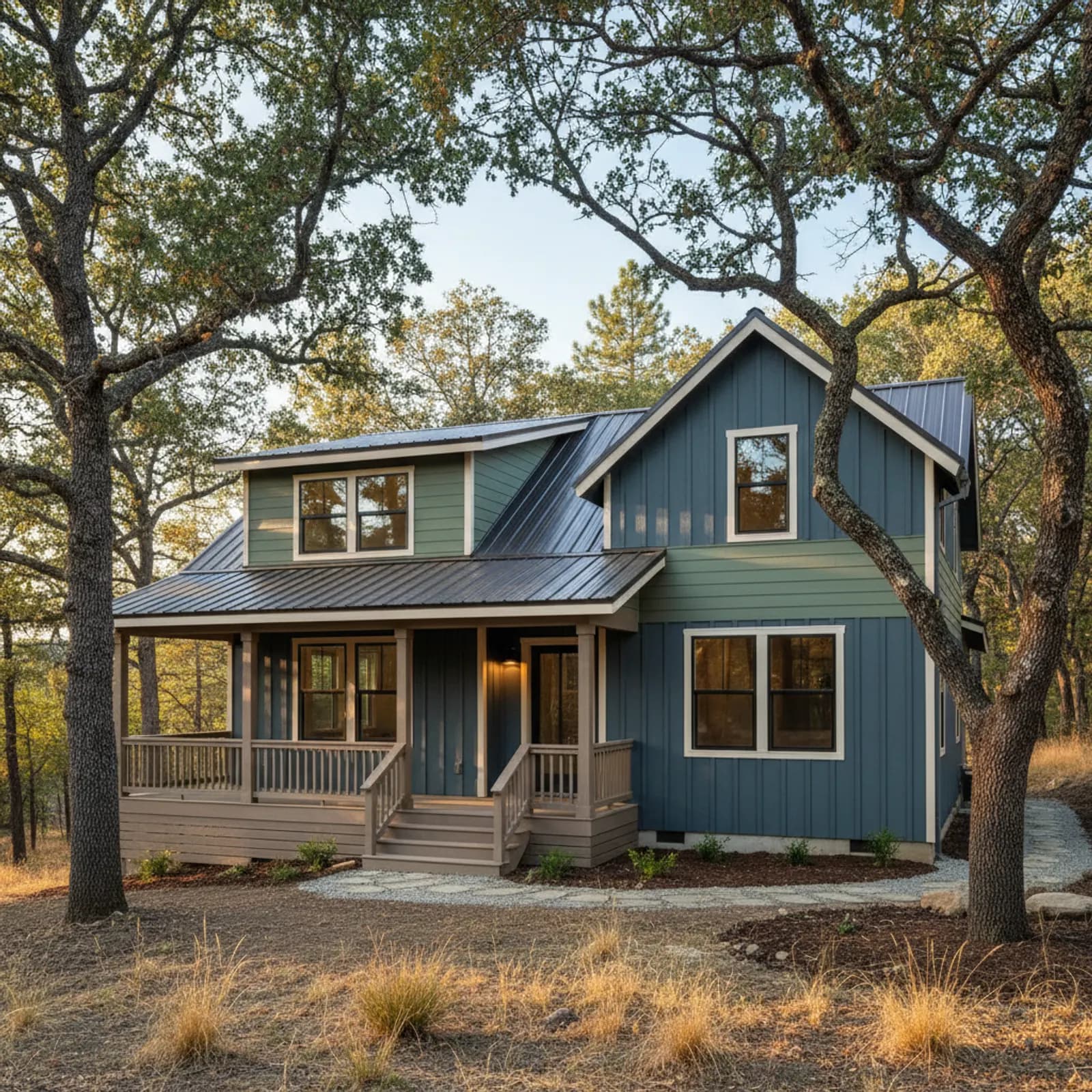
Exterior Contractor in Boulder Creek
Boulder Creek sits even deeper in the Santa Cruz Mountains than Felton, in some of the most fire-exposed and remote terrain we serve. The CZU Lightning Complex devastated portions of Boulder Creek in 2020 and rebuilding/hardening continues. The housing stock is deep-forest cabins, rural acreage, and modest custom homes — most parcels remote, many on long driveways with limited access for materials staging.
What an integrated Boulder Creek exterior delivers is aggressive whole-envelope hardening designed for the absolute worst-case fire exposure: closed soffits, ember-resistant vents, non-combustible cladding and trim, hardened ground-to-wall transitions, and remote-site logistics planned realistically. Splitting any of that across separate trades over time is how Boulder Creek homes get caught half-defended.
What an integrated Boulder Creek exterior includes
On a Boulder Creek deep-forest home an integrated scope strips combustible cladding, corrects the WRB with mountain detailing, replaces all ember-vulnerable vents with ember-resistant equivalents, hardens eave and soffit detailing with closed assemblies as standard, integrates window flashing into a Class A assembly, details ground-to-wall transitions with non-combustible base trim and clearance from landscape contact, and re-clads in non-combustible fiber cement throughout. Outbuildings and accessory structures are scoped into the same project where they share parcel exposure.
Where the split-trade exterior fails in Boulder Creek
Boulder Creek's failure mode is partial hardening. A trade replaces cladding; original soffit vents and unhardened eaves stay. The home is no better defended than before. In Boulder Creek's extreme exposure, that gap between visible and functional hardening is the difference between surviving and not surviving the next event. An integrator removes the gap.
Materials and detailing we specify for Boulder Creek
Maximally hardened: Class A non-combustible cladding, ember-resistant vents at every penetration, closed soffit and eave assemblies as standard, non-combustible base trim and ground-to-wall transitions, robust flashing throughout. The detailing is the product; cladding alone is the smallest piece of the actual defense.
Long driveways and the wildland-urban edge above San Lorenzo Valley
An exterior contractor working at the top of the San Lorenzo Valley plans the job around access before anyone touches a wall. Many Boulder Creek parcels sit at the end of narrow, tree-tunneled driveways that a delivery truck cannot back down, so siding bundles, fiber-cement sheets, and non-combustible trim get shuttled in stages on smaller rigs and staged where the canopy thins enough to work safely. That same wildland-urban edge dictates the spec: where the redwood and tanoak crowd right up to the eaves, the envelope has to assume direct ember contact rather than a managed defensible-space buffer. Practically, that pushes us toward Class-A wall assemblies, metal or sealed connections at every penetration, and detailing that does not rely on the homeowner clearing fuel they realistically cannot clear on steep, remote acreage. A contractor who treats your driveway and your slope as afterthoughts will mis-bid the work and under-spec the hardening. On these lots the logistics and the fire strategy are the same conversation.
Hardening a CZU rebuild without trapping moisture under the redwoods
Boulder Creek lives with a quiet contradiction: extreme fire exposure under a canopy that stays damp much of the year. For an exterior contractor, that means the fire-hardening you do during a CZU-era rebuild or retrofit cannot become a moisture trap. Sealing soffits, swapping to ember-resistant vents, and wrapping the structure in non-combustible cladding all reduce the openings that once let a forest wall breathe, so the assembly behind that cladding has to manage water deliberately. We detail a drained, back-ventilated rain screen behind fiber-cement, keep weather-resistant barriers continuous, and flash every transition so wind-driven rain off the ridge has a path out rather than a place to sit against sheathing. Done carelessly, an aggressively buttoned-up envelope here rots from the inside while looking fire-ready from the street. The goal on a Boulder Creek home is a wall that shrugs off embers and persistent redwood-canopy humidity at once, because protecting against one risk by inviting the other is no protection at all.
Why this matters in Boulder Creek
- Specified for Santa Cruz Mountains conditions
- Class A non-combustible fiber cement as the recommended system
- Correctly detailed weather-resistive barrier and flashing
- Installed by a crew with 20 years combined experience
Recommended systems for Boulder Creek
- Class A non-combustible fiber cement
- aggressive fire-hardening detailing
- robust flashing
Exterior Contractor for Boulder Creek homes
The full exterior contractor approach — materials, weather-resistive detailing, and the manufacturer standards we install to — is covered on the main service page, then specified for Boulder Creek's conditions on this one.
Our Boulder Creek process
- Step 1
Consultation
We listen to your goals and assess your home on site — exposure, substrate, and architecture.
- Step 2
Design & Proposal
A clear written proposal with the right system specified for your climate and a transparent scope.
- Step 3
Expert Installation
Trained crews install to manufacturer best practices with careful weather-management detailing.
- Step 4
Walkthrough & Support
A final walkthrough, full cleanup, and a clear written record of the scope completed — work we stand behind.
FAQ
Exterior Contractor in Boulder Creek — FAQ
Yes — deeper forest, more remote terrain, and the parcels most affected by the CZU Lightning Complex. The hardening standard here is maximal.
Yes — we plan access, materials staging, and crew logistics around remote-site constraints. Long driveways, limited turnaround, and accessory-structure scope are normal for Boulder Creek and we plan around them.
Often — and in this exposure it's frequently the right call. Untouched combustible outbuildings are an obvious ignition path; we scope them into the same project where it makes sense.
In post-CZU deep-forest terrain it can be the difference between insurability and uninsurability for many carriers. We document materials, vent details, eave assemblies, and ground-to-wall transitions thoroughly.
Most Boulder Creek homes are five to nine weeks of active work depending on size, hardening scope, accessory-structure scope, and remote-site logistics.
Keep Exploring
More for Boulder Creek homeowners
More in Boulder Creek
Other exterior services in Boulder Creek
Back to
Santa Cruz County & Boulder Creek
Helpful Exterior Guides