
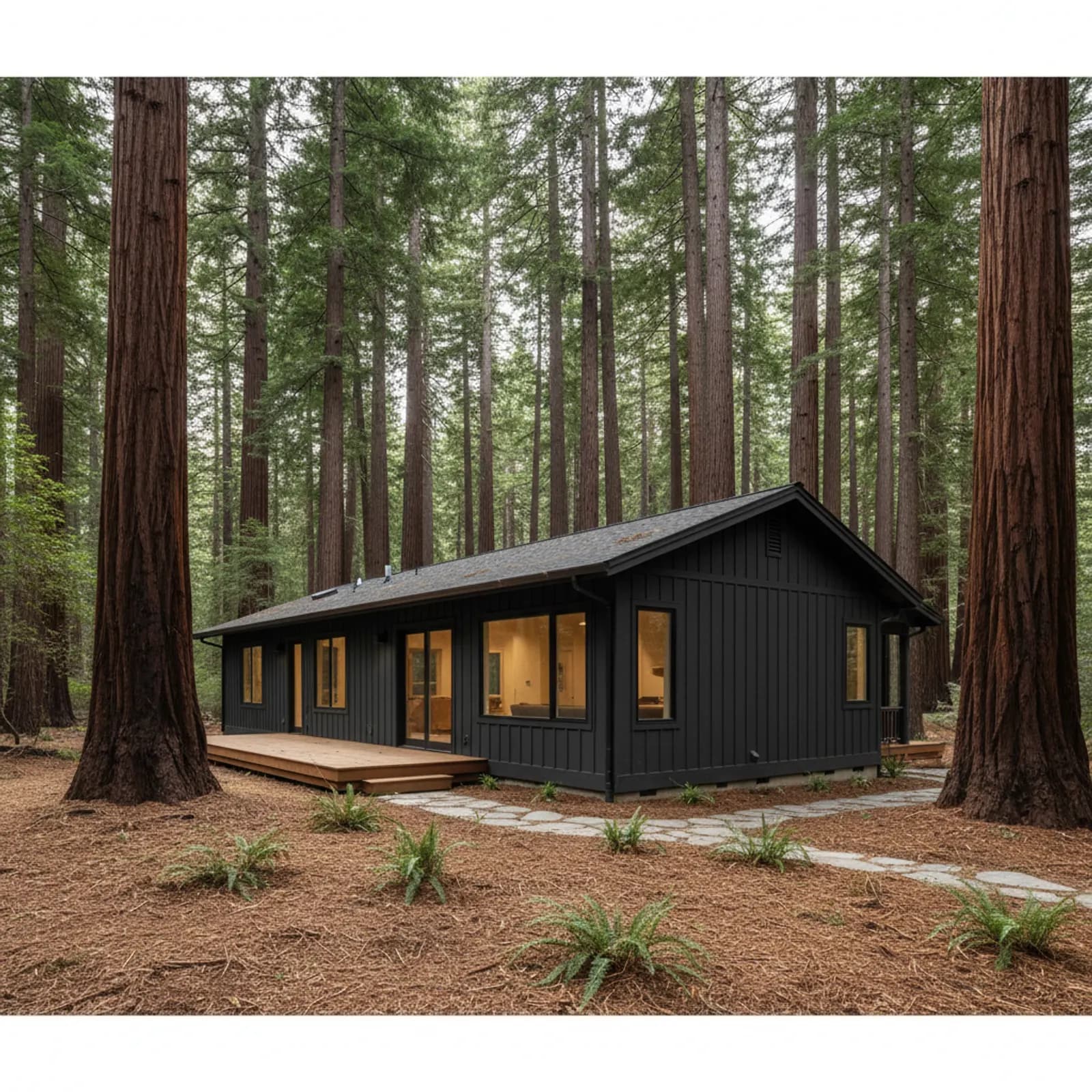
Exterior renovation in Boulder Creek
Boulder Creek sits at the upper end of the San Lorenzo Valley, the most deeply forested community in the Santa Cruz Mountains. The CZU Lightning Complex devastated this area, and rebuilding and hardening continue years later. For Boulder Creek homeowners an exterior project is, unambiguously, a wildfire-survival decision made under a perpetually damp redwood canopy — which is what makes the spec here genuinely demanding.
Fire and damp at the same time
What sets Boulder Creek apart from most fire country is that the exterior has to solve two opposing problems at once. The redwood shade keeps walls cool and wet for much of the year, while the cured forest fuel load drives extreme ember exposure in fire season. A wall that only resists fire but never dries will rot; a wall that breathes but burns is no safer. Both have to be engineered together.
Considering an exterior project in Boulder Creek?
Boulder Creek housing and architecture
Boulder Creek's stock is overwhelmingly forest cabins, rural acreage homes, and off-grid and ridge properties deep among redwoods, plus a small historic town core along the main highway and a growing body of post-CZU rebuilds. Many older homes are owner-built or incrementally added-onto, clad in combustible wood, board-and-batten, or shingle, and embedded in dense canopy. Those combustible older homes deep in the forest are the highest-priority hardening targets in our entire service area, and rebuilds are an opportunity to set the standard correctly from the studs out.
Boulder Creek's deep-forest climate
The controlling stressor in Boulder Creek is the deep-forest moisture-and-fire combination. Surfaces under dense redwood canopy stay cool, heavily shaded, and persistently damp, rarely fully drying between wet spells, which punishes any assembly that can't shed and release water. The same forest then produces extreme, fuel-laden fire seasons. The exterior must drain and dry aggressively and resist embers — one of the most demanding climate combinations we encounter anywhere in Northern California.
Aggressive wildfire hardening in Boulder Creek
Boulder Creek warrants the most aggressive hardening we do. We specify Class A non-combustible fiber cement plus uncompromising detailing at eaves, soffits, vents, decks, and ground-to-wall transitions, recognizing that deep ridge-and-forest terrain and narrow canyon drainages drive extreme ember loading. We pair that with a drying-capable drainage plane so the hardened wall doesn't trap forest moisture, and we build to current California WUI standards. We document every assembly so the work can support defensible-space and rebuilding programs; we won't soften how serious the exposure here is.
Recommended materials for Boulder Creek
Non-combustible fiber cement over a rigorously detailed, drying-capable drainage plane is the only cladding we recommend for Boulder Creek's exposure. Combustible cladding is not a category we entertain here. Because fiber cement also manages the relentless forest damp when it's installed over a proper rainscreen and flashed correctly, the safest material is also the most durable one — it earns its place on both the fire and the moisture ledger rather than as a compromise.
What an exterior project costs in Boulder Creek
Boulder Creek projects carry the heaviest combined fire-hardening and moisture-detailing scope we undertake. On top of that sit difficult deep-forest, ridge, and sometimes off-grid access; long or unpaved private drives that complicate delivery and debris hauling; and substantial substrate, rot, and pest discovery on older damp forest homes once cladding comes off. Rebuilds add full code-current detailing. We assess on site and provide a written, itemized estimate, because the hardening and drying detail — not square footage alone — is where the real value sits.
Off-grid and long-drive access
Many Boulder Creek parcels sit well off the paved road network, reached by steep gravel drives, seasonal crossings, or shared forest easements. That shapes everything from delivery sizing to whether power and water are on site for the crew. We confirm access, turnaround, and staging during the walkthrough so material handling and scheduling reflect the actual approach rather than an assumed roadside lot, and so wet-season conditions don't strand a delivery.
Rot and substrate discovery on older forest homes
Decades of canopy damp on owner-built and added-onto cabins mean removing old wood or shingle siding frequently reveals soft sheathing, compromised framing, or hidden water tracks. We treat substrate and rot discovery as an expected part of Boulder Creek scope, not a surprise, and we'd rather find and correct it under the new hardened, drainable assembly than clad over a problem that will keep working in the dark.
Rebuilding to a defensible standard
For CZU rebuilds and major hardening projects, the exterior is a chance to lock in survival detailing from the start — non-combustible cladding, hardened vents and eaves, and a drying drainage plane all integrated rather than retrofitted. We document the materials and assemblies used so the work complements broader defensible-space efforts and gives owners and insurers a clear record of what was built.
Our process in Boulder Creek
- Step 1
Consultation
We listen to your goals and assess your home on site — exposure, substrate, and architecture.
- Step 2
Design & Proposal
A clear written proposal with the right system specified for your climate and a transparent scope.
- Step 3
Expert Installation
Trained crews install to manufacturer best practices with careful weather-management detailing.
- Step 4
Walkthrough & Support
A final walkthrough, full cleanup, and a clear written record of the scope completed — work we stand behind.
In Boulder Creek the exterior is survival infrastructure that must also endure the damp forest, and the two demands have to be solved together. We scope every Boulder Creek project on site, plan around the real forest access, and your written estimate governs.
FAQ
Boulder Creek — Common Questions
Extreme — Boulder Creek is the most deeply forested Santa Cruz Mountains community, devastated by the CZU fire. We apply the most aggressive hardening we do here.
Class A non-combustible fiber cement with uncompromising detailing at eaves, soffits, vents, decks, and ground transitions, over a drying-capable drainage plane for the damp forest.
Re-cladding combustible wood or shingle in non-combustible fiber cement is the single highest-value hardening step available for a deep-forest Boulder Creek property.
Severe — under dense redwood canopy surfaces rarely fully dry, so drying-capable drainage detailing is essential alongside the fire strategy.
No — given the extreme exposure we do not entertain combustible cladding. Fiber cement also handles the forest damp, so it is sound on both counts.
Yes — difficult forested, ridge, and sometimes off-grid access is a routine, explicitly planned part of Boulder Creek scope.
Yes — we document the materials and assemblies used so the work complements broader hardening and rebuilding programs.
A correctly installed, well-drained fiber cement system commonly performs 30+ years while materially reducing ignition risk in the deep forest.
Explore
Exterior Services
Helpful Exterior Guides