
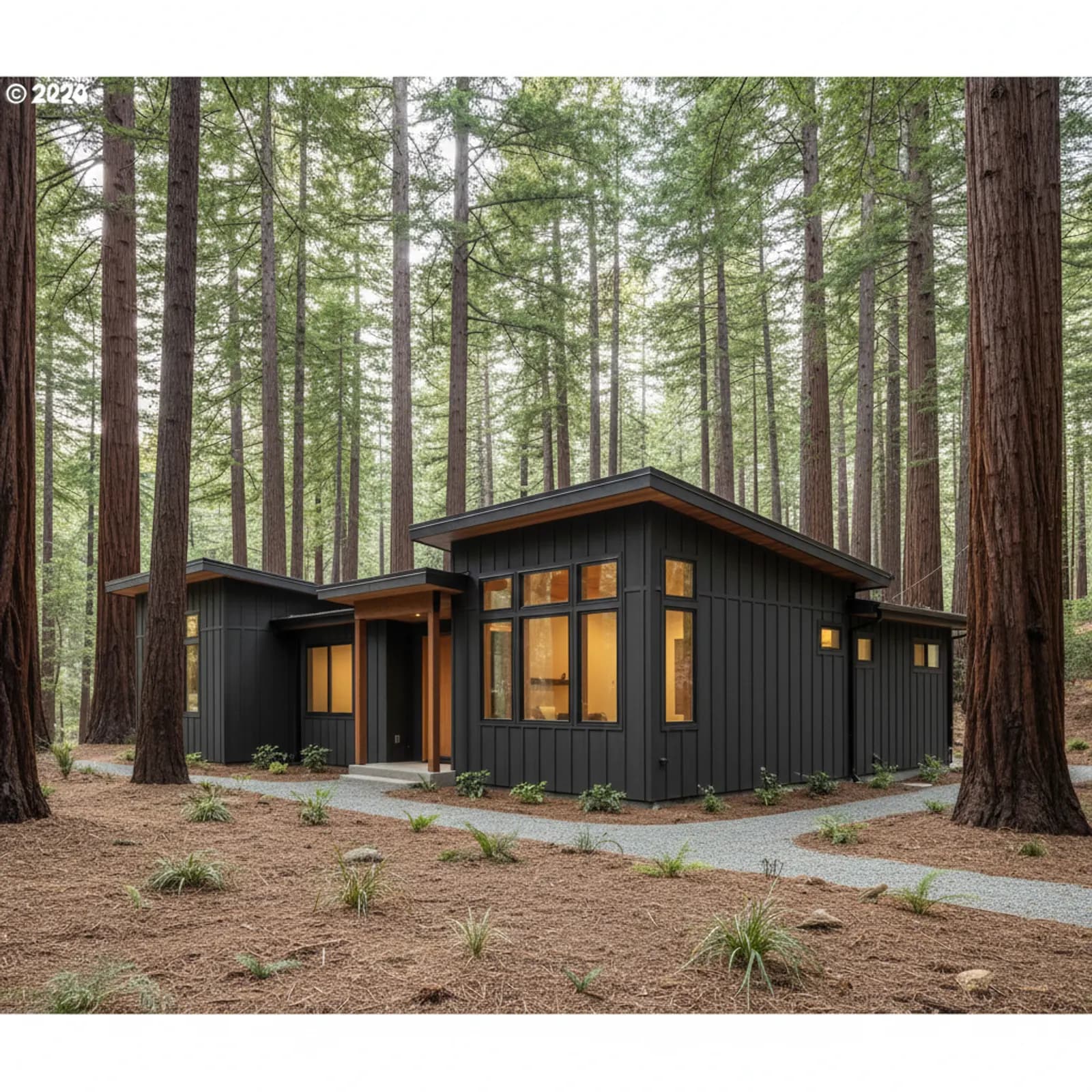
Exterior renovation in Felton
Felton sits deep in the redwoods of the San Lorenzo Valley, in the heart of the Santa Cruz Mountains. The 2020 CZU Lightning Complex burned to and through this area, so for Felton homeowners an exterior project is fundamentally a wildfire-hardening project, combined with managing the cool, perpetually damp forest environment that defines life under the redwood canopy. The wall here has two non-negotiable jobs at once, to resist embers and to keep drying, and that double demand drives every material and detail we put on a Felton home rather than any single concern on its own.
What a re-side delivers on a Felton forest home
In Felton the exterior is genuinely defensive infrastructure, not decoration, because this is extreme terrain that the CZU fire moved through. The single highest-value step available to many owners is re-cladding the combustible wood or shingle still wrapping older San Lorenzo Valley cabins, swapping it for Class A non-combustible fiber cement detailed hard at eaves, soffits, vents, decks, and ground-to-wall transitions. That same change retires the chronic-moisture problem the redwood canopy creates, since the drainage-plane work that lets a wet wall keep drying rides along with the hardening. We document the materials and assemblies we install so the work can support defensible-space and rebuild efforts, while being honest that the detailing, not any single product, is what carries the protection, and insurers set their own criteria.
Considering an exterior project in Felton?
Felton housing and architecture
Felton's stock is largely forest cabins, older San Lorenzo Valley homes along the river and the highway, and rural-residential and acreage parcels scattered among the redwoods, with a growing share of post-CZU rebuilds. Many older homes still wear combustible wood or shingle siding deep in the forest, exactly the highest-priority assemblies to replace. The rebuilds tend toward modern, code-current detailing, while the surviving older cabins need both hardening and moisture correction. We match profiles to the home's character where we can, but on Felton's exposure the material's fire and moisture performance always comes first.
Felton's redwood-forest climate
Felton stays cool, shaded, and persistently damp under dense redwood canopy, with north walls and ground-level surfaces rarely drying fully even in summer. Yet the same forest that holds all that moisture produces severe, fuel-heavy late-summer and fall fire seasons once the rains stop. That combination is what makes Felton unusually demanding: the exterior must both dry out a wall that is chronically wet and resist the ember loading a wind-driven fire pushes through the trees. Few California climates ask both of a single assembly as hard as the San Lorenzo Valley does.
Aggressive wildfire hardening in Felton
Felton warrants the most aggressive end of our hardening practice, given that it sits in extreme terrain that the CZU fire burned through. That means Class A non-combustible fiber cement plus determined detailing at eaves, soffits, vents, decks, and ground-to-wall transitions, recognizing that dense redwood forest drives extreme ember loading in a wind event. We document the assemblies we install so the work supports defensible-space planning and rebuilding programs. We will not entertain combustible cladding on a Felton forest property, and we won't pretend a single product alone hardens a home, the detailing is the point.
Recommended materials for Felton
Non-combustible fiber cement over a rigorously detailed, drying-capable drainage plane is the only cladding we recommend for Felton's exposure. We do not consider combustible wood or shingle here on its merits, because the fire exposure removes that option, and fiber cement also handles the persistent forest damp, so it is the sound choice on both counts. The drainage plane and flashing keep a chronically wet redwood-canopy wall drying, while the Class A material and tight eave and vent detailing carry the ember-resistance side. One system, two problems solved.
What an exterior project costs in Felton
Felton projects carry extensive fire-hardening scope, rigorous moisture detailing, and difficult forested and sometimes steep access that affects how material and scaffolding even reach the wall. Substrate and rot discovery is frequent on older damp forest homes, and the eave, soffit, vent, and ground-transition detailing is labor-heavy by design. Here the hardening and drying detail is the core of the value, not an upgrade tacked onto a basic re-side. We assess on site and provide a written, itemized estimate, and that written estimate governs the work.
Forest cabins versus post-CZU rebuilds
Felton's projects split between two very different starting points. Older San Lorenzo Valley cabins and homes often arrive still clad in combustible wood or shingle, with decades of forest damp behind it, so they need both aggressive hardening and serious moisture correction at once. The post-CZU rebuilds are typically further along on code-current fire detailing and need us to extend and complete that work rather than start it. Reading which situation a given Felton property is in changes the scope, the sequence, and where the real value of the job sits.
Forested and steep-lot access
Working among Felton's redwoods is a logistics problem before it is a siding problem. Long forested driveways, steep grades, narrow San Lorenzo Valley lanes, soft or wet ground, and the trees themselves all shape how we land material, set scaffolding, and protect the site and its defensible space. We plan that access explicitly as part of Felton scope rather than discovering it on day one, because rushed staging on a steep forest lot is exactly where moisture and fire detailing get quietly compromised.
Hardening that supports defensible space
On a Felton property the exterior is genuinely defensive infrastructure, and it works best as one layer in a broader hardening effort. We document the materials and assemblies we install so they complement defensible-space work, vegetation management, and any rebuilding or grant programs an owner is pursuing. Re-cladding a combustible redwood cabin in non-combustible, drying-capable fiber cement is one of the highest-value single steps available here, but we frame it honestly as part of a system, not a guarantee against an extreme fire.
Our process in Felton
- Step 1
Consultation
We listen to your goals and assess your home on site — exposure, substrate, and architecture.
- Step 2
Design & Proposal
A clear written proposal with the right system specified for your climate and a transparent scope.
- Step 3
Expert Installation
Trained crews install to manufacturer best practices with careful weather-management detailing.
- Step 4
Walkthrough & Support
A final walkthrough, full cleanup, and a clear written record of the scope completed — work we stand behind.
In Felton the exterior is genuinely defensive infrastructure that also has to survive the damp redwood forest, and we build to that standard on both counts. We scope every Felton project on site, and your written estimate governs the work.
FAQ
Felton — Common Questions
Extreme — Felton sits deep in Santa Cruz Mountains redwood forest, burned to and through by the CZU fire. We apply the most aggressive end of our hardening practice here.
Class A non-combustible fiber cement with determined detailing at eaves, soffits, vents, decks, and ground transitions, over a drying-capable drainage plane for the damp forest.
Re-cladding combustible wood or shingle in non-combustible fiber cement is one of the highest-value hardening steps available for a forest-embedded Felton property.
Very much — under dense redwood canopy surfaces rarely fully dry, so drying-capable drainage detailing is essential alongside the fire strategy.
No — given the extreme exposure we do not entertain combustible cladding. Fiber cement also handles the forest damp, so it is sound on both counts.
Yes — difficult forested and sometimes steep access is a routine, explicitly planned part of Felton scope.
Yes — we document the materials and assemblies used so the work complements broader hardening and rebuilding programs.
A correctly installed, well-drained fiber cement system commonly performs 30+ years while materially reducing ignition risk in the redwood forest.
Explore
Exterior Services
Helpful Exterior Guides