Exterior renovation in Scotts Valley
Scotts Valley sits in the Santa Cruz Mountains just above the coast, a small, prosperous city tucked among redwoods and second-growth forest at the edge of the San Lorenzo Valley. That position, wooded, elevated, and minutes from both the CZU burn scar and the marine layer, makes its exterior conversation a two-part problem: serious mountain wildfire exposure first, persistent forest moisture second. For most Scotts Valley homeowners a re-side is a hardening project that also has to manage damp, and getting that order right is what keeps the assembly honest.
Why Scotts Valley siding fails the way it does
The combustible wood, shingle, and T1-11 still common on the 1970s-through-1990s subdivision homes here is fighting two enemies at once, and it usually loses to both. Under the redwood canopy those walls stay damp much of the year, so the cladding swells, holds water, and quietly rots from behind long before the visible surface gives out. Then late summer flips the script: the same forest cures into heavy fuel, and that combustible siding becomes the home's biggest ignition liability in a wind-driven ember event. Re-cladding in non-combustible fiber cement over a drying-capable drainage plane is the one move that retires both failure modes together, which is exactly why we prioritize it on Scotts Valley's older stock.
Considering an exterior project in Scotts Valley?
Scotts Valley housing and architecture
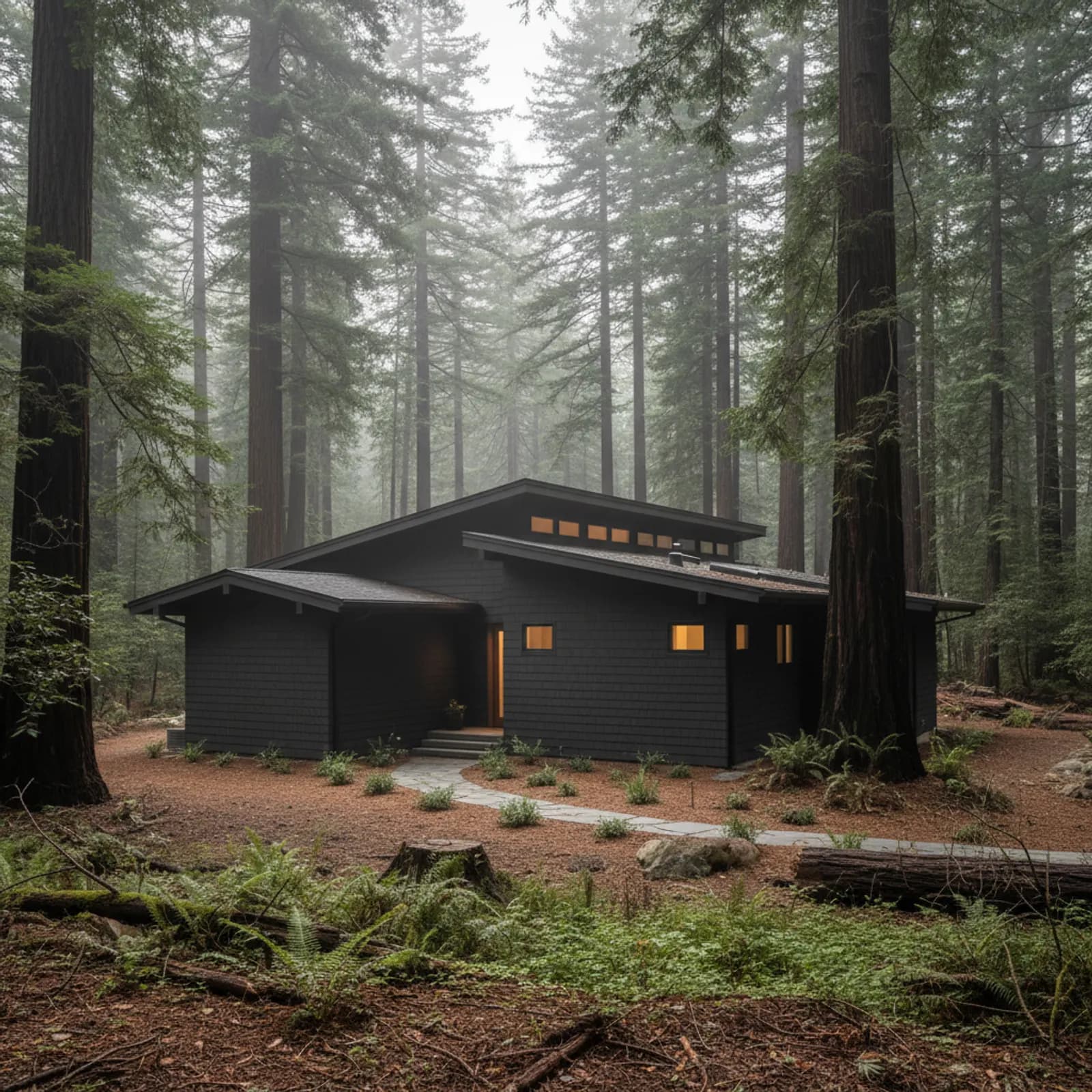
Scotts Valley's stock is mostly 1970s through 1990s wooded subdivision homes, a set of newer custom builds on forested lots, and rural-residential parcels toward the mountain fringe and the San Lorenzo Valley edge. Many of the older subdivision homes still wear wood, shingle, or T1-11 siding directly under a redwood canopy, which is exactly the combustible, moisture-trapping assembly we prioritize replacing here. The mix of tract and custom stock means trim complexity and access vary widely from one street to the next.
Scotts Valley's mountain-fringe climate
The controlling stressor in Scotts Valley is the foothill fire-and-forest mix, not heat or coast alone. The city is cooler and damper than the valley floor, shaded by redwoods and reached by the marine layer, yet it runs hot, dry, high-fuel windows in late summer and fall. Surfaces stay damp under canopy much of the year while the dry season drives real ignition risk. That forces a spec where the assembly has to dry reliably and resist embers at the same time, with neither demand compromised for the other.
Hardening a Scotts Valley forest home
Underscored by the 2020 CZU Lightning Complex, Scotts Valley's wooded and mountain-fringe parcels carry high wildfire exposure. We specify Class A non-combustible fiber cement and harden eaves, soffits, vents, and ground-to-wall transitions, recognizing that redwood canopy and steep forested terrain drive heavy ember loading in a wind event. We document the materials and assemblies we install to support defensible-space and insurability efforts, while being clear that insurers set their own criteria and we will not overstate any single parcel's risk.
Recommended materials for Scotts Valley
Non-combustible fiber cement over a rigorously detailed, drying-capable drainage plane is the recommendation for Scotts Valley, because it answers the mountain fire exposure and the under-canopy moisture together in one system. We generally advise against combustible cladding on wooded parcels here given the exposure, and we weight the detailing toward keeping persistent forest damp moving out of the wall. The board choice and the hardened eave, soffit, and vent details are treated as a single package rather than separate decisions.
What an exterior project costs in Scotts Valley
Scotts Valley pricing turns qualitatively on home size and stories, wooded and sometimes steep site access, and trim complexity that varies between tract and custom stock. The substrate and rot condition revealed once cladding comes off is frequently significant on older damp forest homes, and window integration plus the combined fire- and moisture-management scope add to it. Forested lots can complicate staging and material handling, so we provide a written, scoped estimate only after an on-site assessment of the parcel.
Wooded and steep-lot access
Forest terrain is a real scope factor in Scotts Valley, not a footnote. Many homes sit on wooded, sometimes steep parcels with narrow drives and limited staging room under canopy, which affects how materials are handled and how the work is sequenced. We plan access and defensible-space coordination before mobilizing, because clearing safe working room around a forest home is part of the job here. These conditions are estimated explicitly rather than discovered mid-project.
Re-cladding the combustible older stock
The highest-value move for many Scotts Valley homeowners is re-cladding the combustible wood, shingle, or T1-11 still common on the 1970s through 1990s subdivision homes. Swapping that for non-combustible fiber cement is one of the strongest single hardening steps available for a forested property, and it solves the under-canopy moisture problem at the same time. We prioritize these assemblies because they sit at the intersection of the city's two real risks.
Hardening with insurability in mind
In this WUI terrain, owners often pursue a re-side partly to support insurance and defensible-space efforts after the CZU fire reshaped the local risk picture. We document the materials and assemblies used so that record exists for those conversations, while being clear that insurers apply their own criteria and we don't promise a coverage outcome. The honest framing is that hardened, non-combustible cladding materially reduces ignition and moisture-failure risk, and the written estimate governs the scope.
PG&E + PSPS, SVWD water, and Scotts Valley Fire Protection District
Working exteriors in the City of Scotts Valley coordinates with a few local authorities. Electric and gas both come from PG&E, and Scotts Valley is in high-PSPS territory. Water is supplied by the Scotts Valley Water District (SVWD), a customer-owned public agency. Fire response is the Scotts Valley Fire Protection District alongside CAL FIRE for surrounding State Responsibility Area. On the permit side, the City of Scotts Valley Development Services Department handles building permits. We flag utility, permit, and fire-district items at the estimate stage.
HZ10, the 2020 CZU Fire, and Very-High FHSZ in the Santa Cruz Mountains
Scotts Valley is in James Hardie's HZ10 climate zone; installing HZ5 is a documented warranty misapplication. On the fire side, essentially all of Scotts Valley sits in the wooded Santa Cruz Mountains foothills, with most parcels carrying Moderate to Very High FHSZ under California's 2025 LRA Fire Hazard Severity Zone map, and surrounding unincorporated territory largely in State Responsibility Area. The 2020 CZU Lightning Complex Fire — which burned 86,509 acres and destroyed nearly a thousand structures in the Santa Cruz Mountains — reset the fire conversation for the area. The 2025 California Wildland-Urban Interface Code governs the exterior wall on designated parcels. The code frame changed on January 1, 2026, when Chapter 7A moved into the standalone WUI Code.
Our process in Scotts Valley
- Step 1
Consultation
We listen to your goals and assess your home on site — exposure, substrate, and architecture.
- Step 2
Design & Proposal
A clear written proposal with the right system specified for your climate and a transparent scope.
- Step 3
Expert Installation
Trained crews install to manufacturer best practices with careful weather-management detailing.
- Step 4
Walkthrough & Support
A final walkthrough, full cleanup, and a clear written record of the scope completed — work we stand behind.
Scotts Valley rewards an exterior built for mountain fire and forest damp together, with access and old combustible stock factored in honestly. We design for both and scope every Scotts Valley project on site, so the hardening plan and the moisture strategy fit the actual parcel under the redwoods.
FAQ
Scotts Valley — Common Questions
Yes — wooded and mountain-fringe Scotts Valley parcels carry high wildfire exposure, underscored by the CZU fire. Non-combustible cladding with hardened detailing is the baseline here.
Yes — under redwood canopy and within reach of the marine layer, surfaces stay damp much of the year, so drying-capable drainage-plane detailing is essential.
Class A non-combustible fiber cement over a rigorously detailed drainage plane — it meets the fire and moisture demands together.
Re-cladding combustible wood or shingle in non-combustible fiber cement is one of the highest-value hardening steps available for a forested Scotts Valley property.
Yes — wooded and sometimes steep access is a real scope factor here and is planned and estimated explicitly.
On wooded mountain-fringe parcels we generally advise against it; fiber cement adds fire and moisture resilience with no durability penalty.
It can support insurability in this WUI terrain. We document the materials and assemblies used, though insurers set their own criteria.
A correctly detailed, well-drained fiber cement system commonly performs 30+ years here while materially reducing ignition and moisture-failure risk.
Explore
Exterior Services
Helpful Exterior Guides