
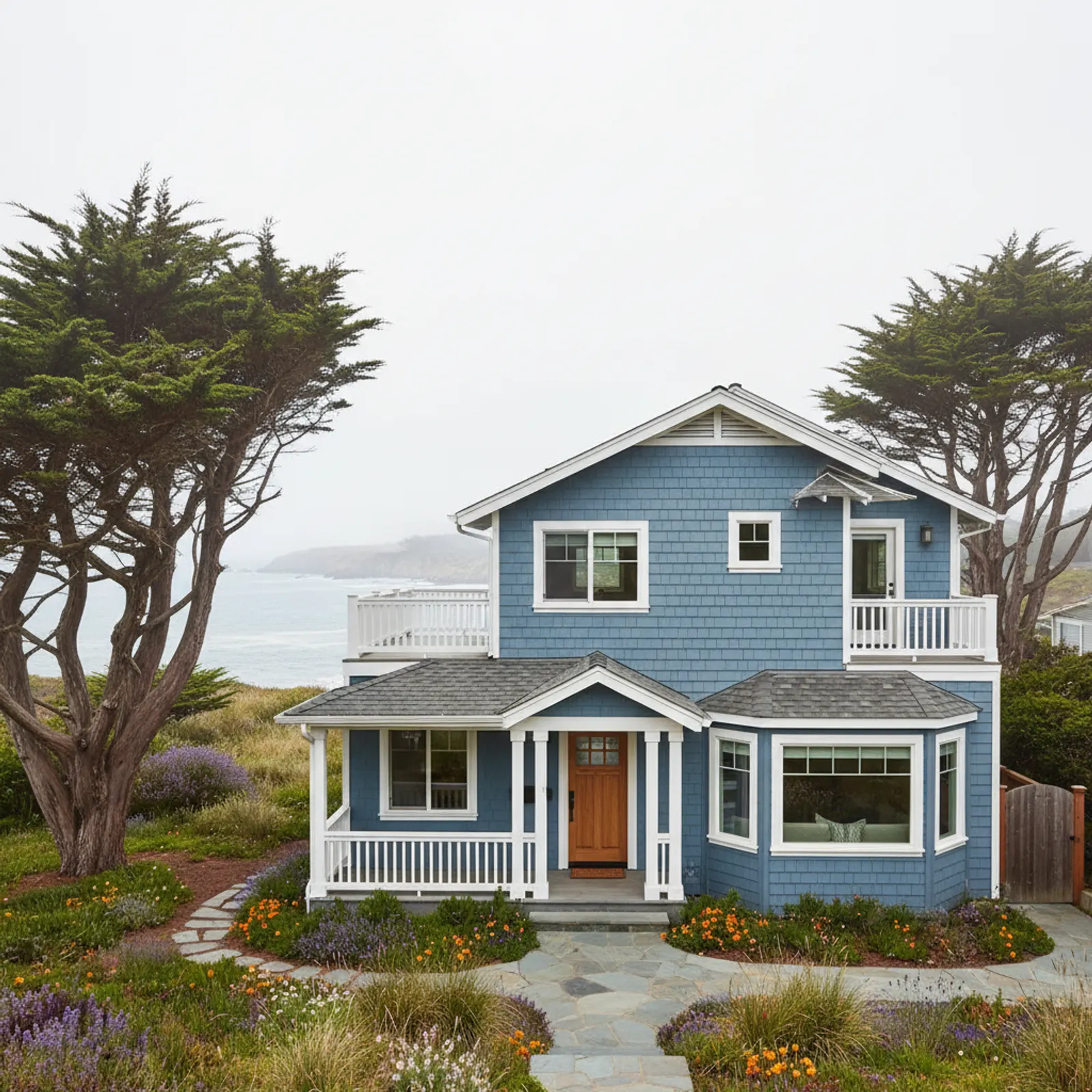
Exterior renovation in Santa Cruz
Santa Cruz sits where the Monterey Bay meets the redwood-forested Santa Cruz Mountains, and its exterior-renovation conversation is shaped by that exact collision. Coastal Westside and Eastside neighborhoods, beach-area cottages, and Victorian-era homes face among the most aggressive salt-air and marine-moisture exposure on the California coast, while homes toward the mountain fringe pick up real wildfire consideration. A correct Santa Cruz exterior has to be specified for the parcel, not the ZIP code.
One city, two exposure profiles
Santa Cruz really behaves as two environments under one name. Down on the flats near the water the enemy is chloride: salt-laden fog that never fully dries, corroding fasteners and flashing long before the cladding itself gives out. Up toward the redwoods the picture shifts to ember exposure and trapped forest damp. Because those two profiles call for different emphasis in the same fiber cement system, we sort each home by where it actually sits relative to the coast and the mountains before we write a spec.
Considering an exterior project in Santa Cruz?
Santa Cruz housing and architecture
Santa Cruz's stock includes coastal Victorian and craftsman homes, beach cottages, Westside and Eastside bungalow neighborhoods, and university-influenced housing, plus mountain-fringe homes toward the redwoods. The older coastal Victorians often carry intricate trim and period profiles that owners want preserved, while the Westside and Eastside bungalows tend toward simpler lap and shingle stock. Many of these homes wear wood siding that salt air and persistent damp have worked hard on, which is exactly the assembly we replace with corrosion-aware, drying-capable systems in period-appropriate profiles.
Santa Cruz's coastal-marine climate
The controlling stressor in Santa Cruz is the marine environment, not heat. The city is cool, foggy, and salt-laden much of the year, with a persistent marine layer that keeps surfaces damp and drives chloride corrosion of fasteners and flashing well before the cladding fails. That forces a spec centered on corrosion-resistant fastening and rigorous, drying-capable drainage-plane detailing. Mountain-fringe parcels add a late-summer and fall fire window on top of those coastal demands, so the same assembly often has to answer salt and embers both.
Mountain-fringe fire consideration
For Santa Cruz homes toward the Santa Cruz Mountains and Scotts Valley fringe, fire is a genuine factor, underscored by the CZU Lightning Complex on the county's recent record. There we specify non-combustible cladding and harden eaves and vents alongside the coastal corrosion strategy. Pure coastal-flat parcels carry lower fire exposure, and we will not overstate it, but they still benefit from the non-combustibility of fiber cement at no cost to the salt-and-moisture detailing.
Recommended materials for Santa Cruz
Non-combustible fiber cement with corrosion-resistant fastening over a rigorously detailed, drying-capable drainage plane is the core recommendation for Santa Cruz. Wood and standard fasteners perform poorly against persistent salt air here, with corrosion often showing at the fasteners and flashing first. Fiber cement carries no durability penalty in this environment, takes period-appropriate profiles for the Victorians, and adds fire resilience for mountain-fringe parcels, so a single material choice answers both halves of the city.
What an exterior project costs in Santa Cruz
Santa Cruz pricing turns qualitatively on home size and stories, trim complexity that runs high on coastal Victorians, and the substrate and rot condition revealed once cladding is removed, which is frequently significant on older salt-exposed homes. Window integration and the depth of the moisture- and corrosion-management scope add to it, and tight Westside and beach-area lots can complicate staging. We provide a written, scoped estimate after an on-site assessment rather than a number sight unseen.
Westside, Eastside, and the beach flats
The coastal flats are where the salt problem is sharpest. Westside and Eastside bungalow blocks and the beach-area cottages sit closest to the marine layer, so corrosion-aware fastening and drainage detailing matter most there and we expect to find the heaviest hidden damage at fasteners, flashing, and bottom courses. These are also the tighter, denser lots, which shapes staging and access. We plan the corrosion strategy and the logistics together for homes in this part of town.
Re-siding a coastal Victorian sensitively
Santa Cruz's older Victorians and craftsman homes carry character that owners rightly want to keep. Fiber cement is well suited to this: period-appropriate lap widths, shingle courses, and trim profiles can reproduce the look while finally solving the salt and moisture problem the original wood never could. We treat trim-heavy historic homes as detailing projects, sequencing the work so the corrosion and drainage upgrades disappear into a faithful exterior rather than flattening it.
Toward the redwoods and the mountain fringe
Homes on the upper, forested edge of the city read more like their Santa Cruz Mountains neighbors than like the beach flats. Salt influence eases, but ember exposure and under-canopy damp rise, so the same fiber cement system gets re-weighted toward non-combustible eave, soffit, and vent hardening with continued attention to drying. Because a single Santa Cruz address can fall anywhere on this gradient, we let the parcel's real position drive the spec instead of assuming a city-wide answer.
PG&E, Santa Cruz Water, and Coastal Commission oversight
Working exteriors in the City of Santa Cruz coordinates with a few local authorities. Electric and gas both come from PG&E, and Santa Cruz is in high-PSPS territory. Water is supplied by the Santa Cruz Water Department, a city-owned utility drawing largely from the San Lorenzo River watershed. Fire response is the Santa Cruz Fire Department. On the permit side, the City of Santa Cruz Planning and Community Development Department handles building permits, and Coastal Zone parcels along West Cliff, East Cliff, and the beach flats additionally fall under California Coastal Commission oversight — a coastal-development permit can be triggered by scope that alters the building envelope. The city also maintains a Historic Preservation program that reviews visible exterior work on designated Landmark structures and contributing properties in named historic districts. We flag utility, permit, coastal, and heritage items at the estimate stage rather than at the wall.
HZ10, the 2020 CZU Fire, and Santa Cruz's coast-to-mountains FHSZ
The City of Santa Cruz is in James Hardie's HZ10 climate zone; installing HZ5 is a documented warranty misapplication. On the fire side, the flat downtown, Westside, Eastside, and coastal blocks sit in Low FHSZ territory or unmapped under California's 2025 LRA Fire Hazard Severity Zone map, while the mountain-fringe blocks climbing toward the Santa Cruz Mountains and DeLaveaga Park carry Moderate designations. The 2020 CZU Lightning Complex Fire — which burned more than 86,000 acres and destroyed nearly a thousand structures in the unincorporated Santa Cruz Mountains — reset the fire conversation for the entire county, and on hillside parcels the 2025 California Wildland-Urban Interface Code governs the exterior wall. The code frame changed on January 1, 2026, when Chapter 7A moved into the standalone WUI Code. On the flats the corrosion-and-moisture spec is the entire game.
Our process in Santa Cruz
- Step 1
Consultation
We listen to your goals and assess your home on site — exposure, substrate, and architecture.
- Step 2
Design & Proposal
A clear written proposal with the right system specified for your climate and a transparent scope.
- Step 3
Expert Installation
Trained crews install to manufacturer best practices with careful weather-management detailing.
- Step 4
Walkthrough & Support
A final walkthrough, full cleanup, and a clear written record of the scope completed — work we stand behind.
Santa Cruz rewards an exterior built for salt, fog, and, toward the mountains, fire, and the right balance shifts block by block. We specify per parcel to all of it and scope every Santa Cruz project on site so the system fits where the home actually sits.
FAQ
Santa Cruz — Common Questions
Non-combustible fiber cement with corrosion-resistant fastening over a drying-capable drainage plane — it handles persistent salt air and moisture far better than wood.
Among the most aggressive on the California coast. It corrodes standard fasteners and flashing, which is why we specify corrosion-resistant detailing.
Yes — homes toward the Santa Cruz Mountains and Scotts Valley fringe carry real wildfire exposure, underscored by the CZU fire. We specify non-combustible cladding there.
Almost always salt-driven corrosion and trapped marine moisture in poorly detailed assemblies, not the cladding alone. Corrosion-aware, drying-capable detailing fixes the root cause.
Yes — period-appropriate profiles and trim in non-combustible fiber cement preserve character while solving the salt and moisture problem.
Against persistent salt air and damp it underperforms a properly fastened, drying-capable fiber cement assembly; we generally steer away from it on coastal parcels.
When feasible, yes — correct flashing integration is especially important in a high-moisture coastal environment.
A correctly detailed, corrosion-aware fiber cement system commonly performs 30+ years even in Santa Cruz's salt-and-fog environment.
Explore
Exterior Services
Helpful Exterior Guides