
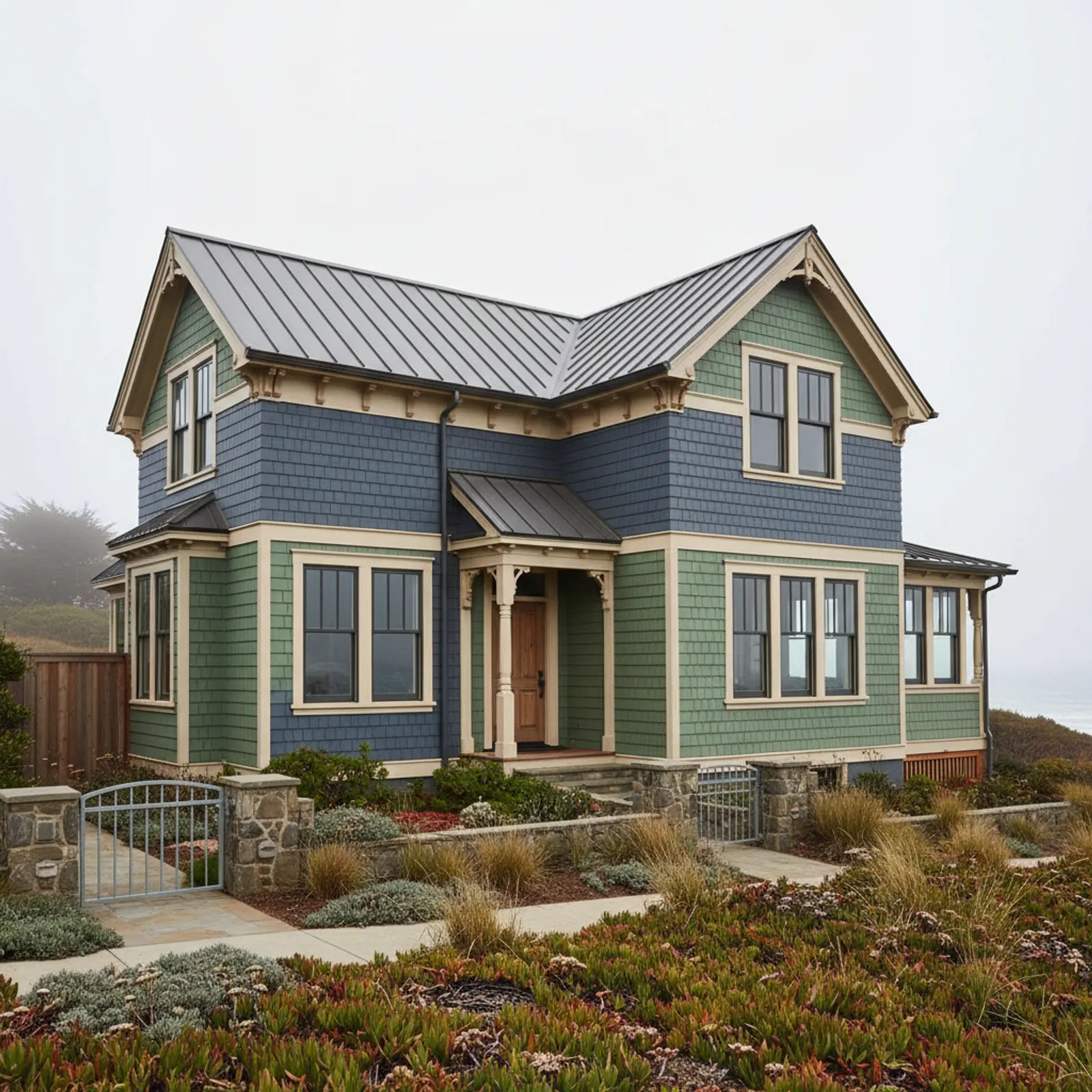
Fire-Resistant Siding in Santa Cruz
Direct answer: the developed Santa Cruz Westside, downtown, and Eastside are coastal, marine-influenced, low-fire areas — salt and moisture, not fire, are the controlling factors. Fire-resistant siding here is a low-regret choice rather than a primary need; mountain-fringe county parcels are different and assessed separately.
Santa Cruz city's exposure reality
The coastal city itself carries low wildfire exposure — cool, damp, and developed. Higher exposure begins in the mountain-fringe communities behind it, not in the Westside/Eastside coastal grid. We assess by address and won't manufacture urgency for a coastal Santa Cruz home.
Incidental to the corrosion-engineering choice
Santa Cruz's real spec is corrosion control — coastal-rated metal and a drying plane that decide whether a Westside wall lasts 8 years or 30. Fiber cement's Class A rating is a free consequence of that decision, not a coastal-city fire pitch we'd ever inflate.
Where the redwood fringe changes the spec above Santa Cruz
The dividing line in Santa Cruz is not a city boundary, it is the point where the developed coastal grid gives way to the forested slopes climbing into the Santa Cruz Mountains. A bungalow off Mission Street or a cottage near the Westside cliffs is wind-and-salt territory, but a parcel tucked against the redwoods toward the upper canyons inherits genuine ember and radiant-heat exposure that the flatter neighborhoods never see. For those wooded-edge addresses, fire-resistant siding stops being a low-regret upgrade and starts driving real material decisions: noncombustible cladding, ember-resistant detailing at eaves and vents, and ground-clearance behavior at the bottom course. We do not apply one rule to every Santa Cruz lot. A home backing onto tree canopy and dry summer understory gets assessed for defensible-space realities, while a sea-level home a few blocks from the wharf is evaluated on corrosion first. Same city, two completely different siding briefs, decided by where the parcel actually sits on that mountain-to-bay gradient.
Specifying cladding that resists both embers and Monterey Bay salt
On a Santa Cruz home that sits at the wooded fringe, the hard part is that the fire-resistant choice still has to survive marine air rolling in off Monterey Bay. Pick the wrong combination and you trade a wildfire weakness for a corrosion one. Fiber cement earns its place here because it is noncombustible and shrugs off salt-laden moisture without rotting or feeding flame, but the fasteners, flashing, and trim behind it are where coastal jobs fail. Standard fasteners streak and bleed in this air; we move to corrosion-rated hardware and detail the laps so wind-driven rain off the bay cannot wick behind the course. Eave and soffit assemblies get the same dual treatment, since that is exactly where embers find a wooded Westside-adjacent home and where damp redwood-shaded walls stay wet longest. The point is a single assembly that answers the parcel's fire exposure and its salt exposure together, rather than a fire-rated panel bolted on with hardware that will not last a Santa Cruz winter.
Why this matters in Santa Cruz
- Specified for Central Coast conditions
- non-combustible fiber cement as the recommended system
- Correctly detailed weather-resistive barrier and flashing
- Installed by a crew with 20 years combined experience
Recommended systems for Santa Cruz
- non-combustible fiber cement
- corrosion-aware fastening
- rigorous drainage-plane detailing
Fire-Resistant Siding for Santa Cruz homes
The full fire-resistant siding approach — materials, weather-resistive detailing, and the manufacturer standards we install to — is covered on the main service page, then specified for Santa Cruz's conditions on this one.
Our Santa Cruz process
- Step 1
Consultation
We listen to your goals and assess your home on site — exposure, substrate, and architecture.
- Step 2
Design & Proposal
A clear written proposal with the right system specified for your climate and a transparent scope.
- Step 3
Expert Installation
Trained crews install to manufacturer best practices with careful weather-management detailing.
- Step 4
Walkthrough & Support
A final walkthrough, full cleanup, and a clear written record of the scope completed — work we stand behind.
FAQ
Fire-Resistant Siding in Santa Cruz — FAQ
In the developed Westside/Eastside it's a low-regret upgrade rather than a necessity — salt and moisture are the controlling factors. We assess by address honestly.
The coastal city is low-exposure; higher exposure is in the mountain-fringe communities behind it, which we evaluate separately by parcel.
No — the fiber cement we recommend for coastal salt-and-moisture durability is already non-combustible, so Class A performance is included.
Corrosion-rated fastening and flashing plus drying capacity — the salt-driven failures that actually affect coastal Santa Cruz homes.
Keep Exploring
More for Santa Cruz homeowners
More in Santa Cruz
Other exterior services in Santa Cruz
Nearby Service Areas
Fire-Resistant Siding near Santa Cruz
Back to
Santa Cruz County & Santa Cruz
Helpful Exterior Guides