
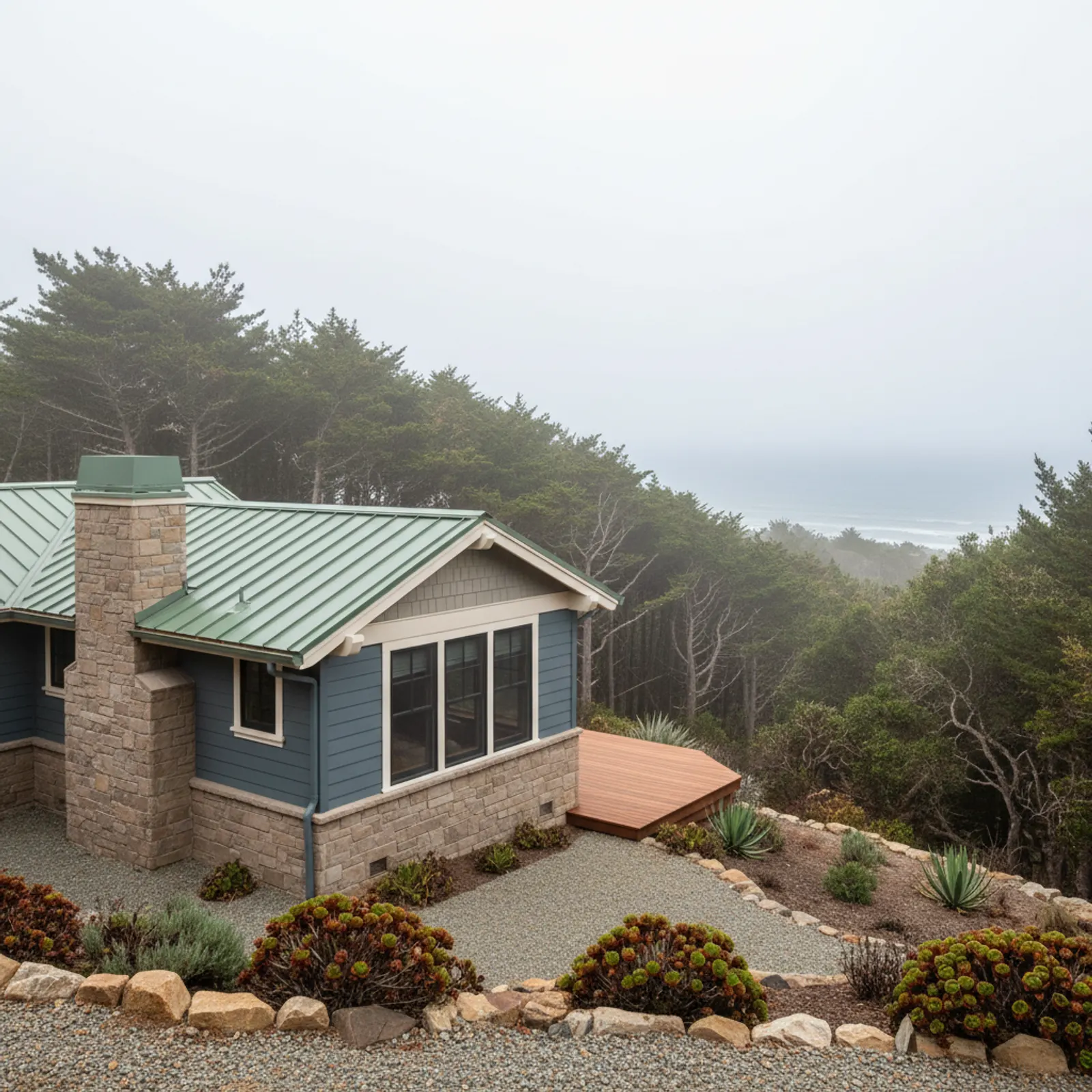
Fire-Resistant Siding in Soquel
Honest answer: Soquel is split. The creek-village floor is lower-exposure and damp-led where fire-resistant siding is a low-regret default; the wooded-edge parcels rising toward the redwood hills carry genuine moderate exposure where it is a real decision.
Village floor lower, wooded edge moderate
Soquel's village floor sits in low-to-moderate exposure where fire-resistant siding is low-regret; the wooded-edge homes toward the redwood hills carry moderate, real exposure and warrant Class A non-combustible cladding with hardened eaves, vents, and ground transitions — designed alongside the damp strategy.
Free on the creek floor, real up the canyon
Soquel's old creek-village floor gets Class A as an incidental benefit of the damp-durable fiber cement it chooses anyway. Up Soquel-San Jose Road toward the redwood ridge it flips to the real reason — hardened eaves, vents, and ground transitions designed alongside the creek-damp strategy, scoped to where the home actually sits.
Where the redwood canopy meets your cladding
The parcels climbing from Soquel Creek toward the Santa Cruz Mountains sit beneath redwood and Douglas-fir canopy, and that shade changes how fire-resistant siding has to be detailed. Litter from those trees collects in gutters, against foundation walls, and in the wind-sheltered pockets where the village core gives way to the canyon. Fiber-cement and other Class A claddings answer the wall surface, but on these wooded-edge lots the bigger gains come at the connections: a noncombustible six-to-twelve-inch base course so duff banked against the house cannot wick flame into the panel bottoms, ember-resistant vent screening, and boxed or soffited eaves rather than exposed open rafter tails. Because these homes spread up narrow lanes with limited turnaround, we plan staging and material drops before demolition starts. The objective on a Soquel hillside parcel is not simply swapping cedar for fiber-cement; it is making the lowest three feet and every gap a place embers die rather than enter.
Marine damp and noncombustible walls, working together
Sitting just inland of Capitola, Soquel pulls humid marine air up the Soquel Creek corridor most mornings, so any fire-resistant siding here has to survive a damp, slow-drying wall as much as an ember. That pairing decides the assembly. We back Class A fiber-cement with a rainscreen gap so the wall can shed and dry the moisture the coast pushes into it, rather than trapping it behind a sealed face where rot and paint failure start. Flashing at every window head, deck ledger, and the kick-out where roof meets wall gets detailed for wind-driven rain off the bay, since on a wooded canyon lot a moisture-rotted board is also a more combustible board. Caulk joints and butt seams are chosen for movement in a temperate, never-freezing climate. Done this way, the same cladding that resists ignition on the hillside edge also holds paint and structure through Soquel's long damp season, so the fire spec and the durability spec reinforce each other instead of fighting.
Why this matters in Soquel
- Specified for Central Coast conditions
- non-combustible fiber cement as the recommended system
- Correctly detailed weather-resistive barrier and flashing
- Installed by a crew with 20 years combined experience
Recommended systems for Soquel
- non-combustible fiber cement
- drainage-plane and fire-aware detailing
- durable finishes
Fire-Resistant Siding for Soquel homes
The full fire-resistant siding approach — materials, weather-resistive detailing, and the manufacturer standards we install to — is covered on the main service page, then specified for Soquel's conditions on this one.
Our Soquel process
- Step 1
Consultation
We listen to your goals and assess your home on site — exposure, substrate, and architecture.
- Step 2
Design & Proposal
A clear written proposal with the right system specified for your climate and a transparent scope.
- Step 3
Expert Installation
Trained crews install to manufacturer best practices with careful weather-management detailing.
- Step 4
Walkthrough & Support
A final walkthrough, full cleanup, and a clear written record of the scope completed — work we stand behind.
FAQ
Fire-Resistant Siding in Soquel — FAQ
It depends on the parcel — the creek-village floor is lower-exposure (low-regret only), while wooded-edge homes toward the redwood hills carry genuine moderate exposure warranting hardened non-combustible detailing.
Moderate and real on the wooded edge toward the redwood hills; lower on the creek-village floor. Not the extreme exposure of deep-forest San Lorenzo Valley.
No — we design both into one assembly: a drying-capable plane for the creek damp plus hardened eaves/vents/ground transitions for the wooded exposure.
On Soquel's up-canyon wooded parcels it can support insurability; we document materials and assemblies, though insurers set their own criteria.
Keep Exploring
More for Soquel homeowners
More in Soquel
Other exterior services in Soquel
Nearby Service Areas
Fire-Resistant Siding near Soquel
Helpful Exterior Guides