
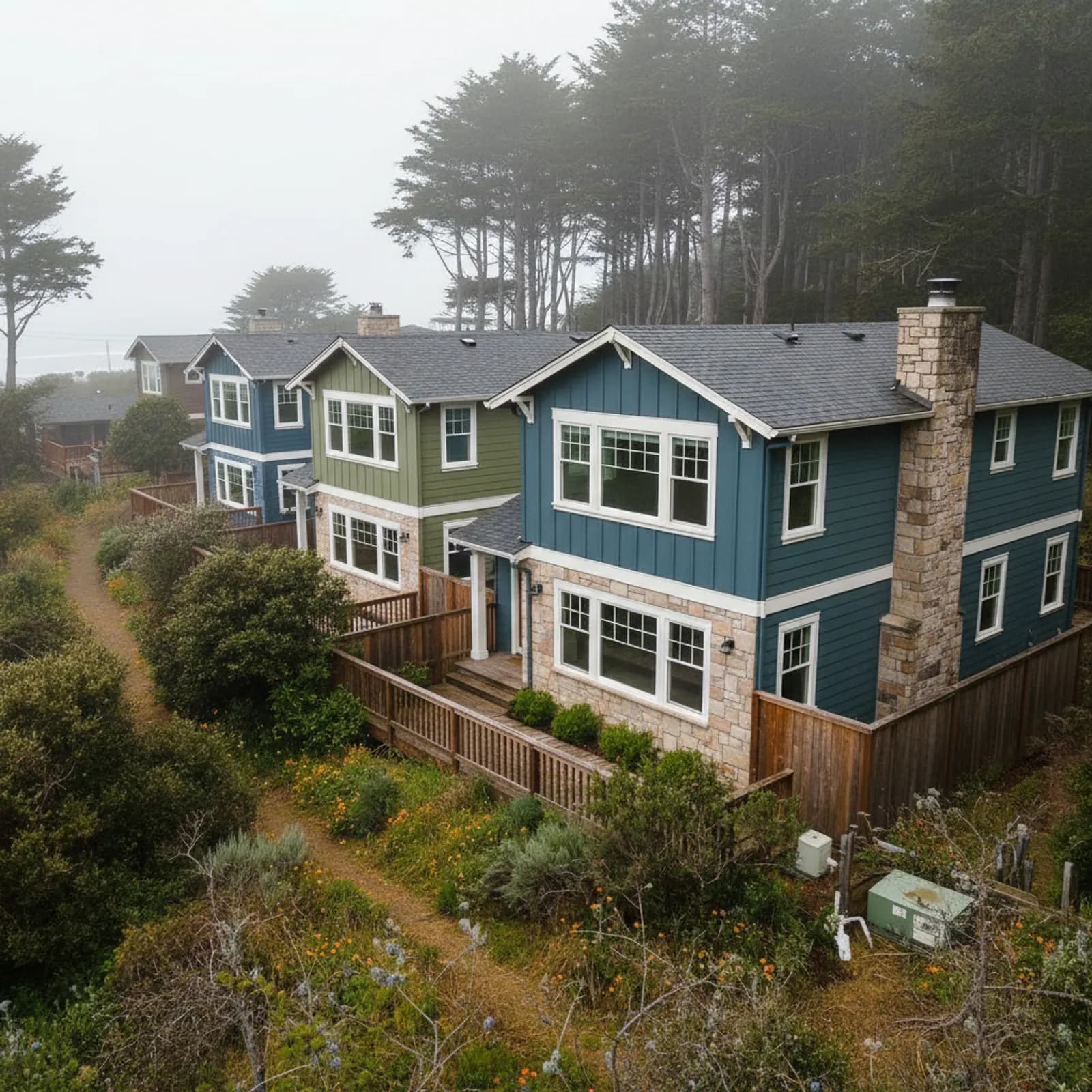
Exterior Contractor in Soquel
Soquel is the village-and-wooded-edge city tucked between Capitola and Aptos. The older village homes around Soquel Drive and the streets near downtown carry real character, while the wooded-edge homes climbing the hills above town pick up moderate fire exposure. The moisture exposure is persistent and bay-marine-typical with modest coastal salt influence.
An integrated Soquel exterior is what handles village character, wooded-edge fire exposure, and persistent moisture as one project. The right scope varies between a Soquel Village older home and a wooded-edge custom, and an integrator's job is to scope each appropriately rather than apply a city-wide default.
What an integrated Soquel exterior includes
On a Soquel Village older home an integrated scope respects the village character with profile and trim selection appropriate to the era, while modernizing the WRB and flashing behind it. On a wooded-edge home the same scope adds ember-resistant vents and hardened eaves. Both versions install corrosion-aware fasteners for the modest salt influence.
Where the split-trade exterior fails in Soquel
Soquel's failure mode is the village/wooded-edge mismatch. A separate trade picks the same scope across both settings and one of them ends up wrong — either under-hardened on the wooded-edge or over-defensive in the village. An integrator scopes per parcel.
Materials and detailing we specify for Soquel
Non-combustible fiber cement with corrosion-aware fasteners, factory ColorPlus finishes selected for the moisture and modest salt exposure, a rigorous drainage plane behind the cladding, and profile and trim selection respectful of the home's setting. Wooded-edge parcels add hardening detail.
Climbing toward the Santa Cruz Mountains: the wildland-edge spec
The further a Soquel home sits up the wooded canyons toward the mountains, the more an exterior contractor has to treat it as a wildland-edge build rather than a coastal one. Homes backing onto canyon brush and forest catch wind-driven embers along eaves, vents, and the gap where siding meets the foundation, so the exterior scope shifts toward ember-resistant detailing: noncombustible or rated cladding on exposure-prone walls, ember-rated soffit and gable vents, tight metal flashing, and closed-off under-deck and crawlspace openings. None of this is a code citation a homeowner should assume applies to their parcel; the right move is to confirm the actual fire zone for that specific address before locking the spec. A village home near Soquel Drive and a custom house tucked into a hillside canyon do not get the same vent or cladding decisions. Handling that exposure as one continuous exterior envelope, instead of stitching together a siding crew and a separate trim crew, is how you avoid leaving an ember path open at a transition nobody owned.
Soquel Creek's canyons and the drainage every exterior plan answers to
Soquel grew up around the creek, with the old village core hugging the water and the rest of town spreading up steep, wooded canyon walls. That terrain shapes exterior work as much as the marine moisture does. On the canyon hillsides, water moves downhill against the back of a house, so an exterior contractor has to think about grading, kickout flashing, and where roof runoff actually lands before it ever drives a siding choice. Persistent inland-marine damp keeps walls wet longer than a sunnier inland town would, which rewards a real rainscreen gap, generous overhangs, and flashing laps that shed rather than trap. Access is its own reality here: narrow lanes off Soquel Drive and tight hillside driveways limit staging and lift placement, so scaffolding and material delivery get planned early. Pulling siding, flashing, drainage detailing, and the water-management plan together under one integrated exterior scope keeps the canyon's runoff and the coast's humidity from finding the seam between two trades that never talked.
Why this matters in Soquel
- Specified for Central Coast conditions
- non-combustible fiber cement as the recommended system
- Correctly detailed weather-resistive barrier and flashing
- Installed by a crew with 20 years combined experience
Recommended systems for Soquel
- non-combustible fiber cement
- drainage-plane and fire-aware detailing
- durable finishes
Exterior Contractor for Soquel homes
The full exterior contractor approach — materials, weather-resistive detailing, and the manufacturer standards we install to — is covered on the main service page, then specified for Soquel's conditions on this one.
Our Soquel process
- Step 1
Consultation
We listen to your goals and assess your home on site — exposure, substrate, and architecture.
- Step 2
Design & Proposal
A clear written proposal with the right system specified for your climate and a transparent scope.
- Step 3
Expert Installation
Trained crews install to manufacturer best practices with careful weather-management detailing.
- Step 4
Walkthrough & Support
A final walkthrough, full cleanup, and a clear written record of the scope completed — work we stand behind.
FAQ
Exterior Contractor in Soquel — FAQ
Yes — village profile and trim proportions are documented before tear-off and replicated in non-combustible cladding.
Moderate to elevated exposure on parcels climbing into the hills above town. Village and downtown flats are essentially low-fire.
If the existing windows are dated, yes — particularly on older village homes where the original flashing rarely meets current standard.
Most Soquel single-family homes are four to seven weeks of active work depending on size, scope, and character-preservation detail.
Keep Exploring
More for Soquel homeowners
More in Soquel
Other exterior services in Soquel
Nearby Service Areas
Exterior Contractor near Soquel
Helpful Exterior Guides