
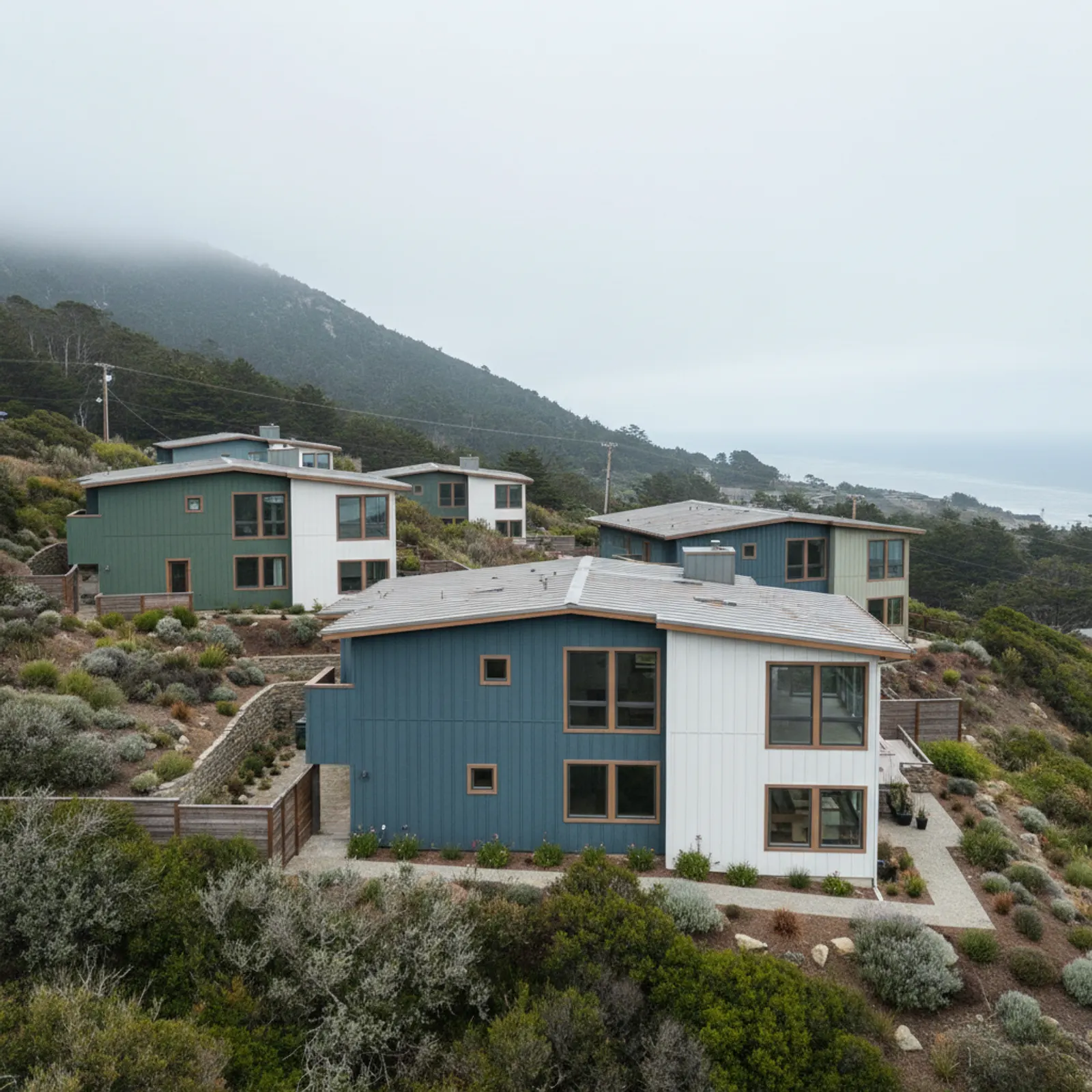
Fire-Resistant Siding in Scotts Valley
This is a primary service in Scotts Valley. The city's mountain-fringe subdivisions and wooded customs sit in conifer/redwood Santa Cruz Mountains terrain along the Highway 17 corridor with constrained evacuation — fire-resistant siding here is a central exterior decision, not a low-regret nicety.
Forested high exposure, stated plainly
Scotts Valley's exposure is overt: forested terrain, fire history, limited access. We specify Class A non-combustible cladding and harden eaves, soffits, vents, decks, and ground transitions as the baseline on most parcels, with a drying-capable plane for the moderate damp.
A record that corrects the 'suburban' assumption
Scotts Valley reads suburban but is genuine mountain WUI — and carriers know it even when owners don't. The assembly record matters here precisely because the exposure is under-appreciated; we document the Class A materials and hardened detailing so the file states the real risk plainly, while insurers still set their own bar.
Where the Highway 17 ridgelines meet the assembly we spec
The homes that ring Scotts Valley's upper subdivisions sit in exactly the spot embers travel to first: conifer and redwood slopes feeding a single constrained route out toward Highway 17. That access reality shapes how we approach fire-resistant siding here, because a home that can shed radiant heat and resist ignition buys time when an evacuation backs up. On the wooded custom parcels along the San Lorenzo Valley edge, we keep the cladding non-combustible from the foundation line up, then close the details that actually fail in a mountain burn: open eaves, under-deck cavities, and the gaps where wall meets grade. Fiber cement and mineral-based panels carry a Class A rating without the maintenance penalty of treated wood. We also account for the slope itself, since uphill walls take more direct flame contact than the street face. The goal is a continuous hardened envelope rather than a pretty front elevation hiding combustible flanks that nobody inspects until the smoke arrives.
Drying capacity behind a non-combustible skin
Scotts Valley's second problem is the one homeowners underestimate: the marine layer climbs the grade most mornings, and second-growth forest holds that damp against north and shaded walls long after the fog lifts. A fire-resistant exterior that traps this moisture trades one failure mode for another, so we build the wall to dry. Behind the Class A cladding we run a drained, ventilated rainscreen gap that lets water and vapor escape rather than soaking sheathing, and we pair it with a breathable weather-resistive barrier sized for forested humidity rather than open coastal flats. Flashing at windows, transitions, and the lower courses gets detailed for sustained wet, not occasional rain. This matters on the older mountain-fringe homes where the original siding was nailed tight to building paper with no relief, the same homes now showing soft trim and stained corners. Hardening against wildfire and managing chronic forest damp are not competing goals here; done correctly the same re-side handles both, which is why we treat moisture detailing as part of the fire scope, not an afterthought.
Why this matters in Scotts Valley
- Specified for Santa Cruz Mountains conditions
- non-combustible fiber cement as the recommended system
- Correctly detailed weather-resistive barrier and flashing
- Installed by a crew with 20 years combined experience
Recommended systems for Scotts Valley
- non-combustible fiber cement
- fire-aware detailing
- drainage-plane detailing
Fire-Resistant Siding for Scotts Valley homes
The full fire-resistant siding approach — materials, weather-resistive detailing, and the manufacturer standards we install to — is covered on the main service page, then specified for Scotts Valley's conditions on this one.
Our Scotts Valley process
- Step 1
Consultation
We listen to your goals and assess your home on site — exposure, substrate, and architecture.
- Step 2
Design & Proposal
A clear written proposal with the right system specified for your climate and a transparent scope.
- Step 3
Expert Installation
Trained crews install to manufacturer best practices with careful weather-management detailing.
- Step 4
Walkthrough & Support
A final walkthrough, full cleanup, and a clear written record of the scope completed — work we stand behind.
FAQ
Fire-Resistant Siding in Scotts Valley — FAQ
High and overt — conifer/redwood Santa Cruz Mountains terrain along the Hwy 17 corridor with constrained access. Non-combustible, hardened exteriors are the baseline.
Comparable in severity though coastal-mountain rather than foothill — forested WUI with real fire history and limited egress. We assess each address honestly.
It can help insurability in this under-appreciated mountain WUI; we document the assemblies so the file states the real exposure, though insurers decide.
No — eave, soffit, vent, deck, and ground-transition detailing complete the protection; we treat the exterior as one hardened, drying-capable assembly.
Keep Exploring
More for Scotts Valley homeowners
More in Scotts Valley
Other exterior services in Scotts Valley
Nearby Service Areas
Fire-Resistant Siding near Scotts Valley
Back to
Santa Cruz County & Scotts Valley
Helpful Exterior Guides