
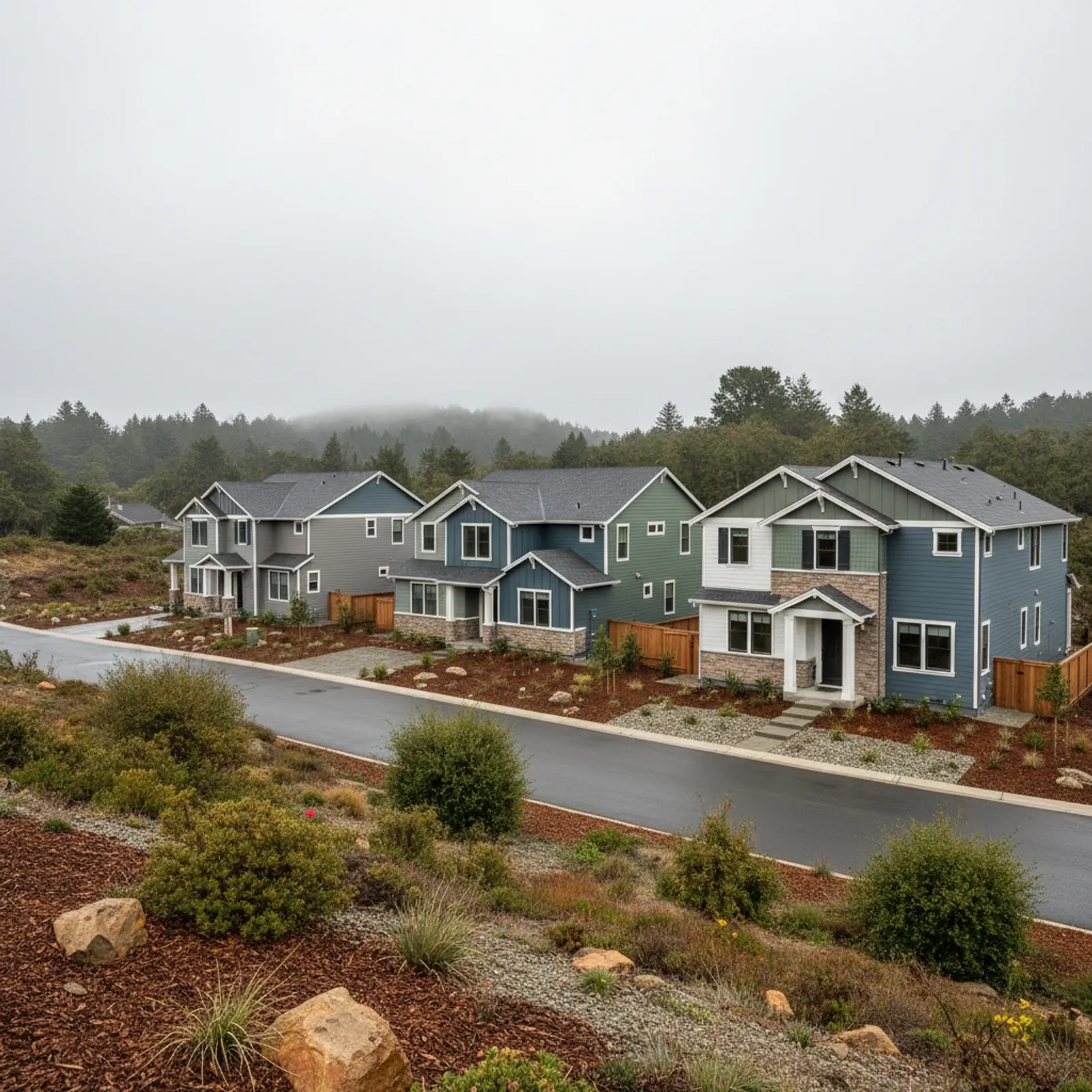
Fiber Cement Siding in Scotts Valley
Fiber cement is the core Scotts Valley recommendation because it is Class A non-combustible for the high forested fire exposure and resists the moderate mountain damp far better than wood — the right answer for a genuine fire-hardening re-clad, not a cosmetic refresh.
Non-combustible for forested mountain terrain
On Scotts Valley's wooded subdivisions and customs, combustible wood is the wrong call; fiber cement's Class A non-combustibility is decisive, paired with hardened eave, vent, and ground-transition detailing.
Damp-durable in the same assembly
Over a drying-capable plane, fiber cement also handles the moderate mountain-fog damp without the decay wood suffers — one material solving the forested fire and the secondary moisture concern together.
Suburban-looking, genuinely WUI
Scotts Valley reads like an ordinary subdivision but sits in high Santa-Cruz-Mountains fire terrain with wildland behind the fences. We treat a fiber-cement re-clad here as hardening — Class A board plus eave/vent detailing over a drying plane for the canopy damp — not the cosmetic refresh the look suggests.
Ember-zone detailing where the redwoods meet the wall
A fiber cement re-clad in Scotts Valley earns its keep at the edges, not the field. Because these mountain-fringe lots sit in a designated wildland-urban interface just up the ridge from the CZU burn scar, the planks themselves are only half the hardening; the other half is the transitions an ember storm actually exploits. We hold a six-inch noncombustible band at grade so bark mulch and duff under the second-growth canopy cannot wick flame onto the cladding, then run the boards tight to ember-rated soffit vents and metal kick-out flashing at every roof-to-wall intersection. Around chimneys, deck ledgers, and the inside corners where wind-driven embers pile up, the laps get caulked and back-flashed rather than left open. On a wooded San Lorenzo Valley custom with overhanging limbs, that detailing is what separates a Class A wall assembly from a Class A product nailed up carelessly. The fiber cement gives you the rating; the eave, vent, and ground-contact work is what makes it defensible on a forested Scotts Valley parcel.
Working a steep, tree-tight lot without scarring the canopy
Re-siding in Scotts Valley is as much a logistics problem as a material one. Many of the city's wooded customs perch on sloped, redwood-shaded parcels with narrow flag-lot driveways, so staging a full fiber cement tear-off means planning where pallets land, how scaffold ties into a hillside, and how we protect mature trunks and root zones from foot traffic and dropped offcuts. Fiber cement is heavy and dusty to cut, so we set up cutting stations downwind of the home and away from the duff layer rather than trimming over open forest floor. Tight setbacks against neighboring wooded lots also shape sequencing: we often work one elevation at a time, keeping the structure weather-closed against the marine-layer damp that rolls up from the coast each evening. For homeowners closer to Felton or down toward Santa Cruz, the same access constraints apply on the canyon roads in between. The result is a clean, fire-hardened exterior installed without churning up the very forest setting that makes a Scotts Valley home worth protecting.
Why this matters in Scotts Valley
- Specified for Santa Cruz Mountains conditions
- non-combustible fiber cement as the recommended system
- Correctly detailed weather-resistive barrier and flashing
- Installed by a crew with 20 years combined experience
Recommended systems for Scotts Valley
- non-combustible fiber cement
- fire-aware detailing
- drainage-plane detailing
Fiber Cement Siding for Scotts Valley homes
The full fiber cement siding approach — materials, weather-resistive detailing, and the manufacturer standards we install to — is covered on the main service page, then specified for Scotts Valley's conditions on this one.
Our Scotts Valley process
- Step 1
Consultation
We listen to your goals and assess your home on site — exposure, substrate, and architecture.
- Step 2
Design & Proposal
A clear written proposal with the right system specified for your climate and a transparent scope.
- Step 3
Expert Installation
Trained crews install to manufacturer best practices with careful weather-management detailing.
- Step 4
Walkthrough & Support
A final walkthrough, full cleanup, and a clear written record of the scope completed — work we stand behind.
FAQ
Fiber Cement Siding in Scotts Valley — FAQ
Yes — its Class A non-combustibility is decisive in this high-fire Santa Cruz Mountains terrain, paired with hardened detailing, with no finish penalty versus wood.
Yes — over a drying-capable plane it resists the moderate fog-driven damp far better than wood, in the same hardened assembly.
Fiber cement — engineered wood is combustible in forested WUI terrain; there's no durability gain to offset the fire risk here.
Slowly — the cool, often-shaded mountain climate is gentle on factory finish; the substrate keeps performing well beyond any refresh.
Keep Exploring
More for Scotts Valley homeowners
More in Scotts Valley
Other exterior services in Scotts Valley
Nearby Service Areas
Fiber Cement Siding near Scotts Valley
Back to
Santa Cruz County & Scotts Valley
Helpful Exterior Guides