James Hardie Siding in Scotts Valley
Scotts Valley's risk is the one homeowners most often underestimate. It reads as a tidy commuter town of normal subdivisions — but those subdivisions sit in the Santa Cruz Mountains, in genuinely high wildfire terrain, with redwood and chaparral right behind the back fences. The James Hardie conversation here usually starts with correcting that 'we're basically suburban' assumption.
Suburban-looking, WUI in reality
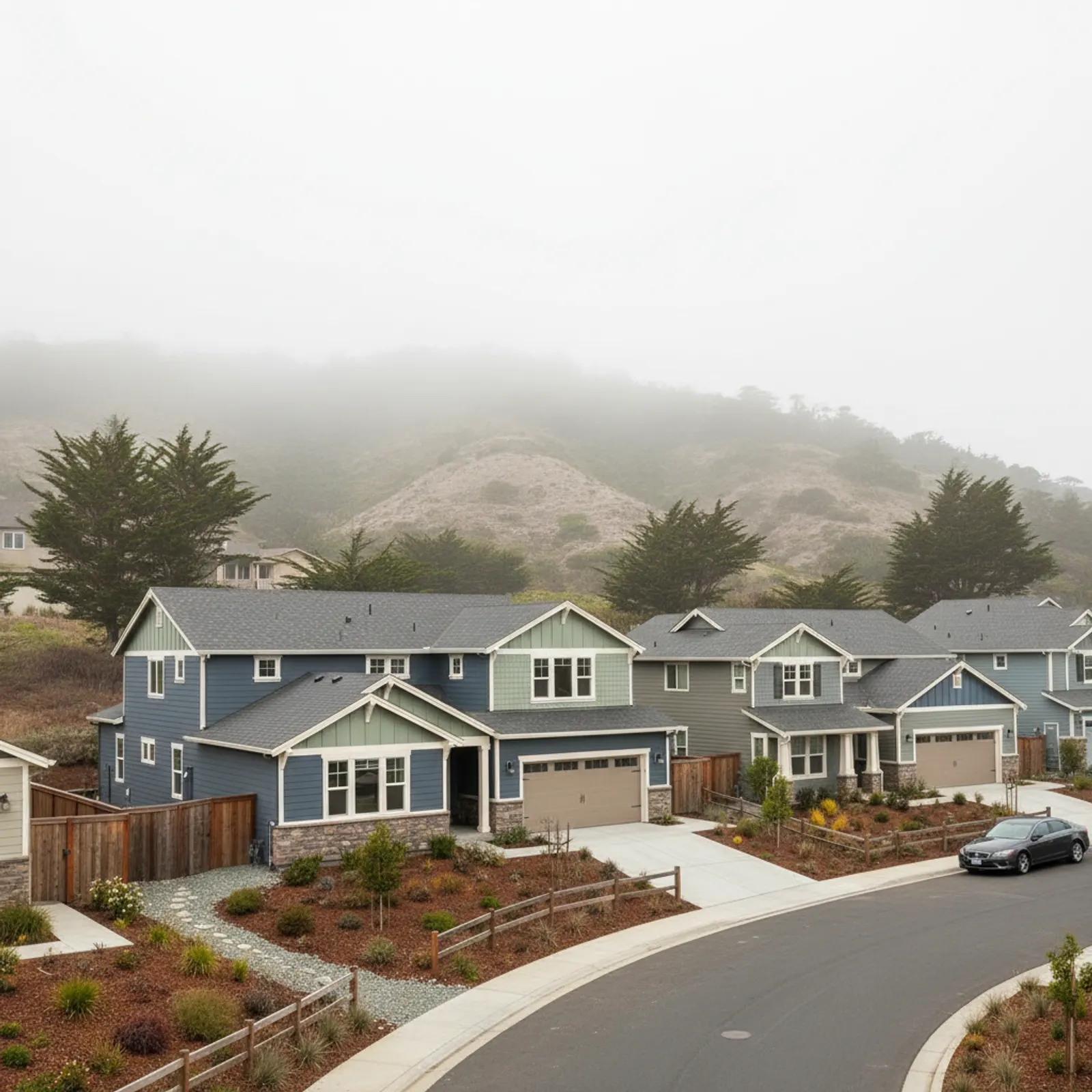
A Scotts Valley cul-de-sac can feel like any valley subdivision until you look at what's 50 feet past the property line. These are wildland-urban-interface parcels, and CZU came close enough to make that concrete. We treat a Scotts Valley re-side as a hardening project — Class A board, hardened eaves and vents — not the cosmetic refresh the neighborhood's appearance might suggest.
Damp enough to still need a drying plane
Unlike the dry interior foothills, Scotts Valley carries moderate marine-influenced damp under the canopy. So the assembly has to do two jobs: non-combustible hardening and a drying-capable plane behind the board. We build for both rather than treating it as a pure fire job.
Hardie's role in defensible space along the San Lorenzo edge
Scotts Valley parcels at the wooded fringe near the San Lorenzo Valley make siding part of a larger defensible-space picture, not a standalone facade decision. When second-growth redwood and chaparral crowd the rear setbacks, embers are the realistic ignition source, and the wall plane has to assume one will land against it. James Hardie fiber cement helps here because it does not feed flame the way wood lap or shingle does, which matters most in the zero-to-five-foot zone right under the cladding where ground litter collects. On the wooded custom homes scattered through the hills, we look at where decks, fences, and planting beds meet the siding, because a non-combustible wall loses its value if a wood gate or bark mulch bridges fire straight to it. The re-side becomes the moment to close those gaps: swap combustible trim returns, rethink the base course above grade, and keep the lowest courses clear of contact with vegetation. For mountain-fringe subdivision lots, that integration is the difference between a hardened exterior and a hardened-looking one.
Working trucks and material up the grade to a mountain lot
Installing James Hardie in Scotts Valley is as much a logistics problem as a carpentry one, because the prosperous custom homes tucked among the redwoods rarely sit on flat, open frontage. Fiber cement is heavy and comes in long, rigid planks, so a wooded lot off a winding mountain-fringe road changes how the job is staged. Narrow approaches, steep driveways, and tight tree canopy limit where a delivery truck can drop pallets and where a crew can stage cutting stations without showering redwood duff with silica dust. We plan dust control and offcut containment deliberately on these parcels, both for the forest setting and for the neighbors close by in the subdivision pockets. Tree clearance also shapes scaffolding and the lift path to upper gables on the taller wooded customs above the valley floor. None of this is exotic, but it is specific: a Scotts Valley re-side that ignores access and slope tends to run long and damage landscaping, so we walk the site and the road in before committing to a schedule for the hardened exterior.
Why this matters in Scotts Valley
- Specified for Santa Cruz Mountains conditions
- non-combustible fiber cement as the recommended system
- Correctly detailed weather-resistive barrier and flashing
- Installed by a crew with 20 years combined experience
Recommended systems for Scotts Valley
- non-combustible fiber cement
- fire-aware detailing
- drainage-plane detailing
James Hardie Siding for Scotts Valley homes
The full james hardie siding approach — materials, weather-resistive detailing, and the manufacturer standards we install to — is covered on the main service page, then specified for Scotts Valley's conditions on this one.
Our Scotts Valley process
- Step 1
Consultation
We listen to your goals and assess your home on site — exposure, substrate, and architecture.
- Step 2
Design & Proposal
A clear written proposal with the right system specified for your climate and a transparent scope.
- Step 3
Expert Installation
Trained crews install to manufacturer best practices with careful weather-management detailing.
- Step 4
Walkthrough & Support
A final walkthrough, full cleanup, and a clear written record of the scope completed — work we stand behind.
FAQ
James Hardie Siding in Scotts Valley — FAQ
It genuinely is — that's the most important thing to correct here. These subdivisions are in high Santa Cruz Mountains WUI terrain with wildland right behind them, and CZU came close. The ordinary appearance is exactly why the exposure gets underestimated.
No — non-combustible board matters, but embers attack eaves, vents, and the base of wall first. The hardened detailing around the Hardie is what actually protects the home; we document the assemblies because insurers in this terrain ask.
Yes — under canopy there's enough moisture that we build a drying-capable plane behind the board as well as hardening it. It's a fire job and a moisture job at once here, not one or the other.
Keep Exploring
More for Scotts Valley homeowners
More in Scotts Valley
Other exterior services in Scotts Valley
Nearby Service Areas
James Hardie Siding near Scotts Valley
Back to
Santa Cruz County & Scotts Valley
Helpful Exterior Guides