
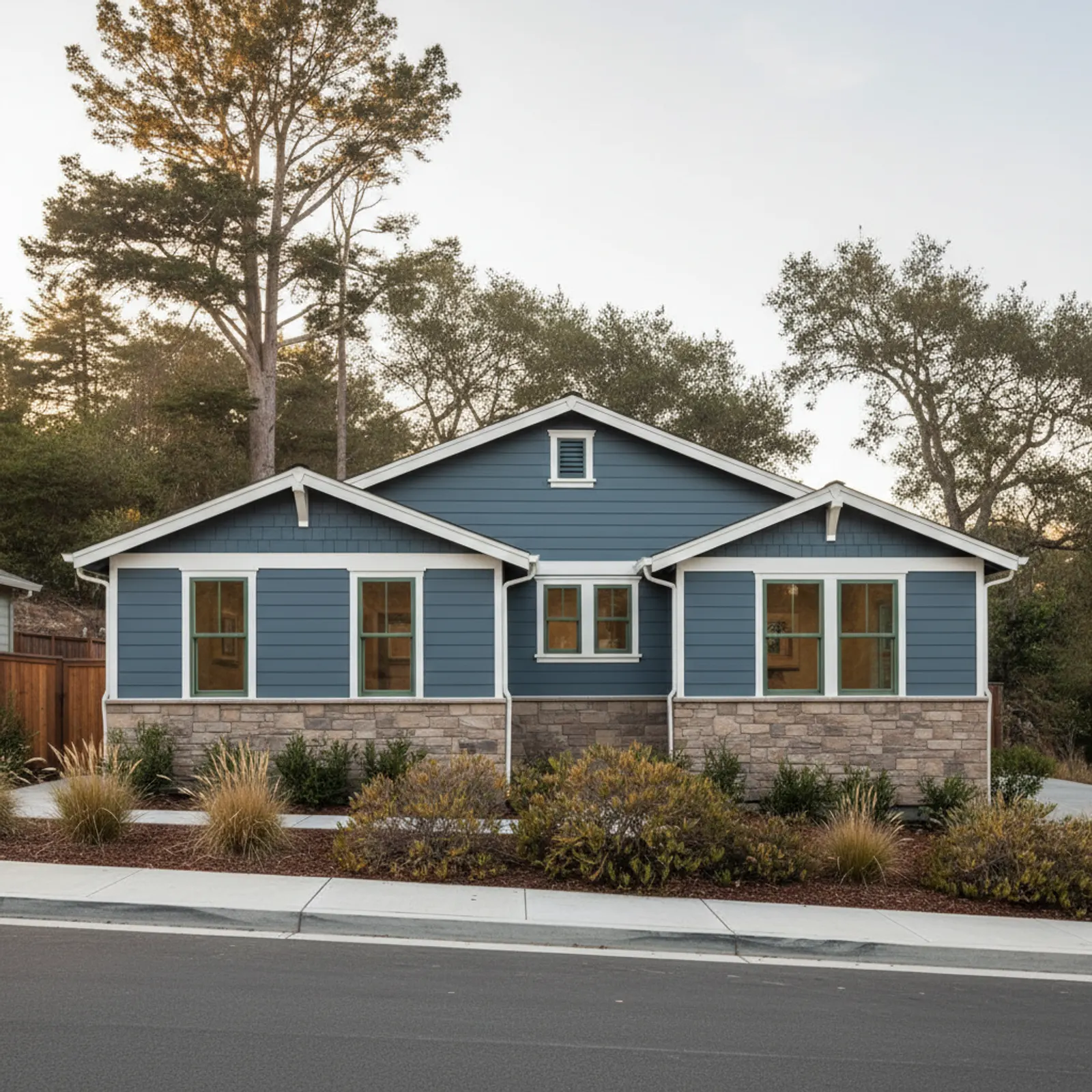
Exterior Contractor in Scotts Valley
Scotts Valley sits at the edge of the Santa Cruz Mountains, in wooded mountain-fringe terrain that carries real wildfire exposure. The CZU Lightning Complex fires made that exposure concrete for many owners. The housing stock is a mix of older subdivisions, wooded custom homes, and newer infill, and the moisture profile is mountain-marine — drier than coastal Santa Cruz but with persistent fog and rain through the wet season.
An integrated Scotts Valley exterior is what brings the assembly up to current CZU-era hardening standard — Class A non-combustible cladding, ember-resistant vents, hardened eaves, ground-to-wall detailing — without losing the wooded-mountain character that defines the city. Separate trades reliably under-harden vents and eaves while the cladding looks defensive.
What an integrated Scotts Valley exterior includes
On a wooded mountain-fringe home an integrated scope strips combustible cladding, corrects the WRB with drainage-plane detailing, replaces ember-vulnerable vents with ember-resistant equivalents, hardens eave and soffit detailing with closed assemblies, integrates window flashing into the new non-combustible assembly, and re-clads in Class A fiber cement with finish selection appropriate to the wooded setting.
Where the split-trade exterior fails in Scotts Valley
Post-CZU, the Scotts Valley failure mode is treating cladding alone as adequate fire defense. New non-combustible boards on a home with original soffit vents and unhardened eaves leaves every ember intrusion path open. An integrator scopes the whole defense story — cladding, vents, eaves, ground-to-wall — as one project so the hardening is functional, not cosmetic.
Materials and detailing we specify for Scotts Valley
Class A non-combustible fiber cement, ember-resistant vents and hardened (often closed) eave and soffit assemblies, non-combustible base trim and ground transitions, and finish selection appropriate to the mountain-fringe character. Drainage-plane detailing handles the wet-season moisture.
How WUI defensible-space rules reshape an exterior scope here
Most of Scotts Valley falls inside a designated Wildland-Urban Interface, and that classification changes what an exterior contractor can sign off on. It is not just the wall plane that matters; the first five feet around a redwood-shaded custom home become an ember zone, which pushes the re-side scope outward into the soffit returns, the deck-to-wall junction, and any wood fencing that ties directly into the structure. On the wooded lots climbing toward Glenwood and the San Lorenzo Valley edge, a crew has to coordinate cladding swaps with vegetation clearance and noncombustible ground-contact zones, or the hardened siding sits behind a combustible ladder fuel that defeats it. We treat the exterior contract as a single envelope decision: where the new fiber-cement or mineral board terminates, how the bottom course meets a noncombustible base, and how vents and gutters are screened so wind-driven embers off the ridge have nothing to enter or catch. That coordination is the difference between a wall that merely looks fire-ready and an assembly that genuinely is, on a fringe lot.
Working around redwood canopy, slope access, and the wet season
Scheduling an exterior job in Scotts Valley is a logistics problem before it is a carpentry problem. Many homes off Mount Hermon Road and the lanes threading up toward Felton sit on sloped, tree-tight parcels where the redwood canopy keeps walls in near-permanent shade and slows drying after the marine layer rolls in. That shade is exactly why the moisture detailing has to be conservative: a north-facing elevation under second-growth forest may not see direct sun for weeks, so any trapped water behind cladding lingers and rots sheathing rather than evaporating. We plan exterior work around the wet season, sequencing tear-off and dry-in so an open wall is never left exposed to a forecasted system, and we build in rainscreen gaps and generous flashing laps that assume slow drying rather than fast. Access also shapes the bid honestly: narrow driveways, steep approaches, and protected trees can mean staging scaffolding by hand and limiting heavy equipment near roots. Naming those constraints up front keeps a wooded-mountain re-side from stalling halfway through a damp Santa Cruz Mountains winter.
Why this matters in Scotts Valley
- Specified for Santa Cruz Mountains conditions
- non-combustible fiber cement as the recommended system
- Correctly detailed weather-resistive barrier and flashing
- Installed by a crew with 20 years combined experience
Recommended systems for Scotts Valley
- non-combustible fiber cement
- fire-aware detailing
- drainage-plane detailing
Exterior Contractor for Scotts Valley homes
The full exterior contractor approach — materials, weather-resistive detailing, and the manufacturer standards we install to — is covered on the main service page, then specified for Scotts Valley's conditions on this one.
Our Scotts Valley process
- Step 1
Consultation
We listen to your goals and assess your home on site — exposure, substrate, and architecture.
- Step 2
Design & Proposal
A clear written proposal with the right system specified for your climate and a transparent scope.
- Step 3
Expert Installation
Trained crews install to manufacturer best practices with careful weather-management detailing.
- Step 4
Walkthrough & Support
A final walkthrough, full cleanup, and a clear written record of the scope completed — work we stand behind.
FAQ
Exterior Contractor in Scotts Valley — FAQ
Because post-CZU defense is an assembly story, not a cladding decision. New non-combustible boards installed alongside original soffit vents leave every ember intrusion path open. One contractor scoping both at once is what makes the hardening functional rather than cosmetic.
Often, yes — carriers in post-CZU mountain terrain increasingly look at the whole envelope (cladding, vents, eaves, ground-to-wall) rather than just the cladding. We document the integrated assembly as one package for the carrier file.
Vents and eaves. Cladding gets the attention but vents are usually the actual ember intrusion path. An integrator scopes them into the same project rather than as a follow-up trade.
Most Scotts Valley homes are four to seven weeks of active work depending on size, hardening scope, and substrate condition.
Keep Exploring
More for Scotts Valley homeowners
More in Scotts Valley
Other exterior services in Scotts Valley
Nearby Service Areas
Exterior Contractor near Scotts Valley
Back to
Santa Cruz County & Scotts Valley
Helpful Exterior Guides