
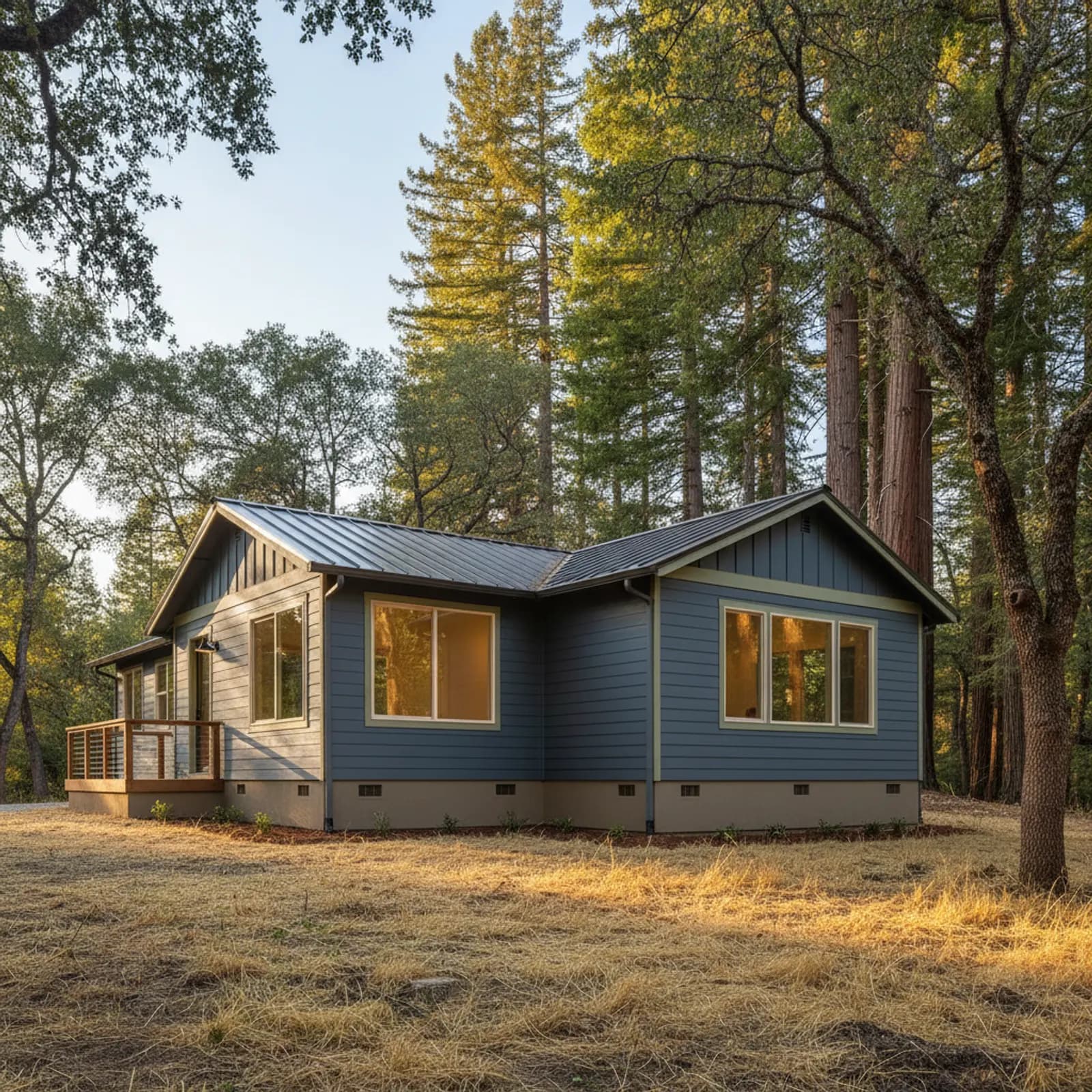
Exterior Contractor in Felton
Felton sits in deep redwood forest in the Santa Cruz Mountains — among the most fire-exposed parcels we serve anywhere in California. The CZU Lightning Complex fires reached Felton terrain in 2020, and the wildfire exposure here is extreme: dense conifer fuel right up to the home, limited defensible space on many parcels, and prolonged fire seasons. The exterior conversation in Felton is almost entirely about ignition resistance.
An integrator's job in Felton is treating the envelope as a single defense system rather than as a sequence of decorative trade engagements. Cladding alone doesn't save a Felton home — the vents, eaves, soffit, ground-to-wall transitions, and the integration of all of them determine whether the home survives an ember event. That coordination has to come from one accountable contractor, not three trades over five years.
What an integrated Felton exterior includes
On a Felton redwood-forest home an integrated scope strips combustible cladding (typically wood or cedar shake), corrects the WRB, replaces ember-vulnerable vents with ember-resistant equivalents, hardens eave and soffit detailing with closed assemblies, integrates window flashing into a non-combustible WRB, and details the ground-to-wall transition with non-combustible base trim and aggressive clearance from landscape contact.
Where the split-trade exterior fails in Felton
Felton is the clearest case of split-trade failure in the county. A siding-only project replaces cladding and the home looks hardened. Every actual ember path — vents, eaves, ground transitions, deck flashing — is unchanged, and the next fire event finds them. The hardening is cosmetic, not real. An integrator scopes all of those details as one project so the defense is functional.
Materials and detailing we specify for Felton
Class A non-combustible cladding, ember-resistant vents, hardened (typically closed) eave and soffit detailing, non-combustible trim and base detail, and aggressively detailed ground-to-wall transitions. On deep-forest parcels the hardening scope is maximal, not conservative.
Living under the redwood canopy: moisture, shade, and exterior longevity in Felton
Wildfire dominates the Felton conversation, but the quieter daily enemy is the perpetual damp under the San Lorenzo Valley redwood canopy. Sunlight barely reaches many forest-floor homes here, so siding, trim, and substrate stay cool and moist far longer after each rain than they would in open terrain. That standing humidity is exactly what feeds rot, swelling fasteners, and the moss and algae film that creeps across north-facing walls below the canopy. As an exterior contractor working Felton parcels, we treat drainage and back-ventilation as seriously as the cladding face itself: rainscreen gaps that let walls dry inward and outward, capillary breaks at every ground-to-wall transition, and flashing laps detailed for water that lingers rather than sheets off in an afternoon. We also push cladding finishes off the soil, since duff and needle litter trap moisture against the base course. Picking a noncombustible cladding for the fire threat is only half the decision in Felton; that same assembly has to shed and breathe through long, sunless, redwood-shaded wet spells without trapping the rot it was meant to resist.
Acreage access, defensible space, and permitting on San Lorenzo Valley parcels
Felton exteriors are rarely a simple driveway-and-go job. Many homes sit on rural acreage off narrow, tree-lined lanes shared with Boulder Creek and the upper San Lorenzo Valley, where staging a lift, a dumpster, and material deliveries takes planning long before the first fastener goes in. Steep, wooded lots limit where scaffolding can land, and the same dense conifer fuel that makes this terrain so fire-exposed also crowds the working envelope around the house. We coordinate that footprint up front so the crew can work the full perimeter safely. Permitting here runs through Santa Cruz County rather than a city counter, and in a post-CZU landscape, reviewers care intensely about how the exterior assembly meets WUI ignition-resistance expectations. We document vent, eave, and cladding choices accordingly, and we fold defensible-space realities into the scope: keeping combustible debris off the new envelope, detailing the first few feet around the structure as the most ember-vulnerable zone. On Scotts Valley-adjacent and deeper backwoods parcels alike, that access and approval groundwork is what keeps a Felton exterior project on schedule.
Why this matters in Felton
- Specified for Santa Cruz Mountains conditions
- Class A non-combustible fiber cement as the recommended system
- Correctly detailed weather-resistive barrier and flashing
- Installed by a crew with 20 years combined experience
Recommended systems for Felton
- Class A non-combustible fiber cement
- aggressive fire-hardening detailing
- drainage-plane detailing
Exterior Contractor for Felton homes
The full exterior contractor approach — materials, weather-resistive detailing, and the manufacturer standards we install to — is covered on the main service page, then specified for Felton's conditions on this one.
Our Felton process
- Step 1
Consultation
We listen to your goals and assess your home on site — exposure, substrate, and architecture.
- Step 2
Design & Proposal
A clear written proposal with the right system specified for your climate and a transparent scope.
- Step 3
Expert Installation
Trained crews install to manufacturer best practices with careful weather-management detailing.
- Step 4
Walkthrough & Support
A final walkthrough, full cleanup, and a clear written record of the scope completed — work we stand behind.
FAQ
Exterior Contractor in Felton — FAQ
Yes. Felton sits in extreme redwood-forest fire terrain — the CZU Lightning Complex reached the area. The decision isn't whether to harden but how aggressively the hardening extends; cladding alone is not enough.
We coordinate the ground-to-wall and base-trim detail; vegetation management beyond five feet goes to a landscape professional. We make sure our work integrates with theirs.
Active exterior work is generally constrained to the drier months. We plan dry-in to land well before the wet season.
In post-CZU deep-forest terrain it commonly supports insurability — many insurers want documented hardening before issuing or renewing policies on these parcels.
Most Felton homes are four to seven weeks of active work depending on size, hardening scope, and remote-site logistics.
Keep Exploring
More for Felton homeowners
More in Felton
Other exterior services in Felton
Nearby Service Areas
Exterior Contractor near Felton
Helpful Exterior Guides