
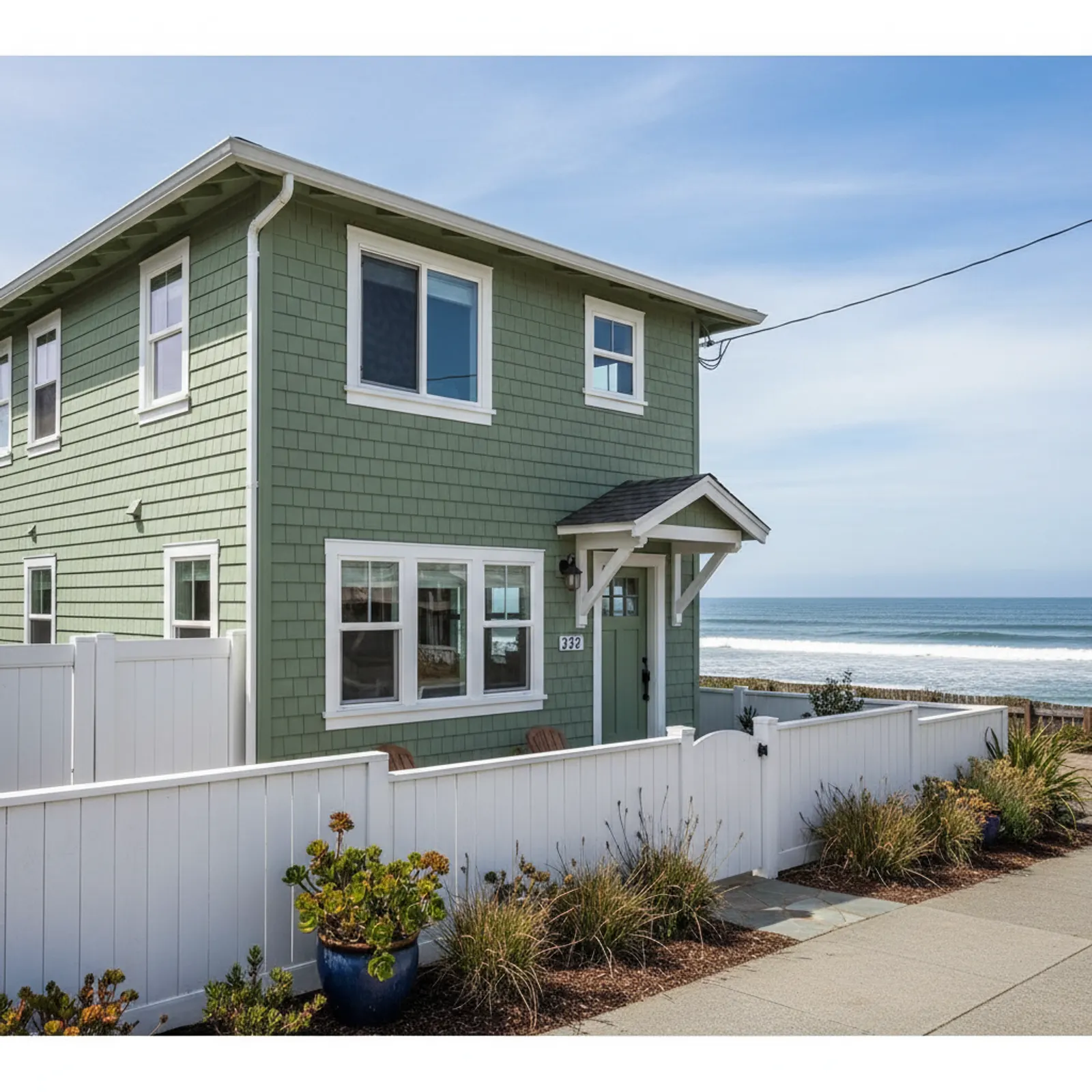
Exterior renovation in Capitola
Capitola is a small, picturesque beach village on Monterey Bay — colorful cottages around Capitola Village, bluff and near-shore homes, and tightly held residential streets just back from the sand. Its exterior environment is among the most salt- and moisture-aggressive in Santa Cruz County: direct ocean air, persistent marine humidity, and wind-driven damp.
What the Capitola market expects from a re-side
In a compact, desirable beach-village market, the exterior does heavy lifting on perceived value, and buyers spot peeling, salt-burned wood and corroded fasteners immediately because everyone knows how punishing this environment is. But Capitola Village trades on a particular look, so a re-side that swaps in a flat, generic profile can quietly subtract from appeal even while it improves durability. We steer toward corrosion-aware, drying-capable fiber cement with stainless or hot-dip fastening that survives the direct ocean salt while preserving cottage proportions, trim depth, and color flexibility. For an owner weighing one more repaint of failing wood against re-siding once, the math in this climate usually favors ending the repeating repaint cycle with an assembly that also presents cleanly whenever the home goes to market.
Considering an exterior project in Capitola?
Capitola housing and architecture
Capitola's stock is dominated by beach cottages and village homes, bluff and near-shore properties, and older small-lot residential streets. Many wear wood siding that constant salt air and damp have worked hard on — exactly the assemblies we replace with corrosion-aware, drying-capable systems while keeping the village's character.
Capitola's beach-village climate
Capitola sits right on Monterey Bay: heavy salt air, persistent marine moisture, and wind-driven damp essentially year-round. Heat is a non-issue; salt-driven corrosion and moisture govern every specification decision here.
Recommended materials for Capitola
Non-combustible fiber cement with corrosion-resistant stainless or hot-dip fastening over a rigorously detailed, drying-capable drainage plane is the core recommendation — it withstands Capitola's salt and moisture far better than wood, in character-sensitive profiles for the village cottages.
What an exterior project costs in Capitola
Capitola pricing turns on home size, the tight access of village and small-lot properties, trim complexity, substrate and rot discovery (frequently significant on older salt-exposed cottages), window integration, and the corrosion- and moisture-management scope. We provide a written, scoped estimate after an on-site assessment.
Working on Capitola's tight village streets and bluff lots
Logistics shape every exterior job in Capitola, and the village is the clearest example. The lanes set immediately behind the beach near Capitola Village run narrow, tightly held, and often short on driveway or staging room, so material drops, scaffold setup, and dumpster placement need planning rather than assumption. Near-shore and bluff properties add their own constraints: limited side-yard access, shared walls or close-set neighbors, and grades that make the seaward elevation the hardest to reach yet the most exposed. We sequence work so the salt-facing walls get the most careful detailing and the least time left open to wind-driven damp. Summer brings heavy foot and beach traffic through the village core, which affects parking and delivery timing, so weekday and shoulder-season scheduling tends to go smoother. None of this is unusual for a small coastal town, but it does mean a Capitola exterior project benefits from a site walk up front to confirm access, staging, and how each elevation will be reached before a crew and materials arrive.
Re-siding and resale value in Capitola's beach-village market
In a compact, desirable market like Capitola, the exterior does heavy lifting on perceived value. Buyers drawn to a Monterey Bay cottage notice peeling, salt-burned wood siding and corroded fasteners immediately, because those signal deferred maintenance in an environment everyone knows is punishing. A re-side here is not just protection; it is part of how a near-shore or bluff home presents. The flip side is that character matters. Capitola Village's colorful cottages and the older small-lot streets behind the beach trade on a particular look, so a re-side that swaps in a flat, generic profile can quietly subtract from appeal even while it improves durability. We steer material and detailing choices toward systems that survive coastal salt and damp while preserving cottage proportions, trim depth, and color flexibility. For owners weighing whether to repaint failing wood again or re-side once, the math in this climate usually favors a corrosion-aware, drying-capable assembly that ends the repeating repaint cycle and presents cleanly whenever the home eventually goes to market.
Our process in Capitola
- Step 1
Consultation
We listen to your goals and assess your home on site — exposure, substrate, and architecture.
- Step 2
Design & Proposal
A clear written proposal with the right system specified for your climate and a transparent scope.
- Step 3
Expert Installation
Trained crews install to manufacturer best practices with careful weather-management detailing.
- Step 4
Walkthrough & Support
A final walkthrough, full cleanup, and a clear written record of the scope completed — work we stand behind.
Capitola rewards an exterior engineered for direct ocean salt and moisture while keeping the beach village's character.
FAQ
Capitola — Common Questions
Non-combustible fiber cement with corrosion-resistant fastening over a rigorously detailed drainage plane — character-sensitive profiles that withstand the direct ocean salt and moisture far better than wood.
Severe — Capitola sits directly on Monterey Bay. We specify corrosion-resistant fastening and drying-capable assemblies for these homes.
Salt-driven corrosion and trapped marine moisture in poorly detailed assemblies — not the cladding alone. Corrosion-aware, drying-capable detailing fixes the cause.
Yes — character-sensitive profiles and trim in corrosion-aware non-combustible fiber cement preserve the look while solving the salt and moisture problem.
Against constant direct salt air and damp it degrades quickly compared to a properly fastened fiber cement assembly.
Low — it is a beach village. Non-combustible fiber cement remains a sound, low-regret choice.
Yes — access and staging on tight small-lot and village properties are real scope factors, planned and estimated explicitly.
A correctly detailed, corrosion-aware fiber cement system commonly performs 30+ years even in Capitola's direct-ocean environment.
Explore
Exterior Services
Helpful Exterior Guides