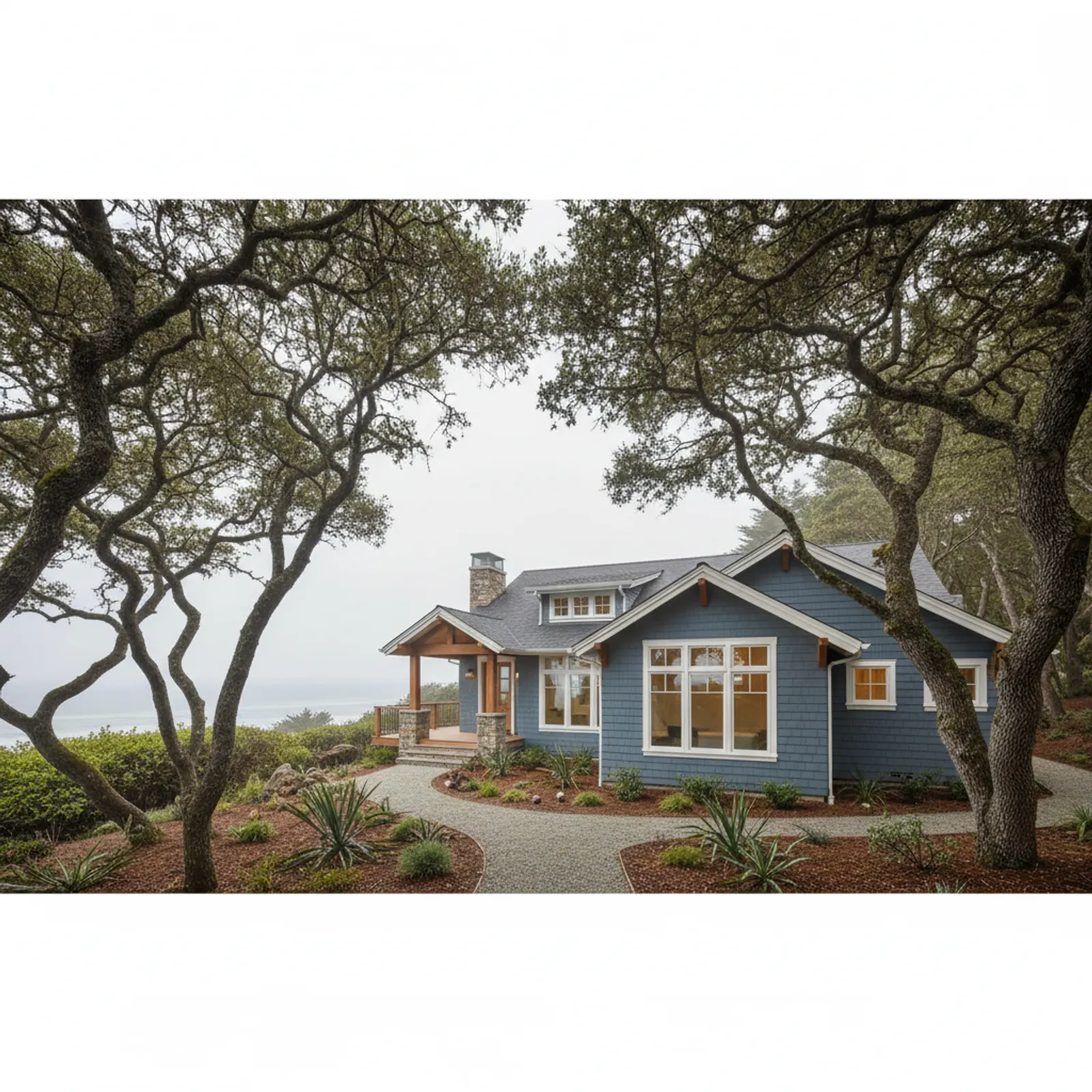
Exterior renovation in Aptos
Aptos stretches from the Monterey Bay shoreline up into the forested foothills of the Santa Cruz Mountains, and that gradient makes it one of the more demanding — and highest-value — exterior markets on the central coast. Beach-close homes contend with salt air and marine moisture; the wooded Aptos Hills and Rio del Mar uplands add real wildfire consideration. The market here expects an architectural result that solves all of it, not a single-problem fix.
One town, two exterior problems
What sets Aptos apart from a flatter coastal town is that the controlling stressor changes with elevation. Down near the water it is chloride corrosion and persistent marine moisture working on fasteners, flashing, and any trapped wood. A few hundred feet up in the forested uplands it is ember exposure and a late-summer fire window. A home on the bluff and a home in the trees need genuinely different details, and the only way to specify correctly is to read where the particular parcel sits on that gradient.
Considering an exterior project in Aptos?
Aptos housing and architecture
Aptos's stock spans coastal and Rio del Mar beach-area homes, established mid-century and ranch neighborhoods inland of the highway, and a strong set of wooded-edge and Aptos Hills custom homes. Coastal homes show salt-driven wear on wood cladding and fasteners, often years before the cladding itself would otherwise fail. The wooded custom homes are detail-intensive — varied rooflines, deep eaves, mixed materials — and increasingly fire-aware. Both stocks reward a corrosion- and fire-conscious fiber cement approach that carries refined trim, rather than an economy re-side that ignores the setting.
Aptos's coastal-and-forest climate
Lower Aptos is cool, foggy, and salt-laden, with marine air that keeps walls and shaded assemblies damp far longer than an inland site. The uplands are warmer and drier with forested fuel and a late-summer fire window. So the exterior must resist chloride corrosion and persistent moisture near the water and resist embers in the hills — a genuine dual specification. We treat fog-driven drying time as a design input near the shore and ember loading as the design input upslope, rather than applying one coastal recipe to the whole town.
Wooded-edge fire consideration in Aptos
For Aptos Hills and forested-edge parcels we specify non-combustible cladding and harden eaves and vents, recognizing the Santa Cruz Mountains fire exposure that the CZU Lightning Complex made concrete in this county. Embers, not direct flame, are what reach most homes in a mountain fire, so the soffit, vent, and ground-to-wall detailing matters as much as the wall material itself. Beach-close homes carry lower fire risk but still benefit from non-combustible fiber cement at no cost to the corrosion strategy — the safer material happens to be the more durable one near the water too. We won't overstate fire risk on a bluff parcel, but we also won't underbuild a home sitting in the trees.
Recommended materials for Aptos
Non-combustible fiber cement with corrosion-resistant fastening over a rigorously detailed, drying-capable drainage plane is the recommendation for Aptos, with fire-aware eave and vent detailing added on wooded-edge parcels. The drainage plane is the quiet hero on the coast: marine moisture will find any assembly, so the system has to let walls dry rather than trap dampness against sheathing. Refined fiber cement profiles and trim then deliver the architectural result the market expects, addressing salt, moisture, and fire demands together rather than trading one off against another.
What an exterior project costs in Aptos
Aptos pricing turns on home size and stories, custom detailing, and substrate and rot condition once cladding is removed — often significant on older salt-exposed coastal homes where corrosion has been working behind the siding for years. Window integration, wooded and steep site access in the hills, and the combined corrosion-, moisture-, and fire-management scope all move the number as well. Hillside parcels add staging and access cost that a flat coastal lot doesn't. We provide a written, scoped estimate after an on-site assessment so the parcel's real conditions drive the bid.
Rio del Mar and the beach-close blocks
The Rio del Mar and shoreline-adjacent neighborhoods are where salt air is most aggressive in Aptos. Homes here take direct marine exposure, and standard fasteners, flashing, and field-painted wood simply don't keep pace. On these blocks the corrosion strategy — resistant fastening, carefully detailed flashing, and a drying-capable assembly — is not an upgrade, it's the baseline that determines how long the whole exterior lasts. The visible cladding is only half the system; what holds it on and lets it dry is the half that fails first when it's specified for an inland climate.
Aptos Hills and the wooded uplands
Up in the Aptos Hills and forested-edge parcels the picture flips toward fire and access. These are often custom homes on steep, wooded lots with long driveways, deep eaves, and the kind of mixed-material design that demands careful trim work. Re-cladding combustible wood or shingle in non-combustible fiber cement is the highest-value hardening step available here, and the eave and vent detailing matters as much as the wall. Site access and material staging on these lots are real planning items we scope before the first board comes off.
A high-expectation coastal market
Aptos buyers and owners expect an architectural result, not just a weather-tight box. That raises the bar on profile selection, trim proportion, and finish — the exterior is part of the home's market position on the central coast. We treat the re-side as a design decision as much as a durability one, matching profiles and palette to the home and its setting, whether that's a fog-belt coastal home or a custom home in the trees. The corrosion and fire engineering stays out of sight; the result reads as a considered, finished exterior.
Aptos is unincorporated: county permits, Soquel Creek Water, and Aptos/La Selva Fire
Aptos, like several affluent central-coast communities, is not a city. It is an unincorporated community — a Census-Designated Place — governed by Santa Cruz County rather than a municipal government of its own. That means building permits, planning review, and code enforcement all run through the Santa Cruz County Community Development and Infrastructure Department, not a city hall. Electric and gas are PG&E, and Aptos is in high-PSPS territory, where PG&E's Public Safety Power Shutoffs during red-flag events can affect job scheduling from late summer through fall. Water is supplied by the Soquel Creek Water District (with Central Water District serving parts of the coastal fringe), a customer-owned public agency, so any work near a water meter or backflow assembly coordinates through the relevant water agency. Fire response is the Aptos/La Selva Fire Protection District, which also runs defensible-space inspection for parcels in state and local responsibility areas. Beach-close Rio del Mar blocks additionally sit in FEMA-mapped coastal flood zones, which affect setbacks and finish-floor elevations on new construction and substantial rebuilds. We flag utility, permit, fire, and flood-zone items at the estimate stage rather than at the wall.
HZ10, the 2020 CZU Fire, and the 2025 FHSZ remap on the Aptos gradient
Aptos sits on a coastal-to-forest gradient where fire and moisture stresses coexist, and the state's fire-code framework applies directly here because the community is unincorporated. The 2020 CZU Lightning Complex Fire — which burned more than 86,000 acres across the Santa Cruz Mountains and destroyed nearly a thousand structures in Bonny Doon, Boulder Creek, and adjacent unincorporated areas — reset the fire conversation for the entire county, and the state's 2025 LRA Fire Hazard Severity Zone map (the first comprehensive revision since 2007) applies to Aptos parcels through Santa Cruz County's adoption. The wooded uplands — Aptos Hills, Rio del Mar's forested edge, and the parcels climbing toward the ridges — carry Moderate to Very High designations, while the coastal blocks near the water are Low or unmapped. On designated parcels the 2025 California Wildland-Urban Interface Code governs the exterior wall; on the beach-close bluffs the corrosion-and-moisture strategy is the primary concern. The code frame itself changed on January 1, 2026, when Chapter 7A was deleted from the Building Code and moved into the standalone WUI Code. On the material side, Aptos is in James Hardie's HZ10 climate zone; installing HZ5 is a documented warranty misapplication. We match the assembly to where the parcel actually sits on the gradient.
Our process in Aptos
- Step 1
Consultation
We listen to your goals and assess your home on site — exposure, substrate, and architecture.
- Step 2
Design & Proposal
A clear written proposal with the right system specified for your climate and a transparent scope.
- Step 3
Expert Installation
Trained crews install to manufacturer best practices with careful weather-management detailing.
- Step 4
Walkthrough & Support
A final walkthrough, full cleanup, and a clear written record of the scope completed — work we stand behind.
Aptos rewards an exterior built for salt and fog near the water and for fire in the hills, with an architectural result the market expects. We scope every Aptos project on site, specifying per parcel to where it actually sits on that coastal-to-forest gradient, and your written estimate governs the work.
FAQ
Aptos — Common Questions
Non-combustible fiber cement with corrosion-resistant fastening over a drying-capable drainage plane — it handles persistent salt air and marine moisture far better than wood.
Yes — wooded and Aptos Hills parcels carry real Santa Cruz Mountains fire exposure. We add non-combustible cladding and hardened eave/vent detailing there.
Yes — beach-close Aptos homes see chloride corrosion of standard fasteners and flashing, which is why we specify corrosion-resistant detailing.
Usually salt-driven corrosion and trapped marine moisture in poorly detailed assemblies — not the cladding alone. Corrosion-aware, drying-capable detailing fixes the cause.
Yes — refined fiber cement profiles and trim over a corrosion- and fire-aware assembly, matched to the home's design.
Near the water it underperforms a properly fastened fiber cement assembly; in the hills it is also a fire liability. We generally steer away from it.
When feasible, yes — correct flashing integration matters in both the high-moisture coastal zone and the wooded uplands.
A correctly detailed, corrosion- and fire-aware fiber cement system commonly performs 30+ years across Aptos's coastal and wooded settings.
Explore
Exterior Services
Helpful Exterior Guides