
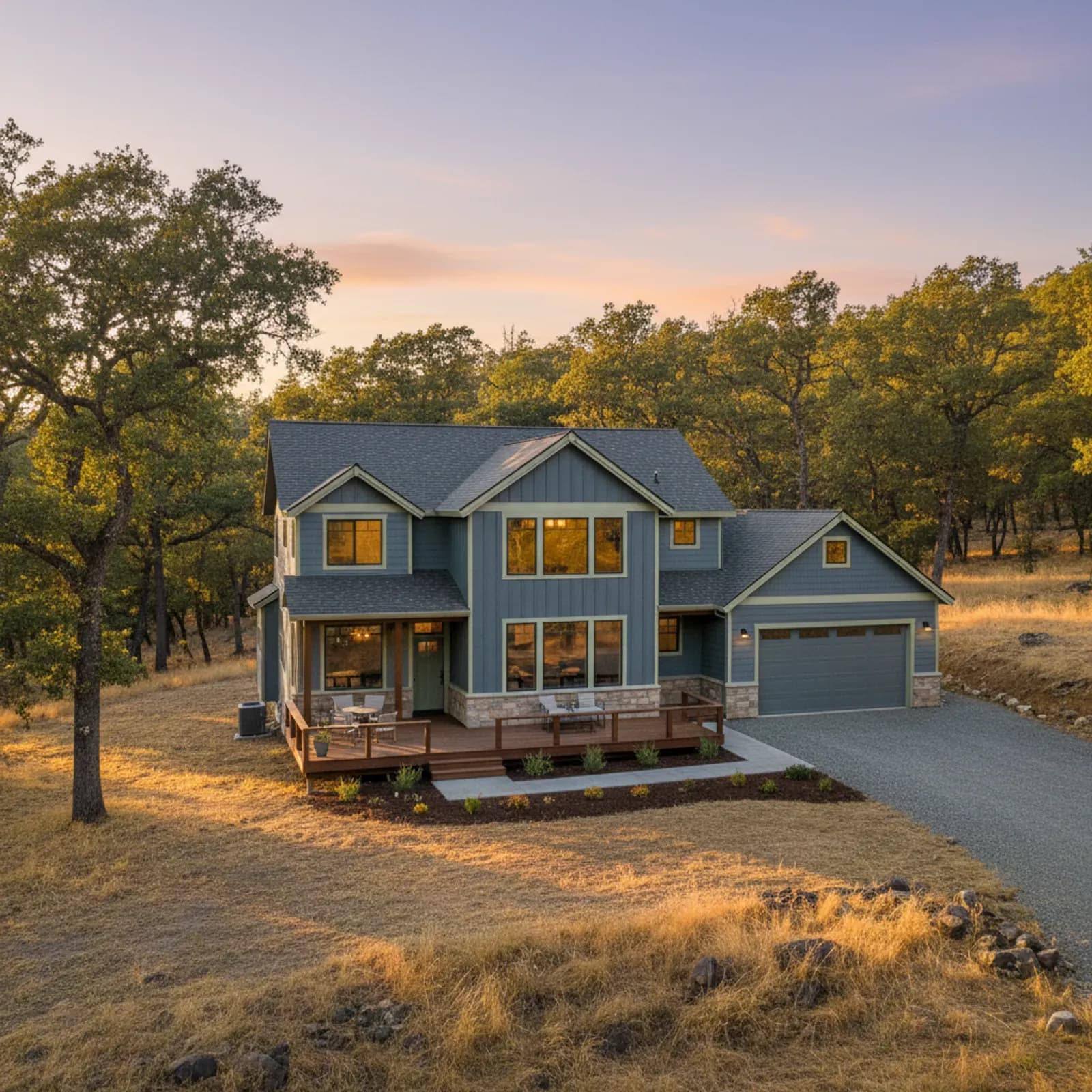
Siding in Boulder Creek
A Boulder Creek re-side is the most remote, deepest-forest extreme-fire work in the San Lorenzo Valley — even more so than Felton. The gateway community to Big Basin, Boulder Creek sits under dense old-growth and second-growth redwood at the constrained upper end of Highway 9/236; the 2020 CZU Lightning Complex devastated the Big Basin / Boulder Creek area, destroying the historic park headquarters and many area structures. We treat it with the seriousness that demands.
Cladding choice is secondary to a fully hardened, non-combustible envelope built for extreme ember exposure on a deep-forest dead-end corridor.
Deepest-forest extreme exposure
Boulder Creek's deep-forest cabins and rural acreage sit in extreme terrain with catastrophic recent CZU history and the most constrained egress in the valley. We strip combustible wood, re-clad Class A non-combustible, and aggressively harden eaves, soffits, vents, decks, and every ground transition.
More remote than Felton
Further up-canyon toward Big Basin and more access-constrained than Felton, Boulder Creek's remote off-grid character shapes logistics; we plan honestly around the deep-forest dead-end corridor rather than promising valley-style timelines.
The ember-resistant spec a CZU rebuild demands
After the CZU Lightning Complex, siding in Boulder Creek is no longer a finish decision; it is the most exposed face of the wildfire envelope. We treat the wall like a Chapter 7A assembly built for the wildland-urban interface, leading with noncombustible cladding such as fiber cement or mineral-based panels rather than the wood or vinyl that once defined these forest cabins. The detail work matters more than the panel. Open eaves, gable vents, and the gap where siding meets the foundation are where wind-driven embers find their way in, so we close those paths with ember-resistant venting and tight, flashed terminations at every penetration. We also rethink the bottom course, holding cladding clear of grade and any bark mulch or duff stacked against the wall, because a single ignition at the base can climb the whole elevation. For a home being rebuilt or hardened on deep redwood acreage, the goal is a continuous, non-combustible skin with no soft seam an ember can exploit.
Working a damp canopy and a one-road corridor
Boulder Creek hands a siding crew a contradiction. The same redwood canopy that makes the town extreme fire terrain also keeps walls in deep shade and chronic damp for much of the year, so a wall built only for ember defense will rot, and a wall built only for moisture will fail another way. We resolve that with a rainscreen behind the noncombustible cladding: a vented air gap and a drainage plane that let trapped moisture dry outward while the outer face stays fire-rated. The detailing leans into the wet side too, with generous flashing over windows and at the mudsill, because fog drip and winter rain off the forest never really let up here. Logistics shape the schedule as much as the spec. Most of these homes sit on rural acreage off the narrow Highway 9 and 236 corridor, often down long single-lane drives with little turnaround or staging room. We plan deliveries around that reality, keep the work zone clear of surrounding duff, and sequence access so a re-side on a forested dead-end does not stall partway through.
Why this matters in Boulder Creek
- Specified for Santa Cruz Mountains conditions
- Class A non-combustible fiber cement as the recommended system
- Correctly detailed weather-resistive barrier and flashing
- Installed by a crew with 20 years combined experience
Recommended systems for Boulder Creek
- Class A non-combustible fiber cement
- aggressive fire-hardening detailing
- robust flashing
Fiber Cement Siding for Boulder Creek homes
The full fiber cement siding approach — materials, weather-resistive detailing, and the manufacturer standards we install to — is covered on the main service page, then specified for Boulder Creek's conditions on this one.
Our Boulder Creek process
- Step 1
Consultation
We listen to your goals and assess your home on site — exposure, substrate, and architecture.
- Step 2
Design & Proposal
A clear written proposal with the right system specified for your climate and a transparent scope.
- Step 3
Expert Installation
Trained crews install to manufacturer best practices with careful weather-management detailing.
- Step 4
Walkthrough & Support
A final walkthrough, full cleanup, and a clear written record of the scope completed — work we stand behind.
FAQ
Siding in Boulder Creek — FAQ
Boulder Creek is deeper and more remote up the San Lorenzo Valley — the Big Basin gateway, more access-constrained, with the CZU Complex having devastated the immediate area. Same extreme standard, even tighter logistics.
Extreme — deepest San Lorenzo Valley redwood forest where the 2020 CZU Lightning Complex destroyed much of the Big Basin / Boulder Creek area. Aggressive non-combustible hardening is essential.
No, for essentially all parcels — it's combustible in extreme deep-forest terrain. We build aggressively hardened, non-combustible assemblies.
Yes — the deep-forest dead-end Hwy 9/236 corridor constrains logistics and scheduling; we plan around it honestly.
Yes — we document materials and assemblies thoroughly to support hardening and insurance conversations, while being honest that insurers set their own criteria in extreme terrain.
Keep Exploring
More for Boulder Creek homeowners
More in Boulder Creek
Other exterior services in Boulder Creek
Back to
Santa Cruz County & Boulder Creek
Helpful Exterior Guides