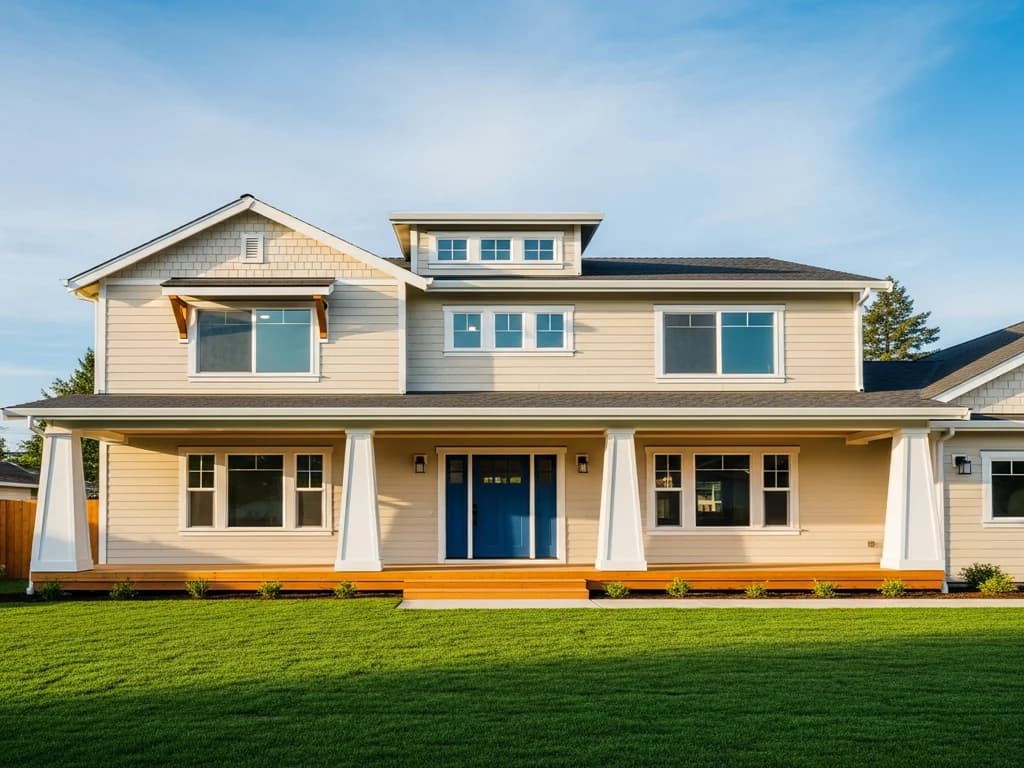
Siding in Corralitos
A Corralitos re-side is a foothill-orchard problem with a coastal twist. Tucked into the wooded slopes above the Pajaro Valley behind Watsonville, this is apple country and rural-residential acreage — homes scattered among orchards, oak-and-redwood draws, and outbuildings, where marine fog drifts up from the valley but the controlling stresses are slow-drying canopy shade and genuine wildfire on the brushy upper slopes.
So a Corralitos project is scoped for two things the valley floor never forces together: a wall that can dry under tree cover and damp air, and an exterior that takes ember exposure on the wooded hillsides seriously.
Why Corralitos walls fail under the canopy
These foothill homes sit in dappled shade off Browns Valley, Hames, and Eureka Canyon roads, where redwood and oak keep walls cool and slow to dry long after the marine fog lifts. Corralitos siding fails from moisture trapped against sheathing that never gets sun, not from the board itself. We strip back to substrate, correct the damp-rot that hides behind original wood lap on the older orchard homes, and re-clad over a genuinely drying-capable, back-vented plane so canopy moisture has a path out.
Orchard acreage and the rural-residential lot
Most Corralitos parcels are deep acreage with the house set back among the apple rows, plus barns, packing sheds, and other outbuildings. That shapes the whole job: staging scaffolding, a cut station, and material lifts takes real planning where the driveway is a long gravel run and the nearest power is at the house. We confirm lines and setbacks before staging because neighboring parcels are actively farmed, and we sequence tear-off so no wall is left open through a foggy night.
Moisture and ember exposure in one assembly
Corralitos is the address where the Pajaro Valley's damp meets foothill fire, and a sensible re-side answers both in a single build rather than choosing one. The lower courses and ground-to-wall transition get the drying-and-clearance treatment that slow-drying shaded lots demand, while on the upper, brush-adjacent elevations we move to non-combustible cladding and start closing the ember pathways — eave gaps, vents, and the litter pockets where conifer needles pile against the base. The point is one coherent wall, not a moisture fix on one side and a fire fix bolted on later.
Older orchard homes and newer rural builds
Corralitos housing splits between decades-old farm and orchard homes near the little village center and newer custom builds tucked higher on the wooded slopes. The older stock often hides original board, brittle felt, and sometimes asbestos-suspect material that needs careful removal before any new cladding goes up, and those walls were never built with a drainage gap. The hillside customs are detail-rich and want their profiles and trim replicated faithfully while the concealed metal and fire detailing get upgraded. In both, the controlling decision is the same: every penetration and horizontal ledge has to drain, dry, and resist embers, because this foothill pocket rarely forgives a wall that does only one of the three.
Why this matters in Corralitos
- Specified for Santa Cruz Mountains / Pajaro Valley conditions
- non-combustible fiber cement as the recommended system
- Correctly detailed weather-resistive barrier and flashing
- Installed by a crew with 20 years combined experience
Recommended systems for Corralitos
- non-combustible fiber cement
- James Hardie
- fire-aware detailing
- drainage-plane detailing
Fiber Cement Siding for Corralitos homes
The full fiber cement siding approach — materials, weather-resistive detailing, and the manufacturer standards we install to — is covered on the main service page, then specified for Corralitos's conditions on this one.
Our Corralitos process
- Step 1
Consultation
We listen to your goals and assess your home on site — exposure, substrate, and architecture.
- Step 2
Design & Proposal
A clear written proposal with the right system specified for your climate and a transparent scope.
- Step 3
Expert Installation
Trained crews install to manufacturer best practices with careful weather-management detailing.
- Step 4
Walkthrough & Support
A final walkthrough, full cleanup, and a clear written record of the scope completed — work we stand behind.
FAQ
Siding in Corralitos — FAQ
Yes — Watsonville is flat valley floor where moisture is the only real driver. Corralitos sits in the wooded foothills above it, so a re-side has to handle canopy damp and genuine ember exposure together.
Redwood and oak canopy keep walls shaded and cool, so they dry slowly after fog and rain and trapped moisture decays the substrate. A back-vented, drying-capable assembly fixes the root cause, not just the board.
Yes — the brushy upper slopes carry real foothill fire exposure, so on hillside and brush-adjacent parcels we specify non-combustible cladding and start hardening eaves, vents, and ground transitions as part of the re-side.
Yes — we plan staging, deliveries, and debris haul-off around long gravel drives and active orchard rows, and confirm property lines before scaffolding goes up near farmed neighboring parcels.
Yes — the older orchard homes need careful removal of original board and hidden damp-rot, while the hillside customs want faithful profile matching with upgraded metal and fire detailing. The drying-and-hardening logic is shared.
Keep Exploring
More for Corralitos homeowners
More in Corralitos
Other exterior services in Corralitos
Back to
Santa Cruz County & Corralitos
Helpful Exterior Guides