
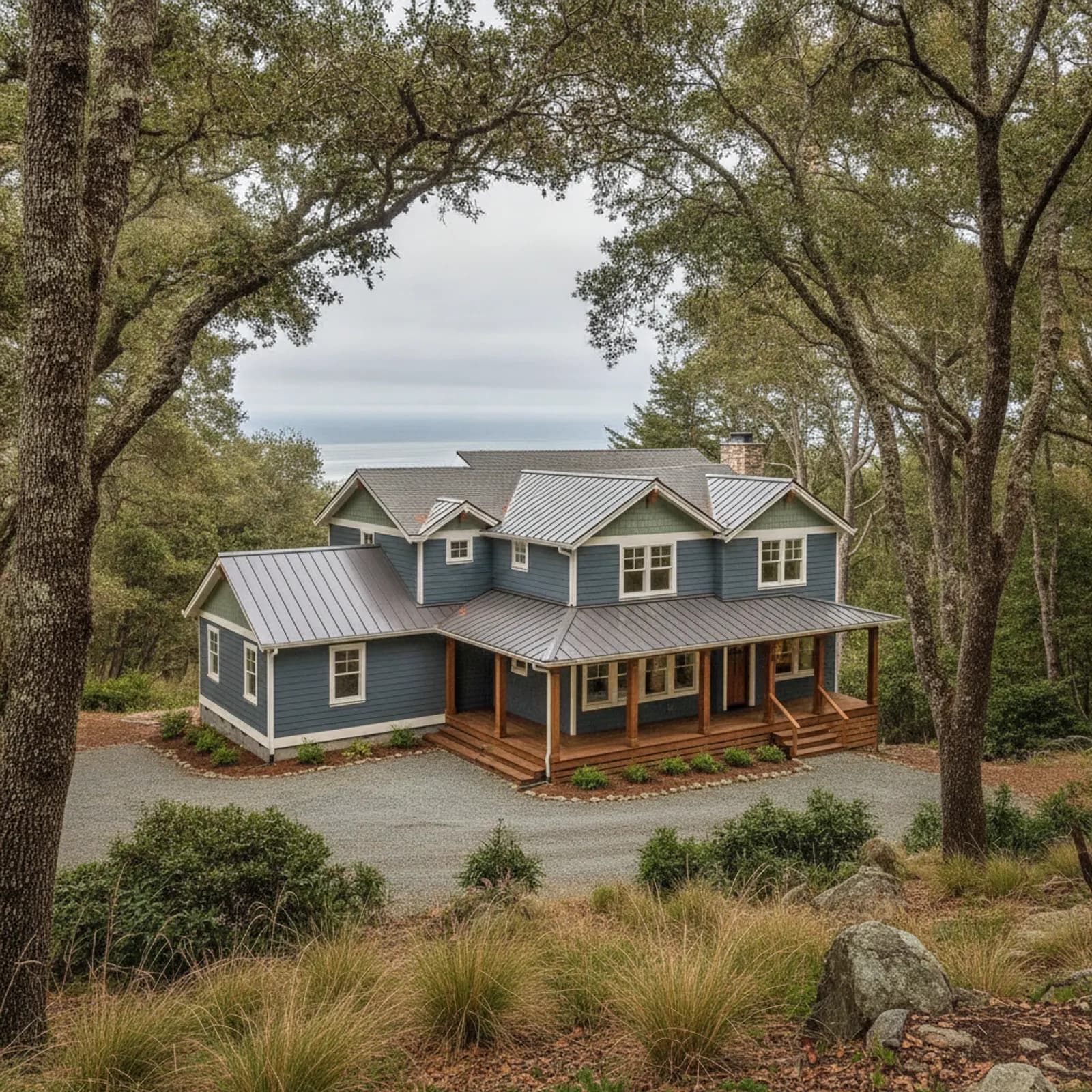
Exterior renovation in Corralitos
Corralitos sits in the wooded foothills above Watsonville, where the Pajaro Valley orchard country climbs into the oak and redwood ridges of the southern Santa Cruz Mountains. That transitional setting defines the work here: Corralitos homes carry real wildfire exposure as the canyons and wooded slopes dry out each fall, yet they also live in the cool, damp marine-influenced air that rolls up from the valley and the coast. For Corralitos homeowners an exterior project means building a wall that resists embers and keeps drying at once, and that foothill-meets-coast combination, not a single concern, drives the material and detailing we put on the home.
Why Corralitos siding wears the way it does
A lot of Corralitos is working and former orchard and farm land, where the house shares a parcel with barns, sheds, and the surrounding vegetation, and that setting shapes how the exterior ages and what a re-side has to answer. Marine-influenced fog from the Pajaro Valley keeps shaded canyon and north-facing walls wet much of the year, so the decades-old wood, board-and-batten, or shingle siding common here holds foothill damp behind it and slowly rots. Then the wooded slopes cure into a real fuel load each fall, turning that same combustible cladding into an ignition liability as a wind-driven fire pushes embers up the canyons. Non-combustible fiber cement over a drying-capable drainage plane, with attentive eave, soffit, and vent detailing, retires both problems at once, and we extend that thinking to how the house relates to its outbuildings and vegetation across a working parcel.
Considering an exterior project in Corralitos?
Corralitos housing and architecture
Corralitos's stock is wooded foothill custom homes on sloped lots, orchard and farm properties with houses and outbuildings, rural acreage and ranch homes, and older country cottages clustered near the little Corralitos store and the creek. Many of these homes wear decades-old wood, board-and-batten, or shingle siding that has held foothill damp behind it for years and now sits in steadily worsening fire terrain. We respect the rural, country character with appropriate lap and trim profiles where the exposure allows, but on a wooded Corralitos slope the material's fire and moisture performance leads the decision, with farm-property outbuildings often needing the same honest assessment as the main house.
Corralitos's foothill-and-marine climate
Corralitos lives at a meeting point: marine-influenced air from the Pajaro Valley and the coast keeps it cool and damp, with fog and humidity that hold moisture in shaded canyon and north-facing walls, while the wooded foothill slopes cure into a real fuel load once the summer rains end. That is the tension that controls the spec here — the exterior has to dry a wall that stays wet much of the year and resist the ember exposure a wind-driven fire pushes up the canyons. It is a milder version of the demand the deeper mountains face, but it is genuinely both fire and moisture, not one or the other.
Fire-aware hardening in Corralitos
Corralitos warrants serious, fire-aware detailing rather than the most extreme regimen, reflecting its elevated but not extreme exposure on wooded foothill slopes above Watsonville. That means non-combustible fiber cement with attentive detailing at eaves, soffits, vents, decks, and ground-to-wall transitions, recognizing that brush- and tree-filled canyons drive ember exposure in a wind event. On orchard and ranch properties we extend that thinking to how the house relates to outbuildings and vegetation. We will not recommend combustible cladding on a wooded Corralitos lot, and we are honest that the detailing, not any single product, is what hardens a home.
Recommended materials for Corralitos
Non-combustible fiber cement, including James Hardie, over a well-detailed and drying-capable drainage plane is our recommended system for Corralitos. The case is twofold: the fire exposure on the wooded slopes makes combustible wood or shingle a poor choice, and fiber cement also handles the marine-influenced foothill damp that keeps shaded walls wet, so it answers both stressors with one assembly. The drainage plane and flashing keep a slow-drying canyon wall venting, while the non-combustible material and careful eave and vent detailing carry the fire-aware side. For Corralitos's foothill-meets-coast exposure, that combination is the sound, durable choice.
What an exterior project costs in Corralitos
Corralitos project cost is shaped by fire-aware detailing, moisture management, and the access realities of rural wooded and orchard properties. Sloped lots, long driveways, soft seasonal ground, and farm layouts with outbuildings all affect how material and scaffolding reach the wall. Substrate and rot discovery is common on older country homes that have held foothill damp behind aging wood, and the eave, soffit, vent, and ground-transition detailing is deliberate scope rather than an add-on. We assess each property on site, account for the rural access and any outbuildings in play, and provide a written, itemized estimate that governs the work.
Orchard properties and outbuildings
A lot of Corralitos is working and former orchard and farm land, where the home shares a property with barns, sheds, and other structures. That changes how we think about an exterior project: hardening and weatherproofing the main house is the priority, but the relationship between the house, its outbuildings, and the surrounding vegetation matters to how the whole property performs in a fire or a wet winter. We scope the house honestly first and talk through the property as a system, so owners understand where re-siding delivers the most value across a working Corralitos parcel.
Wooded slopes and rural access
Working in Corralitos is partly a logistics problem. The community spreads across wooded foothill slopes reached by narrow country roads and long, sometimes steep driveways, with ground that turns soft in the wet season. All of that shapes how we land material, set scaffolding, and protect a site and its defensible space. We plan that access deliberately as part of Corralitos scope rather than improvising on day one, because rushed staging on a steep, wet wooded lot is exactly where the fire and moisture detailing quietly slip.
Santa Cruz County, private wells, and Aptos-La Selva Fire
Working exteriors in Corralitos coordinates with a few local authorities. Corralitos is unincorporated Santa Cruz County — there is no city government, so building permits come through the Santa Cruz County Planning Department rather than a municipal department. Electric and gas are PG&E, and the wooded foothill corridor is documented high-PSPS territory. Water on most parcels comes from private wells or small mutual systems, with the Pajaro Valley Water Management Agency managing regional groundwater. Fire response is the Aptos-La Selva Fire Protection District (which extends coverage into the Corralitos corridor) alongside CAL FIRE San Mateo-Santa Cruz Unit (CZU) on wildland calls into the surrounding foothill and toward the Loma Prieta corridor.
HZ10 and the Loma-Prieta-corridor FHSZ reality
Corralitos is in James Hardie's HZ10 climate zone; installing HZ5 is a documented warranty misapplication. On the fire side, essentially every parcel in and around Corralitos sits in High or Very High FHSZ territory under California's 2025 LRA Fire Hazard Severity Zone map — the community sits on wooded foothill terrain climbing toward the Santa Cruz Mountains and the Loma Prieta corridor. The 2009 Loma Prieta Fire (3,138 acres) burned adjacent ground and destroyed 35 structures; the 2020 CZU Lightning Complex burned the western half of the county. On these parcels the 2025 California Wildland-Urban Interface Code governs the exterior wall. Chapter 7A moved into the standalone WUI Code on January 1, 2026.
Our process in Corralitos
- Step 1
Consultation
We listen to your goals and assess your home on site — exposure, substrate, and architecture.
- Step 2
Design & Proposal
A clear written proposal with the right system specified for your climate and a transparent scope.
- Step 3
Expert Installation
Trained crews install to manufacturer best practices with careful weather-management detailing.
- Step 4
Walkthrough & Support
A final walkthrough, full cleanup, and a clear written record of the scope completed — work we stand behind.
In Corralitos the exterior has to answer both the wooded foothill fire exposure and the damp marine-influenced air at once, and we build to that standard on both counts. We scope every Corralitos project on site, including any outbuildings and rural access, and your written, itemized estimate governs the work.
FAQ
Corralitos — Common Questions
Elevated — Corralitos sits on wooded foothill slopes above Watsonville where canyons and brush dry into a real fuel load each fall, so we apply serious, fire-aware detailing here.
Non-combustible fiber cement, including James Hardie, with attentive eave, soffit, vent, and ground-transition detailing over a drying-capable drainage plane for the foothill damp.
Yes — marine-influenced air and fog from the Pajaro Valley keep shaded canyon and north-facing walls wet much of the year, so drying-capable drainage detailing is essential alongside the fire strategy.
Re-cladding aging wood, board-and-batten, or shingle in non-combustible fiber cement addresses both the worsening fire exposure and the foothill damp in one project.
We assess them honestly as part of the property — the main house is the priority, but we talk through how the house, outbuildings, and vegetation relate so re-siding delivers the most value.
We do not recommend it on a wooded Corralitos lot given the elevated fire exposure, and fiber cement also handles the foothill damp, so it is the sound choice on both counts.
Yes — narrow country roads, long or steep driveways, and soft seasonal ground are routine, explicitly planned parts of Corralitos scope.
A correctly installed, well-drained fiber cement system commonly performs 30+ years while reducing ignition risk on the wooded foothill slopes.
Explore
Exterior Services
Helpful Exterior Guides