
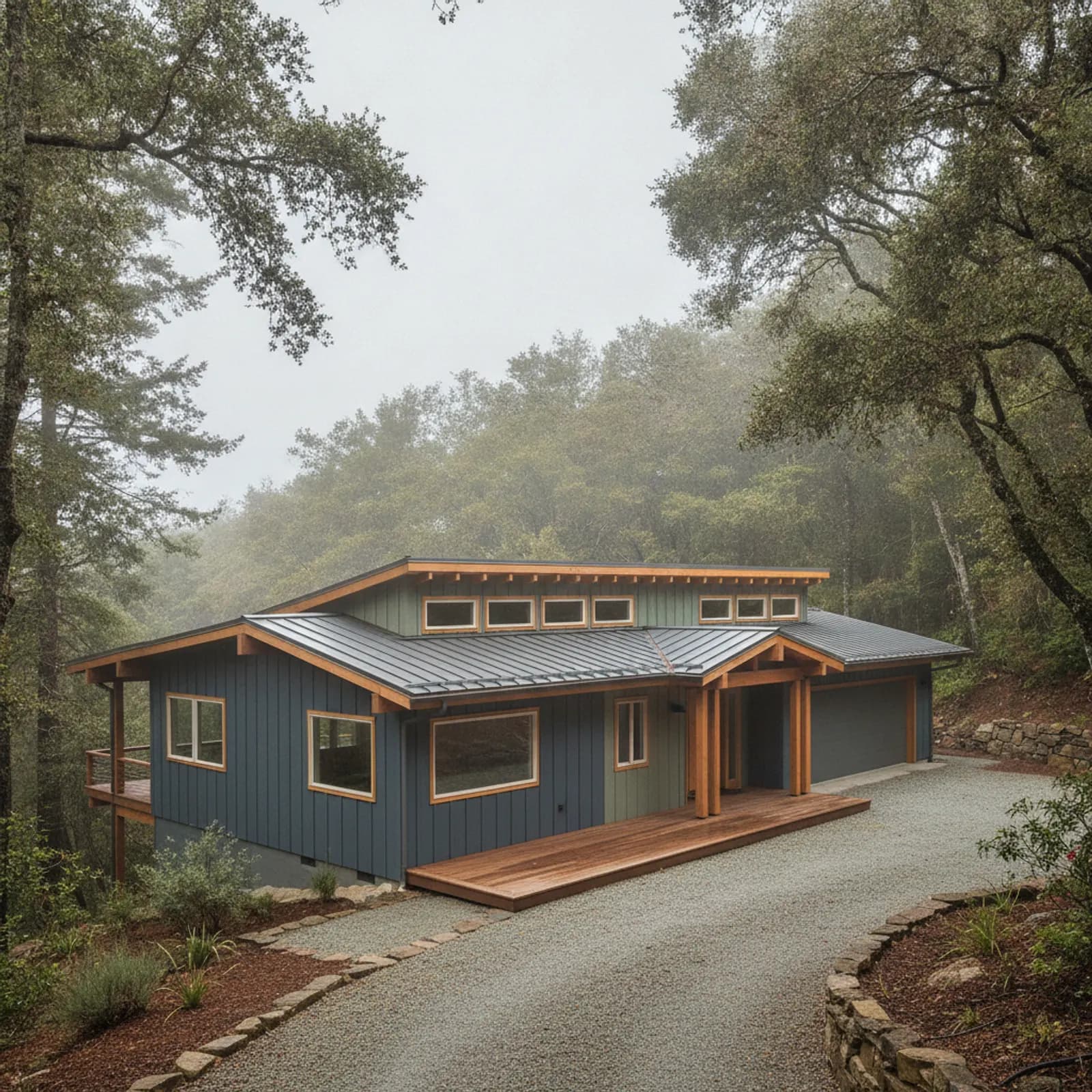
Exterior Contractor in Corralitos
In Corralitos the exterior is a defense and drainage system at once, and a single-trade bid almost never owns the interfaces that matter. These wooded foothill and orchard homes above the Pajaro Valley face two stresses no single crew tends to coordinate: ember intrusion on the brush-adjacent slopes and slow-drying canopy moisture on every shaded elevation. The value of one exterior contractor here is treating cladding, vents, eaves, trim, and window flashing as one assembly.
Most foothill homes that fail don't fail at the board — they fail at a junction no one trade owned: an unsealed vent, an eave never closed in, a window perimeter that wicks fog, or a ground transition open to landscape contact. When one contractor scopes all of it together, none of those interfaces is left to a follow-up trade that may never come back.
What an integrated Corralitos exterior includes
On a Corralitos re-side the cladding is only the visible layer. An integrated scope strips combustible siding, corrects the weather-resistive barrier for a canopy-damp lot, replaces ember-vulnerable vents with ember-resistant equivalents, hardens eave and soffit detailing, integrates window flashing into the new WRB, and details the ground-to-wall transition with non-combustible base trim and clearance from the orchard and brush. The fire detailing and the drying detailing get specified by the same hand, so they actually meet at the corners instead of fighting each other.
Where the split-trade exterior fails here
We see the same foothill failure repeatedly: fresh non-combustible cladding installed cleanly by a siding crew, but the original vents left in place, the eaves never enclosed, and the window perimeters flashed to no consistent plane. The home looks hardened from the orchard drive and isn't, because defense and drainage were treated as a cladding decision rather than an envelope decision. On a shaded, brush-adjacent Corralitos lot, those orphaned junctions are exactly where embers get in and where fog-driven rot starts.
Coordinating trades on rural acreage
Corralitos sites carry their own logistics. Homes sit back on deep orchard and hillside acreage off long gravel drives, often with barns and outbuildings to work around and limited staging room. An integrator sequences tear-off, dry-in, window setting, flashing, cladding, and the hardening details so the wall is never left open through a foggy night and so the few suppliers willing to climb the canyon roads only make the trip when the site is ready. Confirming lines and setbacks near actively farmed neighboring parcels happens once, up front, not mid-project.
Older orchard homes and hillside customs as whole envelopes
The integration job differs by stock. The older farm and orchard homes near the village often hide layered board, brittle felt, and asbestos-suspect material, so the envelope scope starts with careful removal and substrate repair before any new assembly goes on. The newer hillside customs are detail-rich and want their profiles and trim preserved while the concealed metal, vents, and eaves come up to current foothill standard. In both, the contractor's real work is the coordination problem across cladding profile, flashing plane, ember detailing, and trim — the part sequential single-trade bids consistently drop.
Why this matters in Corralitos
- Specified for Santa Cruz Mountains / Pajaro Valley conditions
- non-combustible fiber cement as the recommended system
- Correctly detailed weather-resistive barrier and flashing
- Installed by a crew with 20 years combined experience
Recommended systems for Corralitos
- non-combustible fiber cement
- James Hardie
- fire-aware detailing
- drainage-plane detailing
Exterior Contractor for Corralitos homes
The full exterior contractor approach — materials, weather-resistive detailing, and the manufacturer standards we install to — is covered on the main service page, then specified for Corralitos's conditions on this one.
Our Corralitos process
- Step 1
Consultation
We listen to your goals and assess your home on site — exposure, substrate, and architecture.
- Step 2
Design & Proposal
A clear written proposal with the right system specified for your climate and a transparent scope.
- Step 3
Expert Installation
Trained crews install to manufacturer best practices with careful weather-management detailing.
- Step 4
Walkthrough & Support
A final walkthrough, full cleanup, and a clear written record of the scope completed — work we stand behind.
FAQ
Exterior Contractor in Corralitos — FAQ
Because the failures here happen at the interfaces — vents, eaves, window flashing, ground transitions — that no single trade owns. One contractor scoping cladding, openings, and hardening together closes those gaps; sequential bids leave them open.
Vents and eaves. Cladding gets the attention because it's visible, but on these brush-adjacent foothill lots most embers enter through soffit vents, dryer terminations, and unsealed eaves. An integrator scopes those into the same project.
Yes — that's the point of one contractor. The drying detailing for the canopy moisture and the ember hardening for the slopes get specified together so they meet correctly at every corner and penetration.
Yes — we plan staging, deliveries, and sequencing around long gravel drives, barns, and active orchard rows, and confirm property lines near farmed neighboring parcels before scaffolding goes up.
Most single-family homes run four to seven weeks of active work depending on size, story count, the level of fire-hardening detail, and what tear-off uncovers on older orchard homes. We schedule realistically and flag which scope items drive the timeline.
Keep Exploring
More for Corralitos homeowners
Nearby Service Areas
Exterior Contractor near Corralitos
Back to
Santa Cruz County & Corralitos
Helpful Exterior Guides