
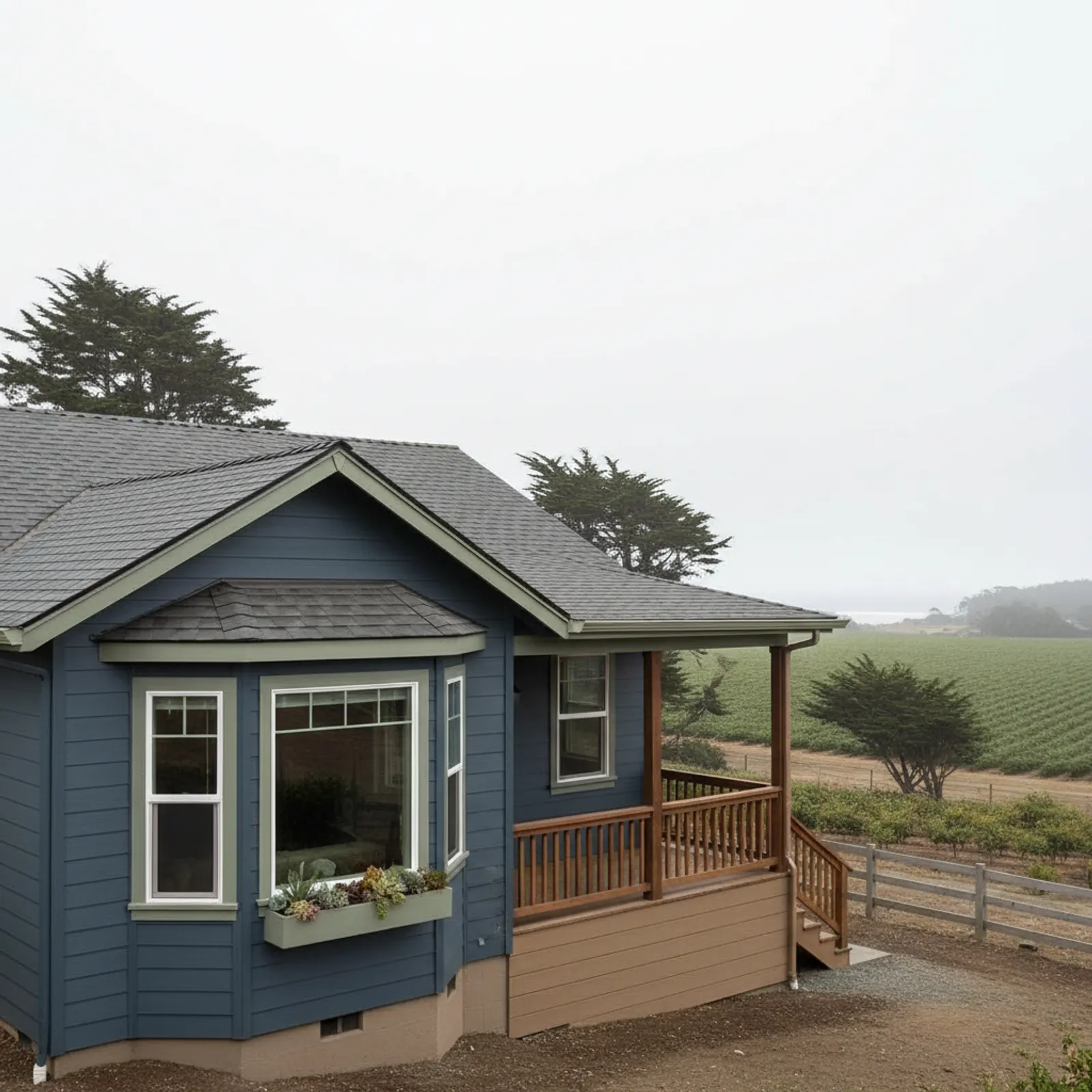
Siding in Watsonville
A Watsonville re-side is a Pajaro Valley problem, not a beachfront one. Inland of the immediate coast, Watsonville is dominated by persistent marine fog and damp with only moderate salt influence — distinct from Santa Cruz's aggressive salt-aerosol corrosion. It's a working agricultural-valley town: ag-valley homes, an older downtown core, and newer tracts, where the brief is durable, practical, moisture-managed work, not coastal-design polish.
So a Watsonville project is scoped around drying capacity first, with corrosion-aware detailing as a sensible secondary measure for the moderate salt.
Marine damp is the controlling factor
Pajaro Valley fog keeps walls wet far more hours than a sunny inland town; Watsonville siding fails from trapped moisture in a non-drying assembly, not the board. We strip, correct moisture-damaged substrate (common on older town homes), and re-clad over a rigorous, drying-capable drainage plane.
Moderate salt, not beachfront corrosion
Watsonville sits back from the surf, so salt is a moderate secondary concern: we specify corrosion-aware fastening and flashing as prudent insurance, without the heavier marine-grade build a Capitola or Santa Cruz beachfront home needs. Honest scoping, no over-spec.
Fog-belt detailing for downtown bungalows and Pajaro tract walls
The split between Watsonville's older downtown core and its newer subdivisions changes how a re-side gets built. The early-century cottages and working-family homes near Main Street and around the East Lake corridor often hide layers of original board, old felt, and sometimes asbestos-suspect material that needs careful removal before any new cladding goes on. Those walls were never built with a drainage gap, so we rework them with a rainscreen-style furred cavity, a self-gapping fiber-cement or engineered-wood profile, and back-vented trim so fog moisture has a path out. The post-1990 tracts on the city's edges usually carry stucco or builder-grade panel that traps damp at sill plates and around windows. There the priority is correct flashing integration, kickout flashing at roof-wall junctions, and a weather-resistive barrier lapped to actually shed water rather than wick it. In both housing types the controlling decision is the same: every penetration and horizontal ledge in this valley has to drain and dry, because Pajaro Valley humidity rarely lets a wet wall recover on its own.
Access, ag-yard lots, and getting the work scheduled around the fog
A practical Watsonville siding job is shaped as much by the lot and the calendar as by the wall itself. Many homes here sit on deep agricultural-valley parcels with outbuildings, fence lines, and limited driveway room, so staging scaffolding, a cut station, and material lifts takes planning that a tight in-town lot doesn't demand. We confirm property lines and any setbacks before staging because adjoining parcels are often actively farmed. Timing matters too: the marine layer that defines this valley means mornings frequently stay damp well past sunrise, and adhesives, caulk, and primer on cut fiber-cement edges need dry, above-dew-point conditions to cure. We sequence tear-off and dry-in so walls are never left open through a fog night, prime every field cut before it goes up, and schedule sealant and paint work for the drier afternoon window. Permitting runs through the City of Watsonville, and like-for-like re-siding is generally straightforward, but structural sheathing repairs uncovered during tear-off can add inspection steps we flag early rather than mid-project.
Why this matters in Watsonville
- Specified for Central Coast / Pajaro Valley conditions
- fiber cement over detailed drainage plane as the recommended system
- Correctly detailed weather-resistive barrier and flashing
- Installed by a crew with 20 years combined experience
Recommended systems for Watsonville
- fiber cement over detailed drainage plane
- corrosion-aware fastening
- durable finishes
Fiber Cement Siding for Watsonville homes
The full fiber cement siding approach — materials, weather-resistive detailing, and the manufacturer standards we install to — is covered on the main service page, then specified for Watsonville's conditions on this one.
Our Watsonville process
- Step 1
Consultation
We listen to your goals and assess your home on site — exposure, substrate, and architecture.
- Step 2
Design & Proposal
A clear written proposal with the right system specified for your climate and a transparent scope.
- Step 3
Expert Installation
Trained crews install to manufacturer best practices with careful weather-management detailing.
- Step 4
Walkthrough & Support
A final walkthrough, full cleanup, and a clear written record of the scope completed — work we stand behind.
FAQ
Siding in Watsonville — FAQ
Yes — Watsonville is inland Pajaro Valley: fog-and-damp dominated with only moderate salt, versus Santa Cruz's aggressive beachfront salt-aerosol corrosion. Drying capacity leads here.
Almost always trapped marine moisture from a poor drainage plane and flashing in the foggy Pajaro Valley — not the cladding alone. A drying-capable assembly fixes the root cause.
Usually not to beachfront levels — moderate salt here warrants corrosion-aware fastening and flashing as prudent insurance, not the heavier build a surf-front home needs. We scope honestly.
Low — Watsonville is flat agricultural valley floor; moisture, not fire, is the controlling factor. Non-combustible fiber cement is still a sound, low-regret default.
Yes — the older town core and the newer tracts share the same damp climate; the detailing approach is the same drying-capable assembly tuned to each home.
Keep Exploring
More for Watsonville homeowners
More in Watsonville
Other exterior services in Watsonville
Back to
Santa Cruz County & Watsonville
Helpful Exterior Guides