Fire-Resistant Siding in Watsonville
Direct answer: Watsonville is flat Pajaro Valley agricultural floor with low wildfire exposure — moisture, not fire, is the controlling factor. Fire-resistant siding here is a low-regret choice, not a need, and we won't manufacture urgency for a Watsonville address.
Watsonville's housing footprint sits in flood-plain agricultural terrain with no canyon, no forested-edge parcel, and no meaningful brush adjacency in the developed city core. The honest scope is moisture-management cladding with Class A non-combustibility riding along as a no-cost byproduct of fiber cement selection.
Watsonville's exposure reality
Watsonville's ag-valley homes, older downtown, and newer tracts carry low wildfire exposure — this is developed valley floor, not foothill or wildland terrain. We tell Watsonville owners plainly that marine moisture is their real concern.
Bundled with the floodplain base-of-wall fix
Watsonville's controlling problem is Pajaro-Valley ground damp rotting the base of the wall — the fix is strict clearance and a drying-capable plane. Class A non-combustibility comes free with the fiber cement that solves that; on developed valley floor it's a margin, never a manufactured concern.
Why fiber cement earns its keep in the Pajaro Valley fog
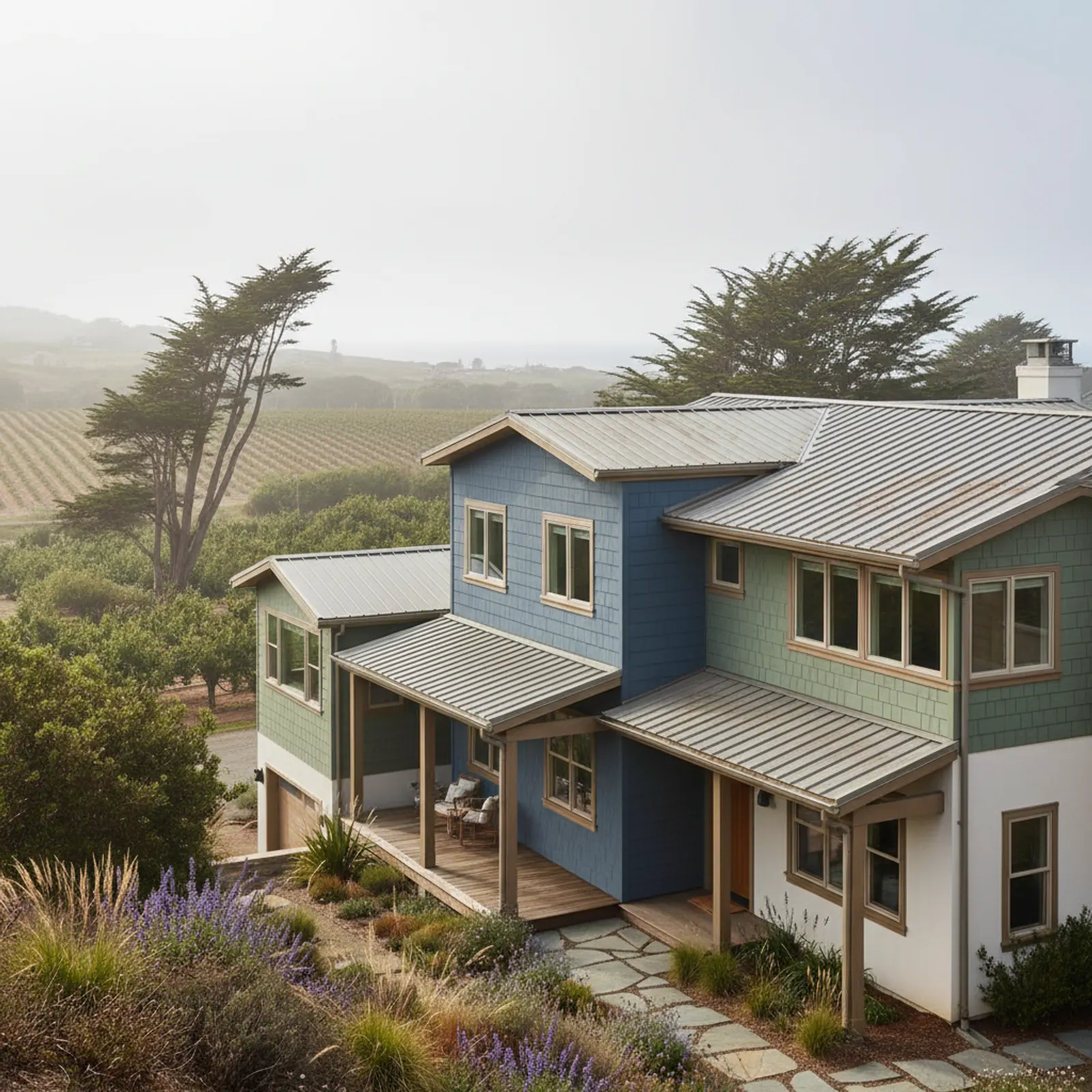
On a Watsonville address, the case for fire-resistant cladding is rarely about flames. It is about choosing a material that survives the Pajaro Valley's persistent marine humidity and shrugs off the Class A fire rating as a bonus. Fiber cement does both. The fog that pools across this farm-floor city, with the bay on one flank and the hills rising on the other, keeps exterior walls damp for long stretches, and the salt that drifts inland accelerates fastener corrosion and finish breakdown on lesser products. Wood and vinyl pay for that exposure with cupping, swelling, and peeling; fiber cement does not feed mold, does not absorb water the way wood does, and holds paint through repeated wet-dry cycles. So when a homeowner here asks about fire-rated siding, the practical answer is that the same panel delivering a non-combustible wall assembly also delivers the moisture resilience this humid valley genuinely demands. You buy the fire performance and get a cladding engineered for fog and salt at the same time, which is the inversion that makes the spec sensible for a low-wildfire town.
Working-family neighborhoods and older downtown stock
Watsonville's housing splits into distinct repair pictures. The older town homes near downtown often wear original wood lap or stucco that has weathered decades of valley damp, where re-siding doubles as a chance to correct rot at sills, window heads, and the lower courses that wick ground moisture first. The working-family neighborhoods carry a mix of mid-century and infill construction where budget matters and a single durable cladding choice has to last without frequent repainting. The newer subdivisions on the city's edges already lean on fiber cement, so matching profiles and trim for a partial replacement is usually straightforward. Across all three, the fire-resistant panel is the same product; what changes is the prep. Downtown jobs demand careful inspection of the existing sheathing and flashing before anything new goes up, because covering hidden moisture damage only buys you a delayed failure. We scope each block of the project to what the wall is actually doing in this valley, rather than treating a Watsonville house like a foothill parcel that genuinely needs defensible-space hardening.
Why this matters in Watsonville
- Specified for Central Coast / Pajaro Valley conditions
- fiber cement over detailed drainage plane as the recommended system
- Correctly detailed weather-resistive barrier and flashing
- Installed by a crew with 20 years combined experience
Recommended systems for Watsonville
- fiber cement over detailed drainage plane
- corrosion-aware fastening
- durable finishes
Fire-Resistant Siding for Watsonville homes
The full fire-resistant siding approach — materials, weather-resistive detailing, and the manufacturer standards we install to — is covered on the main service page, then specified for Watsonville's conditions on this one.
Our Watsonville process
- Step 1
Consultation
We listen to your goals and assess your home on site — exposure, substrate, and architecture.
- Step 2
Design & Proposal
A clear written proposal with the right system specified for your climate and a transparent scope.
- Step 3
Expert Installation
Trained crews install to manufacturer best practices with careful weather-management detailing.
- Step 4
Walkthrough & Support
A final walkthrough, full cleanup, and a clear written record of the scope completed — work we stand behind.
FAQ
Fire-Resistant Siding in Watsonville — FAQ
Watsonville is low-exposure valley floor and moisture-driven, so it's a low-regret upgrade rather than a necessity. We won't overstate fire risk for this address.
Low — flat Pajaro Valley agricultural floor with no significant wildland interface. Marine moisture is the controlling factor.
No — the fiber cement we recommend for Watsonville's moisture durability is already non-combustible, so Class A performance is included.
Drying capacity — a rigorous drainage plane and flashing — plus moderate corrosion-aware detailing; that's what actually fails on damp Pajaro Valley homes.
Keep Exploring
More for Watsonville homeowners
More in Watsonville
Other exterior services in Watsonville
Nearby Service Areas
Fire-Resistant Siding near Watsonville
Back to
Santa Cruz County & Watsonville
Helpful Exterior Guides