Fiber Cement Siding in Watsonville
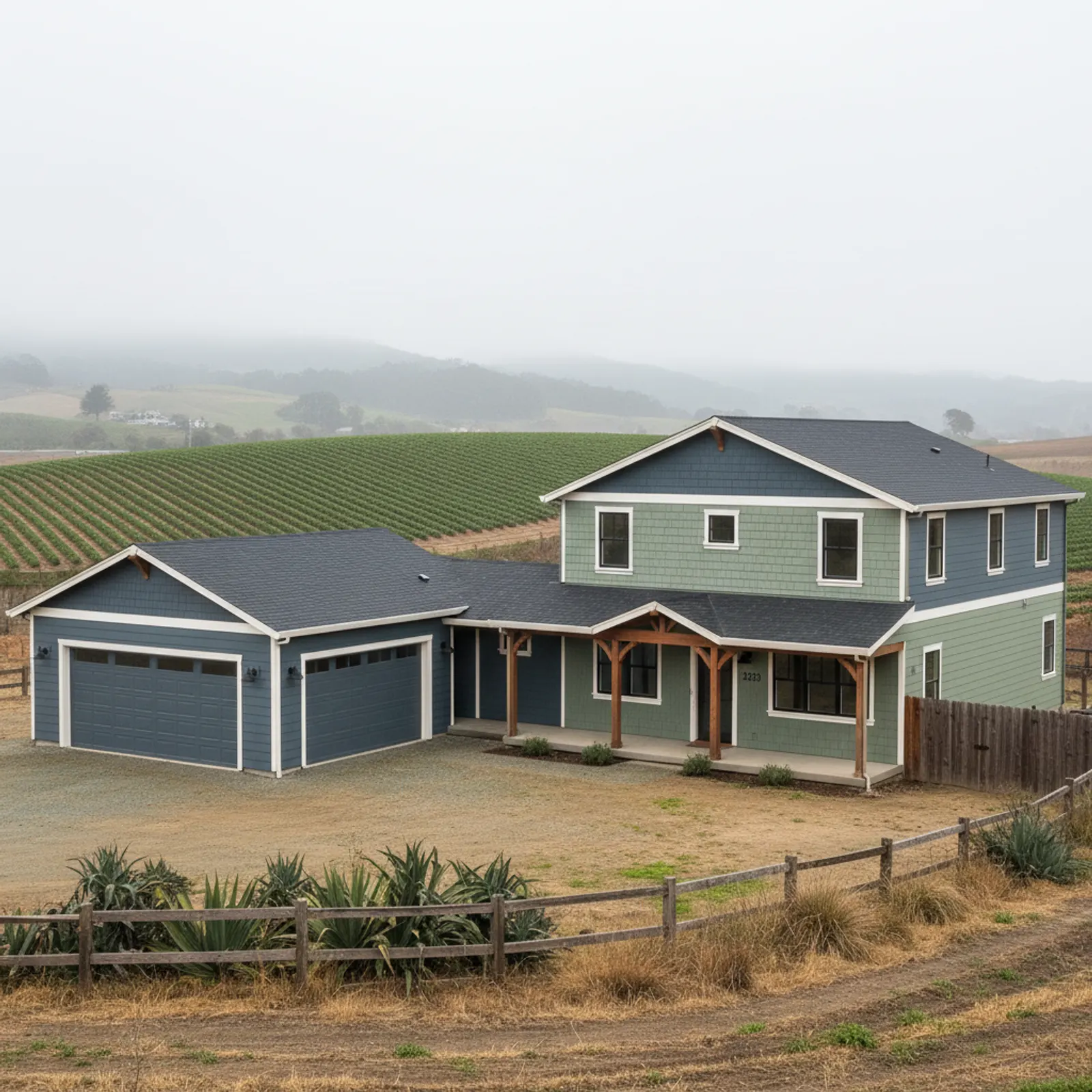
Fiber cement is the core Watsonville recommendation because it resists the Pajaro Valley's persistent marine damp far better than the original wood on the town's older homes, and it shrugs off the moderate salt — a durable, practical re-clad for a working agricultural-valley market.
Built for fog, not just looks
Watsonville's near-constant marine damp decays wood and degrades its finish; fiber cement over a drying-capable plane holds shape and color far longer, ending the rot-and-repaint cycle on a practical ag-valley budget.
Corrosion-aware, appropriately scoped
For the moderate Watsonville salt we pair the board with corrosion-aware fasteners and flashing — sensible insurance without the heavier marine-grade build (and cost) a beachfront home would need.
The base of the wall is the risk
Pajaro-Valley fog and a high water table keep the bottom of a Watsonville wall wet long after the air dries — that's where fiber-cement exteriors fail here. We hold ground clearance strictly and build a genuinely drying-capable plane, because the lowest 18 inches is the whole job.
From old-town bungalows to Pajaro Valley tracts
Watsonville is not one housing stock but several, and fiber cement earns its place differently in each. In the older neighborhoods near the downtown core, many homes still wear original wood lap that has cycled through decades of fog and repainting; here a re-clad means careful removal, inspection of sheathing that has stayed damp, and matching narrow board profiles so the street character holds. In the newer subdivisions toward the valley edges, the work leans toward replacing builder-grade composite or thin lap that swelled at the seams, and we can run wider exposures cleanly. The agricultural-valley homes scattered between often mix additions of different eras, which means transitions and trim details get more attention than the field itself. Because fiber cement is dimensionally stable, it suits all three: it lets a 1920s cottage keep its proportions and lets a tract home get a crisper, longer-lasting face. The common thread is matching board to the home's real character rather than forcing one look across very different Watsonville streets.
Detailing the wall to drain in a foggy valley
In a basin where marine humidity lingers and morning fog drips long after sunrise, the board itself is only half the job. Watsonville walls dry slowly, so the assembly behind fiber cement has to give trapped moisture a way out. That shapes how we sequence the work: a water-resistive barrier lapped correctly, a gap or drainage plane so the back of the board is not pinned against wet sheathing, and head flashing over every window and door rather than relying on caulk to hold back valley damp. Penetrations get particular care, since fog finds gaps that a drier climate would forgive. Joints are flashed or backed instead of simply butted and sealed, because sealant alone fails first in this kind of persistent humidity. The payoff is a wall that handles the Pajaro Valley's slow-drying conditions without staining or swelling at the laps. Done this way, fiber cement in Watsonville is less about the panel and more about building a cladding system that expects the fog and routes water away from it.
Why this matters in Watsonville
- Specified for Central Coast / Pajaro Valley conditions
- fiber cement over detailed drainage plane as the recommended system
- Correctly detailed weather-resistive barrier and flashing
- Installed by a crew with 20 years combined experience
Recommended systems for Watsonville
- fiber cement over detailed drainage plane
- corrosion-aware fastening
- durable finishes
Fiber Cement Siding for Watsonville homes
The full fiber cement siding approach — materials, weather-resistive detailing, and the manufacturer standards we install to — is covered on the main service page, then specified for Watsonville's conditions on this one.
Our Watsonville process
- Step 1
Consultation
We listen to your goals and assess your home on site — exposure, substrate, and architecture.
- Step 2
Design & Proposal
A clear written proposal with the right system specified for your climate and a transparent scope.
- Step 3
Expert Installation
Trained crews install to manufacturer best practices with careful weather-management detailing.
- Step 4
Walkthrough & Support
A final walkthrough, full cleanup, and a clear written record of the scope completed — work we stand behind.
FAQ
Fiber Cement Siding in Watsonville — FAQ
Yes — over a drying-capable plane it resists the persistent Pajaro Valley marine damp far better than wood, holding finish and shape for decades.
Markedly — it resists moisture-driven decay the damp valley inflicts on wood and removes the recurring rot-and-repaint cycle.
No — moderate salt here warrants corrosion-aware fastening and flashing, not full beachfront marine-grade build. We scope it appropriately to control cost.
Slowly — the cool, often-overcast valley is gentle on factory finish; the substrate keeps performing well beyond any eventual refresh.
Keep Exploring
More for Watsonville homeowners
More in Watsonville
Other exterior services in Watsonville
Nearby Service Areas
Fiber Cement Siding near Watsonville
Back to
Santa Cruz County & Watsonville
Helpful Exterior Guides