
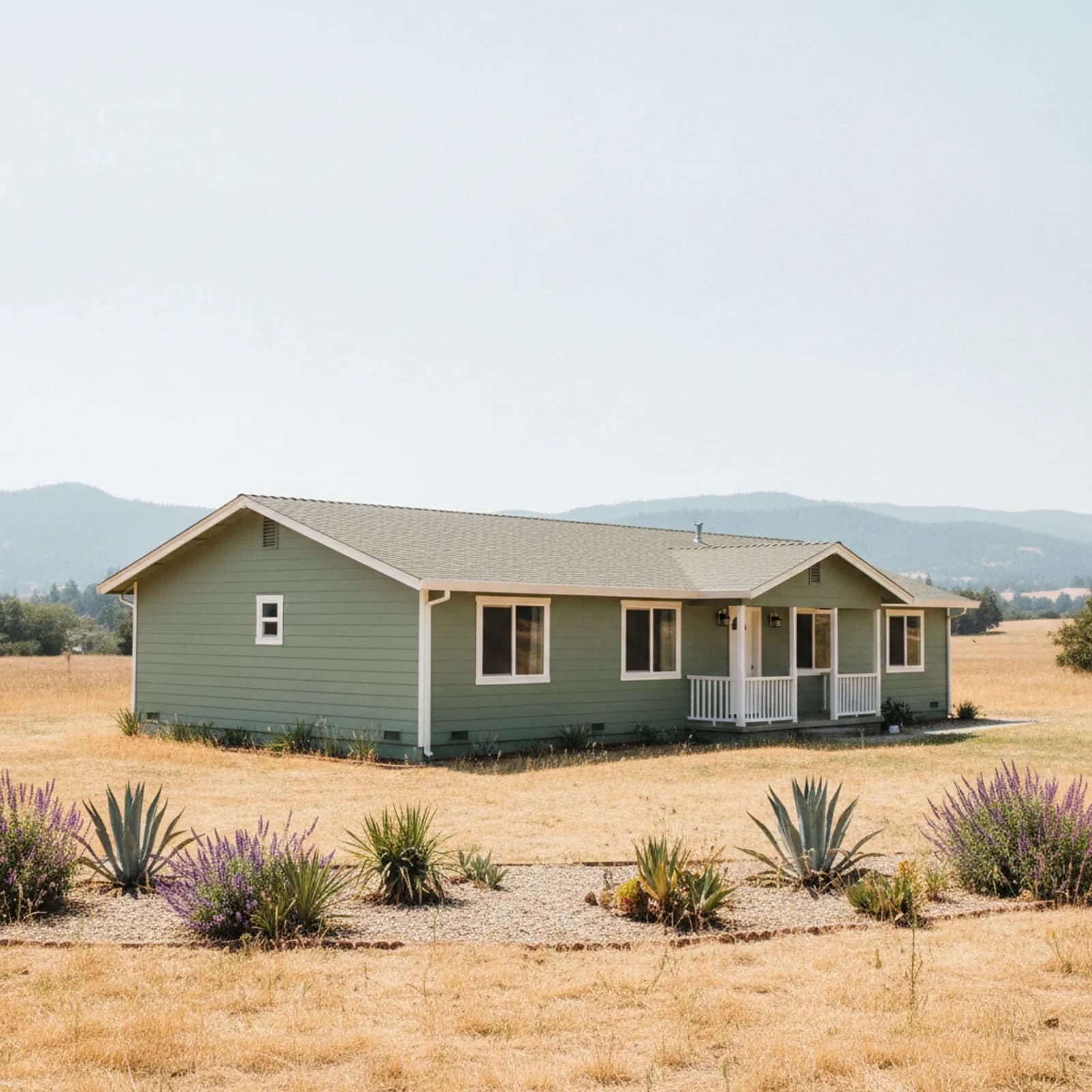
Exterior work in Anderson
Anderson grew up where the lumber industry met the railroad and old Highway 99 — today's Highway 273 — on the Sacramento River about ten miles below Redding. It is still a working town: Sierra Pacific Industries operates a major mill here, the Shasta District Fair calls Anderson home every June, and Anderson River Park gives the city a front porch on the river. The housing matches that history — cottage-scale homes on the old grid between 273 and the tracks, post-war bungalows, ranch-style subdivisions from the 1970s through the 1990s filling in toward Interstate 5, and rural properties running west toward Happy Valley and south toward Cottonwood.
Two seasons, both hard on walls
What separates Anderson from the valley towns farther south is that it gets punished twice a year. Summer runs at Redding intensity — triple-digit stretches that cook the resins out of old hardboard and bleach whatever color the last paint job had. Then winter arrives with real rain: the top of the Sacramento Valley catches storm systems the mid-valley never sees, and Anderson's annual totals run close to double Sacramento's. Cladding that only solves the sun problem rots at its laps and butt joints by February; cladding that only sheds water fades and moves in July. The spec has to hold both lines, and that's the lens we bring to every Anderson wall.
Considering an exterior project in Anderson?
Anderson's building stock
The oldest walls in town belong to the mill-era cottages and bungalows near 273, and they are the most interesting to open up — it's common to find two or three generations of siding layered over the original shiplap, each applied over the previous one's problems. The post-war and 1970s-1990s ranch neighborhoods are simpler: one layer of hardboard or plywood panel at the end of its service life, over framing that's usually sound. Manufactured and modular homes make up a real share of the local market and deserve straight answers about what re-siding them does and doesn't accomplish. Out toward the ag land, farmhouses and shop buildings round out a stock that rewards practical, durable choices over showpiece detailing.
North-valley heat, Klamath-fed winters
Anderson sits in the Sacramento Valley's hot northern pocket, where the surrounding mountains trap summer air and afternoon readings routinely top 100 and spike well beyond it. That heat drives the material conversation: dimensional stability, factory-cured color, and fastening schedules that accommodate daily expansion cycles. But the second conversation matters just as much here — winter systems dropping out of the Klamath country deliver serious water, and wind-driven rain finds every unflashed penetration and every gap where a builder relied on caulk. Our Anderson assemblies get the full wet-climate treatment: continuous weather barrier, head flashing at every opening, kickout flashing where rooflines meet walls, and clearances at grade that keep the bottom course out of splash and soil.
A grounded view of fire risk in Anderson
Anderson's in-town neighborhoods sit on irrigated valley floor between the river and the freeway, and we won't invent a wildfire problem for them — the working risks there are sun and water. The picture shifts on the rural west and south margins, where parcels meet the oak-and-grass country rising toward Happy Valley and Cottonwood; those properties see seasonal ember exposure when grass fires run in a dry summer, and the Carr Fire's 2018 push into west Redding showed everyone in Shasta County how quickly the interface can matter. For edge parcels we default to cladding that doesn't burn and tighten vent and wall-base details; for the town core we simply note that fiber cement's fire rating comes free with the material we'd recommend anyway.
What we install in Anderson
Factory-finished fiber cement earns its place here twice over — the color survives the north-valley sun years longer than site-applied paint, and the material itself doesn't care about the swing between a 108-degree August and a saturated January. Hardie products for this area carry the HZ10 engineering, built for exactly this hot-dry-then-wet cycling. Profile choice follows the house: traditional lap widths suit the mill-era cottages, wider laps and simple trim suit the ranch stock, and vertical panel treatments give the plainer 1980s elevations some architecture they never had. Where an owner wants wood's look without its upkeep, textured fiber cement gets there; where budget rules, we'd rather trim the scope than substitute a lesser cladding.
What moves an Anderson bid
The spread between a low and a high Anderson quote usually comes down to three discoveries: how many siding layers are on the wall (the old-grid cottages can carry several, and hauling off layered material is real cost), what shape the sheathing and framing are in underneath, and how much flashing correction the openings need — plenty of 1980s windows here were installed with caulk doing flashing's job. River-adjacent and rural properties add their own factors, from moisture-heavy detailing to equipment access on acreage. We build the scope with you line by line after walking the house; a bid assembled from assumptions instead of a site visit is a bid that changes later, and we don't work that way.
The old grid between 273 and the river
Anderson's original neighborhoods — the compact blocks around the 273 corridor — hold the town's most character-rich and most deferred housing. These cottages reward a modest, correct restoration: a clean lap at a traditional exposure, real corner and casing trim, and a color that belongs on a 1940s house. Demolition is where the money hides, in layered sidings and patched-over water damage, so we price these with inspected allowances rather than optimistic guesses. The payoff is outsized — on these streets, one correctly re-sided cottage visibly lifts the whole block.
River parcels and the park end of town
Homes near Anderson River Park and along the river corridor live with more moisture than the rest of town — morning fog off the water, higher ambient humidity, and irrigation on lush lots. The cladding doesn't change, but the assembly around it does: extra attention to ground clearance, gutter and downspout coordination, and ventilation behind trim buildups so damp air doesn't sit against the wall. It's inexpensive insurance when specified upfront and a rot repair when discovered later.
City of Anderson, city utilities, and Anderson Fire
Working exteriors in Anderson coordinates with a few local authorities. Building permits come through the City of Anderson Community Development Department (Anderson is one of Shasta County's three incorporated cities alongside Redding and Shasta Lake). Electric and gas are PG&E, and the entire Sacramento River corridor is documented high-PSPS territory since the 2018 Carr Fire. Water and wastewater are supplied by the City of Anderson municipal utilities. Fire response is the Anderson Fire Protection District alongside CAL FIRE Shasta-Trinity Unit (SHU) on wildland calls into the surrounding grass-and-oak corridor.
HZ10 and the Carr-Fire-adjacent FHSZ reality
Anderson is in James Hardie's HZ10 climate zone; installing HZ5 is a documented warranty misapplication. On the fire side, most Anderson parcels sit in Low or Moderate FHSZ territory under California's 2025 LRA Fire Hazard Severity Zone map, while western and rural parcels running toward the Coast Range and eastern parcels toward Bella Vista pick up Moderate to High designations. The 2018 Carr Fire (229,651 acres, 1,614 structures destroyed just north across the county line) is a plain reminder of what wind-driven Shasta County fire can do. On wildland-adjacent parcels the 2025 California Wildland-Urban Interface Code governs the exterior wall. Chapter 7A moved into the standalone WUI Code on January 1, 2026.
Our process in Anderson
- Step 1
Consultation
We listen to your goals and assess your home on site — exposure, substrate, and architecture.
- Step 2
Design & Proposal
A clear written proposal with the right system specified for your climate and a transparent scope.
- Step 3
Expert Installation
Trained crews install to manufacturer best practices with careful weather-management detailing.
- Step 4
Walkthrough & Support
A final walkthrough, full cleanup, and a clear written record of the scope completed — work we stand behind.
Anderson deserves the same engineering attention as the metro markets — arguably more, since its walls face both the region's hardest sun and its wettest winters. From a mill-era cottage on the old grid to a ranch home near the fairgrounds or acreage toward Cottonwood, we scope on site, price in writing, and build the assembly the north valley actually requires.
FAQ
Anderson — Common Questions
Factory-finished fiber cement is the strongest all-around answer. Anderson combines Redding-level summer heat with winters far wetter than the mid-valley's, and fiber cement is the one mainstream cladding indifferent to both — the factory color resists the UV bleaching that kills paint here, and the material won't swell or rot through the wet season.
It's common in the older grid neighborhoods near Highway 273 and it's manageable, but it affects the bid: every layer comes off so we can inspect and flash the actual wall, and removal plus disposal of that material is genuine scope. We carry an inspected allowance for it rather than surprising you mid-project.
In town, fire isn't the driving risk — heat and moisture are — but the fiber cement we recommend for those reasons is noncombustible anyway. On rural parcels toward Happy Valley or Cottonwood that border open grass and oak country, we take seasonal ember exposure seriously and tighten vent and wall-base detailing accordingly.
Very much so. The top of the Sacramento Valley catches Klamath-fed storm systems, and Anderson's rainfall totals far exceed the drier valley towns to the south. That's why our assemblies here emphasize continuous weather barriers, head and kickout flashing, and grade clearances — details that are optional elsewhere and essential here.