
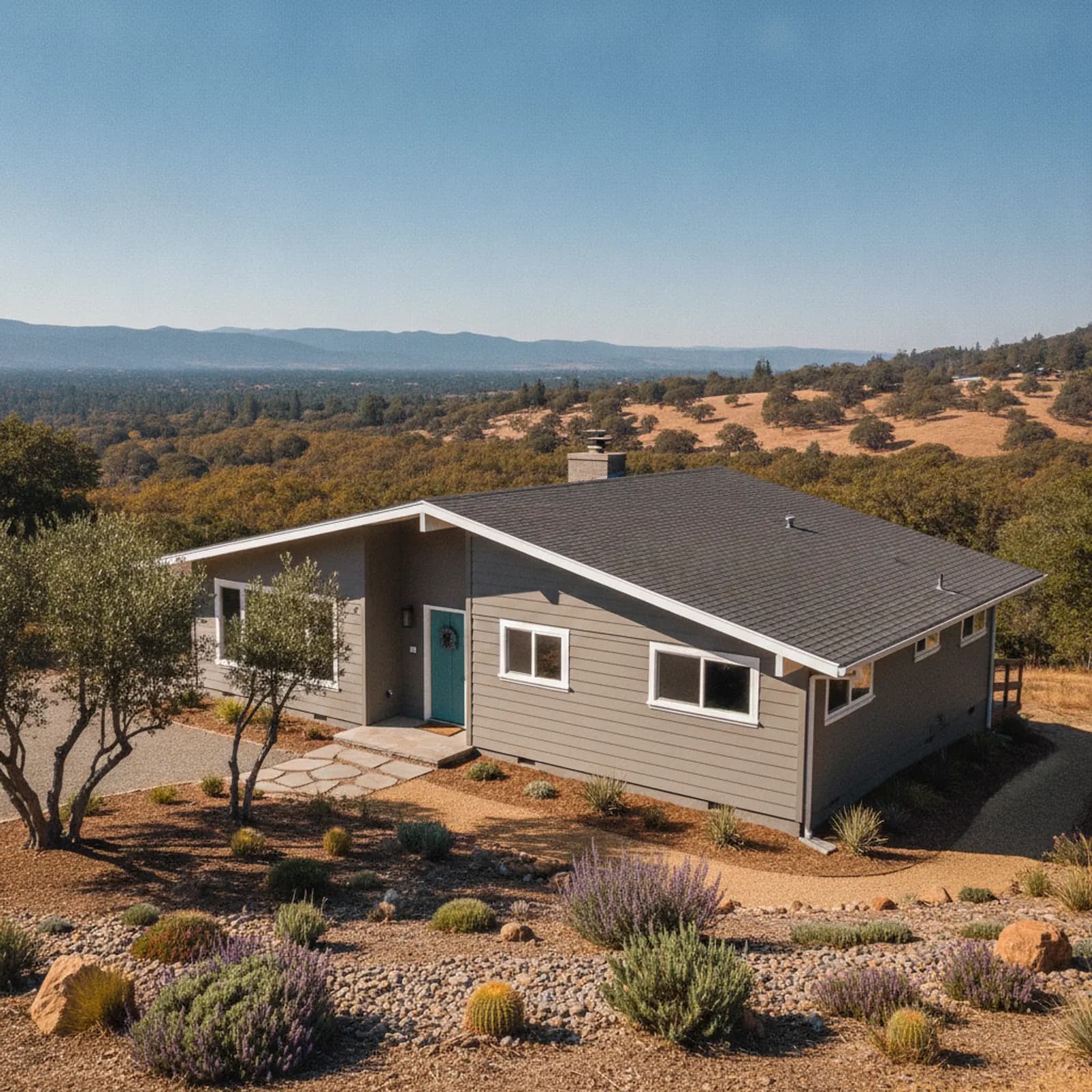
Exterior renovation in Redding
Redding is the hub of far Northern California, the largest city between Sacramento and the Oregon line, sitting at the head of the Sacramento Valley where the floor rises into the Shasta Cascade. Its housing spans mid-century ranch neighborhoods, older downtown and river-area homes, broad 1970s-1990s tract subdivisions, and custom and acreage homes climbing the western and northern edges toward the surrounding brush and forest. Much of that stock has outlived its original cladding under some of the fiercest summer sun in the state, and the homes on the city's wildland margins carry a second reality — genuine fire exposure — that the Carr Fire made impossible to ignore.
Why Redding is a split-spec city
Redding's flat interior neighborhoods and its western and northern foothill-edge parcels don't share a single controlling stressor, so they shouldn't share one spec. Downtown and the interior tracts are fundamentally a heat-and-UV problem — extreme, prolonged summer sun that chalks and fades cladding. The homes climbing toward the wildland on the city's western and northern fringes add an ember and radiant-heat problem on top of that heat. The base cladding can stay consistent across the city, but the detailing diverges, and getting that distinction right is the core of an honest Redding exterior spec.
Considering an exterior project in Redding?
Redding housing and architecture
Redding's stock centers on mid-century ranch neighborhoods and the 1970s-1990s tract subdivisions that built out the city, along with older downtown and Sacramento River-area homes and a growing body of custom and acreage homes on the western and northern edges near the wildland. The interior ranch and tract homes are mostly straightforward, single-story-heavy elevations that take a clean lap or modern lap-and-batten re-side well and respond strongly to a refreshed palette. The foothill-edge and post-fire rebuild homes warrant a more deliberate, fire-aware specification matched to their wildland setting. We design to the neighborhood and the exposure rather than to one template.
Built for Redding's extreme valley heat
Redding is one of the hottest cities in California, with long, prolonged summers of intense heat and UV — the single controlling exterior factor across most of the city. The daily heat swing expands and contracts cladding hard, so we specify fiber cement with factory-applied fade-resistant finishes, correct gapping and fastening for that movement, and finish selection tuned to which elevations take the worst afternoon sun. South and west walls fade first, and darker colors on a west elevation here absorb and hold punishing heat. Winters are cool and genuinely wet, so drainage detailing stays on the list, but the sun — and, at the edges, fire — leads the spec.
Wildland-edge fire hardening in Redding
Interior Redding sits at lower wildland exposure, but the western and northern foothill-edge parcels — and the neighborhoods the 2018 Carr Fire burned into as it crossed the Sacramento River from the west — carry genuine, elevated-to-high fire exposure. For those homes we specify non-combustible Class A fiber cement and harden the vulnerable details: eaves, soffits, vents, and the ground-to-wall transitions where embers gather and collect. We build toward current California WUI practice on wildland-adjacent parcels and document the assemblies so the work supports defensible-space, code, and insurability conversations. We are careful not to overstate what cladding does: fiber cement is noncombustible, which is not the same as making a home immune to fire, and siding is one layer of a whole-home and whole-property strategy — defensible space, vents, roof, and decks all matter alongside it.
Recommended materials for Redding
James Hardie fiber cement with a factory finish is the core recommendation across Redding: non-combustible, dimensionally stable in extreme heat, and far more color-stable than field paint under the city's UV load, with profiles that suit both mid-century ranch homes and contemporary tracts. Because it is non-combustible, the same cladding family that carries the interior neighborhoods for heat durability also serves the western and northern wildland-edge homes for that durability plus added eave, vent, and transition hardening — one product line, spec'd two ways. Engineered wood is acceptable on Redding's genuinely low-fire interior parcels where deep wood character is wanted; the foothill-edge and rebuild parcels warrant non-combustible cladding without exception.
What an exterior project costs in Redding
Redding pricing turns on home size and stories, profile and trim complexity, substrate and dry-rot condition once cladding is removed, window integration, and the weather-management scope. Two variables are particular to Redding: wildland-edge and rebuild parcels carry meaningful fire-hardening scope and current-code detailing that interior tract homes don't, and foothill or acreage lots can add access and staging cost where drives are long or terrain is uneven. Interior ranch and tract homes tend to be more predictable and estimable. We provide a written, scoped estimate after an on-site assessment so bids compare on substance rather than a headline number.
Western and northern wildland-edge neighborhoods
The homes on Redding's western and northern fringes — climbing toward the brush and forest, and including the areas the Carr Fire reached in 2018 — are the city's most fire-consequential re-side work. These parcels warrant non-combustible cladding and hardened eave, vent, and ground-transition detailing built toward current WUI practice, and many are post-fire rebuilds or surviving homes where re-cladding combustible wood or T1-11 is the single highest-value survival upgrade available. We scope these deliberately, document the assemblies, and keep the fire strategy honest — one hardened layer of a whole-property approach, never a promise that a home cannot burn.
Interior ranch and tract neighborhoods
The heart of Redding's housing is its mid-century ranch neighborhoods and the 1970s-1990s tracts that filled in the interior of the city, well back from the wildland. These long, horizontal, mostly single-story elevations take re-cladding cleanly, respond strongly to a modern lap-and-batten program and refreshed palette, and are primarily a heat-durability project — putting a fade-stable, non-combustible system on walls the extreme sun has chalked. Predictable framing usually keeps the scope estimable once a wall is opened and checked.
Documentation, code, and insurability on exposed parcels
In a city that has already seen fire reach its edge, the paper trail matters on wildland-adjacent homes. We document the non-combustible materials and hardened assemblies we install so the exterior supports defensible-space efforts, code requirements, and insurability conversations. Insurers set their own criteria and we don't speak for them, but a documented, current-WUI non-combustible assembly is the strongest position a Redding homeowner on the wildland edge can bring to that conversation.
Redding Electric Utility, PG&E gas, and post-Carr Fire code awareness
Working exteriors in Redding coordinates with a distinctive local utility mix. Electric is supplied by Redding Electric Utility (REU), a city-owned public utility — Redding is one of only a handful of California cities with its own electric utility rather than PG&E. Natural gas is PG&E. Water is supplied by the City of Redding Water Utility, city-owned. Fire response is the Redding Fire Department alongside CAL FIRE for the surrounding State Responsibility Area. On the permit side, the City of Redding Development Services Department handles building permits, and the 2018 Carr Fire — which burned into western Redding and destroyed more than 1,600 structures — reshaped the code and insurance conversation in Shasta County permanently. Many Redding homeowners now approach re-sides with fire performance explicitly in mind, and appraisers and insurers pay closer attention to cladding class than they used to. We flag utility, permit, and fire-history items at the estimate stage.
HZ10 climate, the Carr Fire scar, and the 2025 FHSZ remap
Redding is in James Hardie's HZ10 climate zone; installing HZ5 is a documented warranty misapplication. On the fire side, the interior valley-floor bulk of the city — the ranch belts, downtown-adjacent blocks, and 1970s-1990s tracts well back from the wildland — sits in Low FHSZ territory or unmapped under California's 2025 LRA Fire Hazard Severity Zone map. The western neighborhoods that burned in the 2018 Carr Fire and the parcels backing onto Whiskeytown, Shasta Bally, and the surrounding foothills carry Moderate to Very High designations, and much of the outlying territory falls into State Responsibility Area outright. On designated parcels the 2025 California Wildland-Urban Interface Code governs the exterior wall. The code frame changed on January 1, 2026, when Chapter 7A moved into the standalone WUI Code. We check the parcel at scoping and match the assembly to the parcel — interior tract, hillside, or wildland edge.
Our process in Redding
- Step 1
Consultation
We listen to your goals and assess your home on site — exposure, substrate, and architecture.
- Step 2
Design & Proposal
A clear written proposal with the right system specified for your climate and a transparent scope.
- Step 3
Expert Installation
Trained crews install to manufacturer best practices with careful weather-management detailing.
- Step 4
Walkthrough & Support
A final walkthrough, full cleanup, and a clear written record of the scope completed — work we stand behind.
Redding rewards an exterior strategy that respects its valley-to-wildland split — heat-durable finishes across the interior city, genuine fire hardening where the neighborhoods meet the brush and forest. We scope every Redding project on site and specify per address before any work starts, and your written, itemized estimate governs.
FAQ
Redding — Common Questions
Fiber cement with a factory fade-resistant finish. Redding is one of California's hottest cities, and factory-finished fiber cement holds color and integrity far longer than field paint under that UV load — and because it's non-combustible, it also covers the wildland-edge fire consideration without a material change.
Yes — those foothill-and-wildland-edge parcels, including neighborhoods the 2018 Carr Fire reached, carry genuine fire exposure. We specify non-combustible cladding and harden eaves, vents, and ground transitions there. Interior valley neighborhoods carry lower exposure, though non-combustible fiber cement remains a sound choice.
Yes. In 2018 the Carr Fire ignited west of Redding near Whiskeytown and, driven by extreme heat and wind, spread east across the Sacramento River into Redding's western neighborhoods, destroying more than a thousand homes. It is why fire hardening is a real part of the exterior conversation on the city's wildland-facing edges.
Yes — on rebuilds we coordinate non-combustible cladding with a current-code shell, and on surviving homes still clad in wood or T1-11, re-cladding in hardened non-combustible fiber cement is the highest-value survival upgrade available. We document the assemblies for code and insurability.
No — fiber cement is noncombustible (Class A), which resists ignition but is not the same as making a home unable to burn. It is a strong cladding choice on exposed parcels, but it is one layer of a whole-home and whole-property strategy that also includes defensible space, vents, roof, and decks.
Original wood, hardboard, T1-11, and economy cladding was never specified for Redding's extreme UV load. Chalking, cupping, opening joints, and faded paint on sun-facing elevations is the typical end-of-life pattern.
South- and west-facing walls take the heaviest afternoon sun and age fastest, especially on the open, low-canopy lots common across the city; we account for orientation when specifying finishes and detailing.
A correctly installed fiber cement system commonly performs 30+ years in Redding's climate, with factory finishes extending the time before any cosmetic refresh.
Explore