Exterior renovation in Shasta Lake
The city of Shasta Lake sits north of Redding at the wildland edge of the North Valley, where the floor climbs into oak foothills and conifer forest around Shasta Dam and the vast reservoir that gives the town its name. Its housing runs to forested and foothill homes near the lake and dam, older town and rural acreage homes, post-war and mid-century houses, and wildland-interface and lake-area properties set among the trees. Much of this stock wears original wood, board, T1-11, or builder-grade cladding weathered by the region's extreme summer sun — and, more consequentially, sitting in genuine fire country in a county the 2018 Carr Fire scarred just to the south and west.
Why fire leads the spec here
Unlike the open-floor cities of Redding's interior and Anderson, Shasta Lake sits squarely in the wildland-urban interface: brush, oak, and conifer fuel wrap much of the town, and hot, dry, wind-driven fire seasons put its homes at real, elevated-to-high exposure. That reality was underscored across the wider region by the Carr Fire, which reached toward Keswick and the lake margins as it swept the area in 2018. So while the extreme North Valley heat still governs finish selection, fire leads the specification on most Shasta Lake parcels — non-combustible cladding and hardened detailing come first, with heat durability along for the ride because the same material delivers both.
Considering an exterior project in Shasta Lake?
Shasta Lake housing and architecture
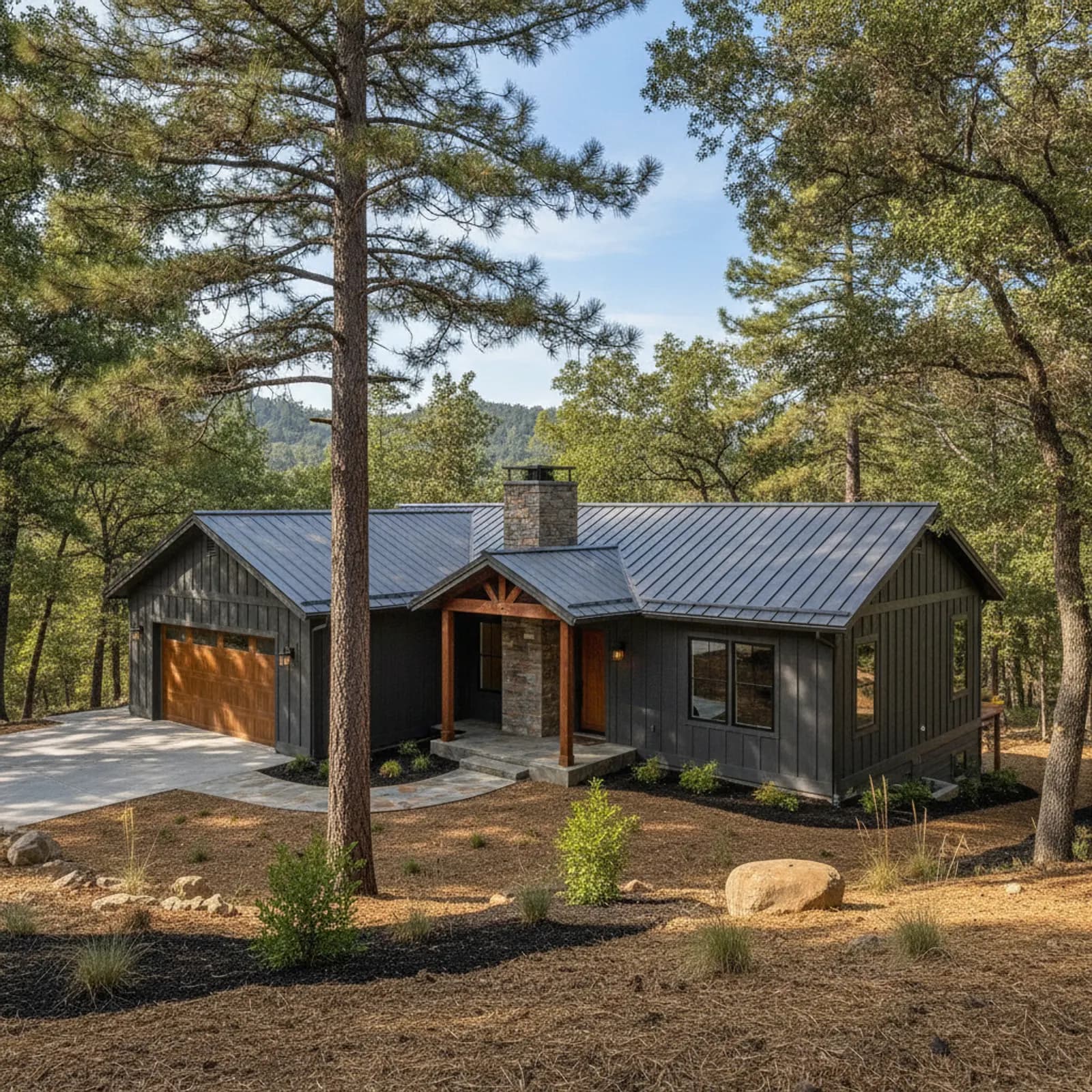
Shasta Lake's stock is shaped by its forest-and-lake setting: forested and foothill homes on rural and acreage parcels near the reservoir and dam, older town homes in the community core, post-war and mid-century houses, and lake-area and wildland-interface properties among the oak and conifer. Older homes were frequently clad in combustible wood, board, or T1-11 with deep wood eaves typical of foothill construction — exactly the details that make a home vulnerable in fire country. Those surviving older homes are the highest-priority hardening targets in the town, and the cleaner post-war and town homes take a straightforward non-combustible re-side well. We design to the parcel's exposure first and its era second.
Shasta Lake's foothill-and-forest climate
Shasta Lake shares the extreme North Valley summer heat and high UV that govern finish durability, but the controlling stressor on most parcels is foothill-and-forest fire. Summers are hot and dry with heavy brush and conifer fuel loading around the town and lake, and the terrain and wind can drive aggressive ember behavior in the worst conditions. Winters are cool and wet, with occasional snow and freeze on the higher forested parcels, so freeze-aware flashing earns its place there, and the lake and river corridors add localized moisture. The exterior here has to resist embers first while still handling extreme summer sun and wet, sometimes freezing winters.
Wildfire hardening in Shasta Lake
Shasta Lake warrants a genuinely fire-aware exterior practice. On its forested, foothill, and lake-margin parcels we specify Class A non-combustible fiber cement and harden the vulnerable details — eaves, soffits, vents, decks, and the ground-to-wall transitions where embers gather — building toward current California WUI standards. On surviving older homes still clad in combustible wood or T1-11 deep in oak and conifer, re-cladding in hardened non-combustible fiber cement is the single highest-value survival upgrade available. We document every assembly so the work supports defensible-space, code, and insurability conversations. And we stay honest about limits: fiber cement is noncombustible, which is not the same as making a home immune to fire; siding is one layer of a whole-home and whole-property strategy that also depends on defensible space, roof, vents, and decks.
Recommended materials for Shasta Lake
Non-combustible fiber cement, hardened and detailed toward current WUI standards, is the cladding we recommend across Shasta Lake's wildland-interface parcels. It is Class A noncombustible for the town's real fire exposure, and it also delivers the heat, UV, and weather durability the exposed North Valley setting demands — so the safest material is also the soundest on every count, with no durability trade made to gain the fire performance. Factory-applied fade-resistant finishes hold color through the extreme summers, and freeze-aware flashing handles the wet, occasionally freezing upper-elevation winters. On genuinely low-exposure town lots well away from fuel, the same fiber cement still leads for its heat and durability performance.
What an exterior project costs in Shasta Lake
Shasta Lake pricing is driven by fire-hardening scope and current-code detailing as the baseline on wildland-interface parcels, plus the usual drivers of home size and stories, trim complexity, substrate and dry-rot discovery once old cladding comes off, and window integration. Two things are particular here: forested, foothill, and lake-area parcels can carry difficult access, long rural drives, and winter-influenced scheduling at the higher elevations, and surviving older homes more often reveal substrate or rot at demolition. The fire-hardening scope is the point on most parcels, not an upsell. We assess on site and provide a written, itemized estimate that reflects the detail rather than square footage alone.
Forested, foothill, and lake-area parcels
The homes set among oak and conifer near the reservoir and dam, and up into the foothills around the town, are Shasta Lake's most fire-consequential work. These parcels warrant non-combustible cladding and uncompromising detailing at eaves, vents, decks, and ground transitions, along with attention to the immediate defensible zone and any outbuildings. Access can be long and staging more involved on acreage and forested drives, which we plan during the on-site walk so the crew sequences the work efficiently across the structures that matter on the property.
Surviving older homes versus cleaner town stock
Shasta Lake's older homes still clad in wood, board, or T1-11 sit in genuine fire terrain with the very cladding that makes them vulnerable, so for them re-cladding in hardened non-combustible fiber cement is the highest-value survival step available and can often be staged ahead of other work. The cleaner post-war and town homes further from heavy fuel are a more straightforward non-combustible re-side that still upgrades both durability and fire posture. We scope each for what it is rather than running one package across the town.
Documentation, code, and insurability
In wildland-interface country, the paper trail matters. We document the non-combustible materials and hardened assemblies we install so a Shasta Lake homeowner has a record that supports defensible-space efforts, code requirements, and insurability conversations. Insurers set their own criteria and we don't speak for them, but a documented, current-WUI non-combustible assembly is the strongest position a homeowner in this fire-exposed town can bring to that conversation.
City of Shasta Lake, city utilities, and Shasta Lake Fire
Working exteriors in Shasta Lake coordinates with a few local authorities. Building permits come through the City of Shasta Lake Community Development Department (Shasta Lake incorporated in 1993 — Shasta County's third incorporated city). Electric and gas are PG&E, and the entire Highway 5 corridor above Redding is documented high-PSPS territory since the 2018 Carr Fire. Water and wastewater are supplied by the City of Shasta Lake municipal utilities; the U.S. Bureau of Reclamation manages Shasta Dam and reservoir. Fire response is the Shasta Lake Fire Protection District alongside CAL FIRE Shasta-Trinity Unit (SHU) on wildland calls into the surrounding Shasta-Trinity National Forest.
HZ10 and the Carr-Fire-corridor FHSZ reality
Shasta Lake is in James Hardie's HZ10 climate zone; installing HZ5 is a documented warranty misapplication. On the fire side, essentially every parcel in and around Shasta Lake sits in Moderate to Very High FHSZ territory under California's 2025 LRA Fire Hazard Severity Zone map, with surrounding land in State Responsibility Area / Shasta-Trinity National Forest. The 2018 Carr Fire (229,651 acres, 1,614 structures destroyed) burned into western Shasta County; the 2020 August Complex (1,032,648 acres — California's largest recorded fire) burned adjacent Trinity/Tehama terrain. On these parcels the 2025 California Wildland-Urban Interface Code governs the exterior wall. Chapter 7A moved into the standalone WUI Code on January 1, 2026.
Our process in Shasta Lake
- Step 1
Consultation
We listen to your goals and assess your home on site — exposure, substrate, and architecture.
- Step 2
Design & Proposal
A clear written proposal with the right system specified for your climate and a transparent scope.
- Step 3
Expert Installation
Trained crews install to manufacturer best practices with careful weather-management detailing.
- Step 4
Walkthrough & Support
A final walkthrough, full cleanup, and a clear written record of the scope completed — work we stand behind.
Shasta Lake rewards an exterior strategy that takes its forest-and-foothill fire exposure seriously while still answering the extreme valley sun — genuinely hardened non-combustible cladding, detailed toward current WUI practice, documented, and honest about being one layer of a whole-property approach. We scope every Shasta Lake project on site, plan around the access and winter window, and your written estimate governs.
FAQ
Shasta Lake — Common Questions
It is a defining factor — Shasta Lake is a wildland-interface town wrapped in oak, brush, and conifer near the reservoir and dam, in a county the 2018 Carr Fire scarred. Most parcels warrant non-combustible cladding and fire-aware detailing as core exterior infrastructure.
Class A non-combustible fiber cement, hardened and detailed toward current WUI standards at eaves, soffits, vents, decks, and ground transitions. It also handles the extreme North Valley heat, so the safest material is also the most durable here.
No — it is noncombustible (Class A), which resists ignition but does not make a home unable to burn. It is the right cladding on Shasta Lake's exposed parcels, but it is one layer of a whole-home and whole-property strategy that also includes defensible space, roof, vents, and decks.
Re-cladding combustible wood or T1-11 in hardened non-combustible fiber cement is the single highest-value survival upgrade available for a surviving forested or foothill home, and it can often be staged ahead of other improvements.
Both. Shasta Lake shares Redding's extreme summer heat and UV, so finish durability matters — but fire leads the specification on most wildland-interface parcels. The same non-combustible fiber cement answers both, which is why we recommend it across the town.
We build toward current WUI standards and document every assembly so the work supports defensible-space, code, and insurability conversations. Insurers set their own criteria, but a documented non-combustible assembly is the strongest position a homeowner can bring.
Yes — the higher elevations see occasional snow and freeze, so we add freeze-aware flashing alongside the fire hardening, and the lake and river corridors get attention to moisture detailing.
A correctly installed fiber cement system commonly performs 30+ years in the North Valley climate while materially reducing ignition risk on wildland-interface parcels.
Explore
Exterior Services
Helpful Exterior Guides