Exterior renovation in Twain Harte
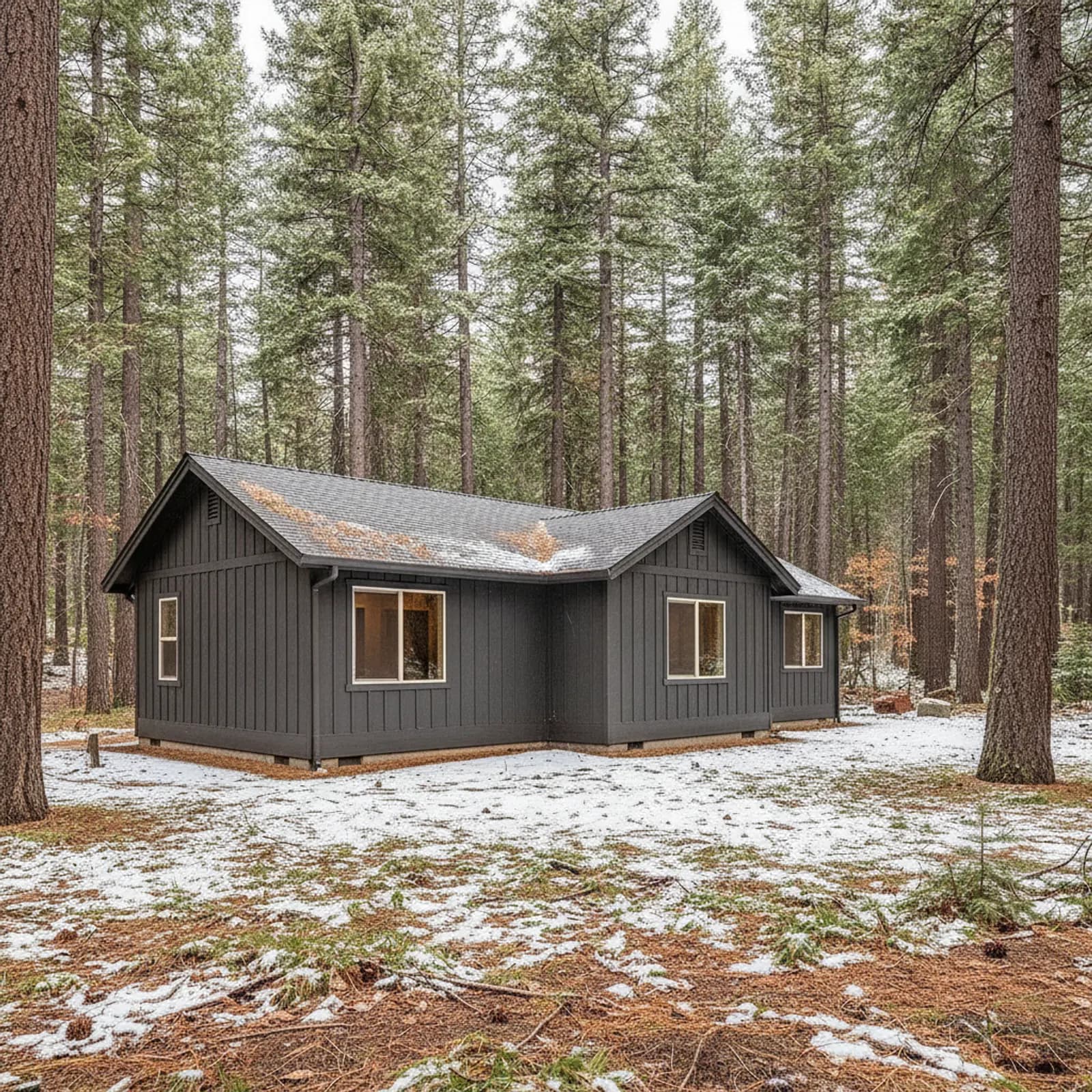
Twain Harte is a higher-elevation pine resort community on the Highway 108 corridor above Sonora, a wooded village of cabins, A-frames, second homes, and full-time residences set among dense conifer forest. Much of its housing was built as vacation property over decades and clad in wood, board-and-batten, and T1-11 typical of mountain construction, with deep wood eaves and forested lots. That stock now stands in some of the most fire-exposed terrain in the county while also carrying a genuine winter snow load — a combination that makes a Twain Harte re-side a serious home-hardening and weather-durability project rather than a cosmetic one.
Fire and snow on the same wall
What sets Twain Harte apart from the county's foothill towns is elevation. The dense pine forest that makes it a beautiful resort community also makes it severe wildfire terrain, where ember and radiant exposure govern the exterior. But at roughly 3,600 feet the community also sees a real snow load and freeze cycle that the lower Gold Country towns largely escape. So the same wall has to resist ignition above all and also shed snowmelt and survive freeze-thaw. We spec non-combustible cladding for the fire and add freeze-aware flashing and drainage detailing for the winter — neither concern gets left off.
Considering an exterior project in Twain Harte?
Twain Harte housing and architecture
Twain Harte's stock is mountain and resort in character: forest cabins and A-frames, second homes and vacation properties, rural acreage homes tucked among conifer, and full-time residences on wooded village lots. Many were owner-built or expanded over time with combustible wood, board, or T1-11 cladding and the deep wood eaves typical of mountain construction — exactly the details that make a home vulnerable in dense forest. These are the highest-priority hardening candidates in the community, and re-cladding them in non-combustible fiber cement is the single highest-value survival upgrade available to an existing cabin. We match durable profiles to the mountain aesthetic while correcting the fire-vulnerable details.
Built for Twain Harte's forest fire and snow
The controlling stressor in Twain Harte is fire in dense conifer forest — hot, dry summers cure heavy pine-and-brush fuel to a hazard, and the forested lots put ember and radiant exposure at the center of the spec. On top of that, the higher elevation brings cooler, wetter winters with a moderate snow load and freeze cycle the foothill towns don't share. Summers are somewhat milder than the valley but still high-UV on exposed elevations. So the exterior is specified for embers first, with freeze-aware flashing, drainage-plane detailing, and finishes that handle both intense summer UV and repeated winter freeze-thaw.
Aggressive wildfire hardening in Twain Harte
Twain Harte warrants rigorous hardening. We specify Class A non-combustible fiber cement and detail uncompromisingly at eaves, soffits, vents, decks, and ground-to-wall transitions, recognizing the dense conifer fuel and the ember behavior that severe forest fire drives. We build to current California WUI standards and document every assembly so the work supports defensible-space, code, and insurability requirements. We won't install combustible cladding on a forested Twain Harte lot, and we won't overstate what siding alone does — it is one layer of a whole-home and whole-property defensible-space strategy in terrain where that strategy genuinely matters.
Recommended materials for Twain Harte
Non-combustible fiber cement, hardened and detailed to current WUI standards, is the only cladding we recommend in Twain Harte. Combustible wood, board, and T1-11 are not a category we will install on a forested lot here. Fiber cement also handles the wet, freezing mountain winters when it is flashed correctly and the intense summer UV on exposed elevations, so the safest material is also the soundest one — there is no durability trade made to gain the fire performance. High-UV factory finishes and corrosion-aware fasteners round out a system built for the community's long dry seasons and snowy winters alike.
What an exterior project costs in Twain Harte
Twain Harte projects carry comprehensive fire-hardening scope and current-code detailing as the baseline, plus freeze-aware flashing and drainage the foothill towns don't need. On top of that sit forested and rural access on narrow mountain roads and long drives, winter-influenced scheduling at elevation, and substrate or dry-rot discovery on older cabins once combustible cladding comes off. Second-home ownership can also mean coordinating around an owner who lives elsewhere. We assess on site and provide a written, itemized estimate; the hardening and weather detailing are the point here, and pricing reflects that scope rather than square footage alone.
Cabins and second homes
Much of Twain Harte's stock is cabins and vacation homes, often owner-built or expanded over the years and still wearing combustible wood or T1-11 deep in conifer forest. These are the community's most urgent hardening targets: re-cladding in non-combustible fiber cement is the highest-value survival step available to them, and it can often be staged ahead of other improvements. For second-home owners who live elsewhere, we coordinate access and scheduling so the work proceeds cleanly on a property the owner can't check on daily.
Mountain access and winter scheduling
Twain Harte's parcels sit along forested village and rural roads that complicate delivery, staging, and debris hauling, and the elevation brings snow and freezing weather that affects timing. We confirm access and plan the work around the wet, snowy season during the on-site visit, so a re-side isn't started into conditions that compromise flashing details or strand a delivery on a narrow mountain approach. Getting the winter window right protects both the schedule and the quality of the freeze-aware detailing.
Documentation, insurability, and the forest
In dense-forest resort country, a documented hardening record increasingly matters. We document the non-combustible materials and hardened assemblies we install so the exterior supports defensible-space, code, and insurability conversations, which can be especially pointed on heavily forested Twain Harte lots. Insurers set their own criteria and we don't speak for them, but a current-WUI non-combustible assembly, properly recorded, is the strongest position a homeowner in these pines can bring to that conversation.
Tuolumne County, TUD, and Twain Harte Fire
Working exteriors in Twain Harte coordinates with a few local authorities. Twain Harte is unincorporated Tuolumne County — there is no city government, so building permits come through the Tuolumne County Community Resources Agency rather than a municipal department. Electric and gas are PG&E, and the entire Highway 108 corridor is at the epicenter of PG&E's PSPS-shutoff footprint. Water is supplied by the Tuolumne Utilities District (TUD) drawing from South Fork Stanislaus watershed sources. Fire response is the Twain Harte Community Services District Fire Department alongside CAL FIRE Tuolumne-Calaveras Unit (TCU) on wildland calls, with the Tuolumne County Sheriff coordinating events.
HZ10 and the Rim-Fire-corridor FHSZ reality
Twain Harte is in James Hardie's HZ10 climate zone (at ~3,600 ft, Twain Harte sits below the HZ5 high-elevation threshold; HZ5 is reserved for higher-Sierra/Tahoe-basin work); installing HZ5 is a documented warranty misapplication. On the fire side, essentially every parcel in and around Twain Harte sits in High or Very High FHSZ territory under California's 2025 LRA Fire Hazard Severity Zone map, with surrounding land in Stanislaus National Forest. The 2013 Rim Fire (257,314 acres — the third-largest wildfire in California history at the time) burned adjacent Tuolumne terrain. On these parcels the 2025 California Wildland-Urban Interface Code governs the exterior wall. Chapter 7A moved into the standalone WUI Code on January 1, 2026.
Our process in Twain Harte
- Step 1
Consultation
We listen to your goals and assess your home on site — exposure, substrate, and architecture.
- Step 2
Design & Proposal
A clear written proposal with the right system specified for your climate and a transparent scope.
- Step 3
Expert Installation
Trained crews install to manufacturer best practices with careful weather-management detailing.
- Step 4
Walkthrough & Support
A final walkthrough, full cleanup, and a clear written record of the scope completed — work we stand behind.
Twain Harte rewards an exterior strategy that takes both its severe forest fire exposure and its mountain winters seriously, from a wooded cabin to a full-time residence in the pines. We scope every Twain Harte project on site so the fire hardening and freeze-aware detailing match the actual parcel and the season, and your written, itemized estimate governs the work.
FAQ
Twain Harte — Common Questions
Serious — Twain Harte is a higher-elevation community set in dense conifer forest, some of the most fire-exposed terrain in the county. We apply rigorous hardening and current WUI standards, specifying Class A non-combustible cladding on forested lots here.
Re-cladding combustible wood or T1-11 in hardened non-combustible fiber cement is the single highest-value survival upgrade available for a conifer-forest cabin. We also correct the deep wood eaves and vents that make mountain homes vulnerable.
Yes — at its elevation Twain Harte carries a moderate winter snow load and freeze cycle the foothill towns don't. We add freeze-aware flashing and drainage-plane detailing on top of the fire hardening so the wall handles both.
No — we won't install combustible wood, board, or T1-11 on a forested lot here. The conifer exposure makes non-combustible, hardened fiber cement the only responsible choice.
No — no cladding is fireproof. Fiber cement is noncombustible (Class A, tested to ASTM E84), which is why we specify it in these pines, but it is one layer of a whole-home hardening and defensible-space strategy, not a guarantee.
Yes — much of Twain Harte is second homes. We coordinate access, scheduling, and updates so the work proceeds cleanly on a property whose owner lives elsewhere.
We build to current WUI standards and document every assembly so the work supports defensible-space, code, and insurability conversations; insurers set their own criteria. On a heavily forested lot that documentation matters.
A correctly installed fiber cement system commonly performs 30+ years in the mountain climate while materially reducing ignition risk, provided the freeze-aware flashing is detailed correctly for the winters.
Explore
Exterior Services
Helpful Exterior Guides