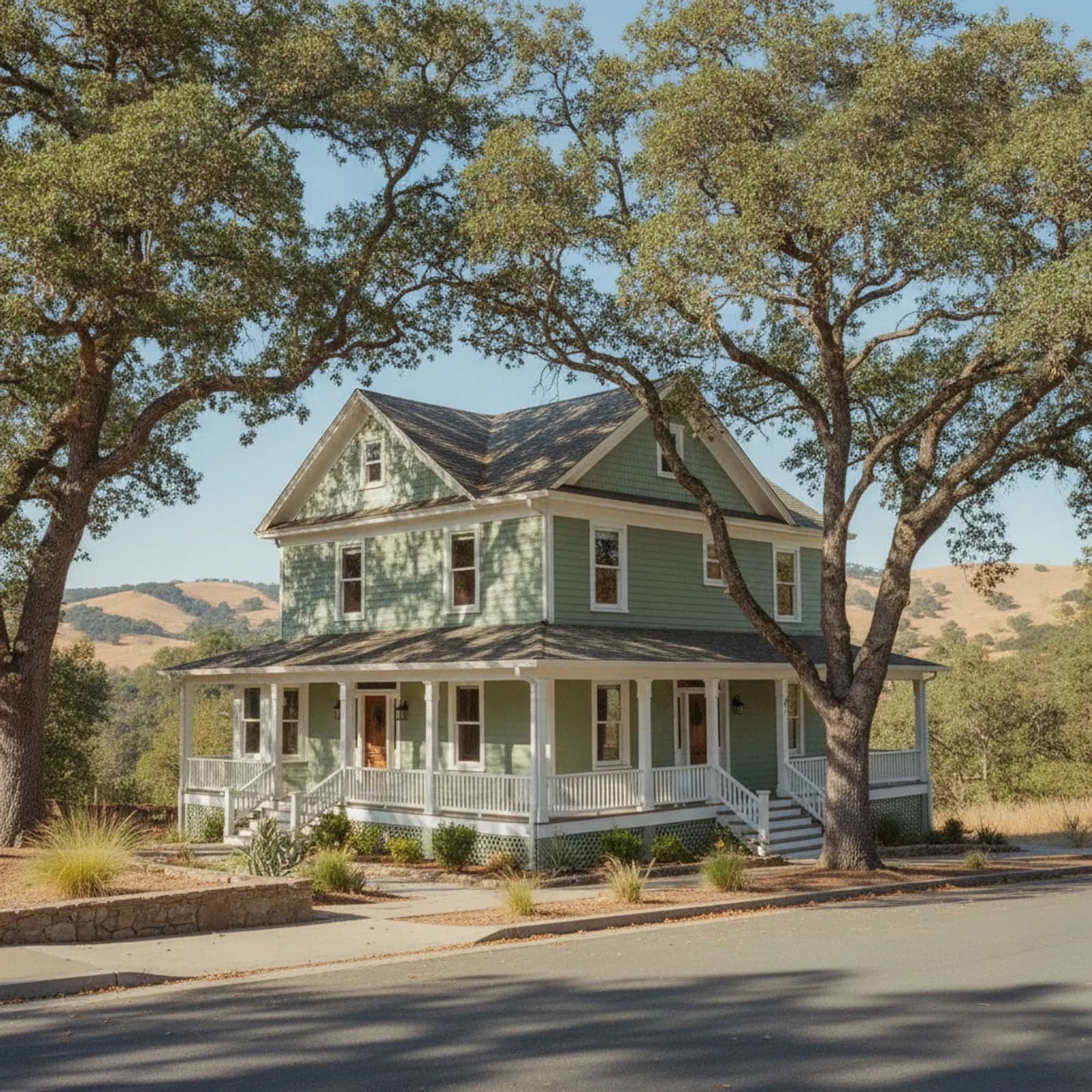
Exterior renovation in Sonora
Sonora is the seat of Tuolumne County and the commercial heart of the Southern Mines, a Gold Rush town whose Washington Street core remains one of the best-preserved historic downtowns in the Mother Lode. Its housing reflects that long history: Victorian and early-1900s homes and brick-and-frame houses on the hillsides above downtown, mid-century foothill neighborhoods, and newer subdivisions spreading onto the oak-wooded edges of town. Much of the older stock now wears original wood, clapboard, and economy cladding well past its service life, weathered by hot foothill sun and standing in genuine wildland-urban interface. A Sonora re-side is therefore both a character-preservation project and a home-hardening one.
Two agendas on one wall
What makes Sonora distinct is that its exterior work answers to history and to fire at the same time. The downtown and hillside homes carry detailing expectations a generic re-side will visibly miss, so profiles, trim proportions, and finish have to read as their era. But Sonora also sits in oak-and-grass foothill country that dries to a hazard every summer, so those same walls need non-combustible cladding and hardened eave, vent, and transition detailing. Neither agenda gets to override the other — the win is a home that keeps its Gold Country character and is materially harder to ignite.
Considering an exterior project in Sonora?
Sonora housing and architecture
Sonora's stock is older and more layered than most of the county: Victorian, Italianate, and early-1900s homes and brick-and-frame houses in and around the historic downtown grid, hillside homes stepping up the slopes above Washington Street, broad mid-century foothill neighborhoods, and newer subdivisions on the oak-wooded margins. The historic homes demand narrow, period-correct profiles, accurate trim depth, and restraint — the wrong board width or a generic corner reads as a mistake on these old streets. The mid-century and newer homes take a clean lap or board-and-batten re-side well, and the oak-edge parcels warrant the most deliberate fire detailing. We design to the era and the exposure, not to one template.
Built for Sonora's foothill sun and fire season
Sonora runs hot, dry, and high-UV through long summers, fading and chalking finishes worst on south and west elevations, so fade-resistant factory-finished cladding is the durability baseline. But the controlling stressor is fire: Sonora sits in oak woodland and cured-grass foothill country that dries to a hazard through a long season, so ember and radiant exposure govern the specification across most of town. Winters are cool and wet with little snow at Sonora's elevation, keeping drainage detailing on the list without the freeze concerns of the higher communities. The same wall has to beat the sun and, above all, resist ignition.
Wildfire hardening in Sonora
Sonora sits in genuine wildland-urban interface, so non-combustible cladding is our standard here and we harden the vulnerable details — eaves, soffits, vents, and ground-to-wall transitions where embers gather. The downtown-core lots surrounded by other structures carry somewhat lower direct-wildland exposure than the oak-wooded hillside and edge parcels, and we read each address for which it is rather than applying one blanket scope. We build to current California WUI practice and document the assemblies we install so the work supports defensible-space, code, and insurability conversations. We won't overstate what siding does — it is one layer of a whole-home and property strategy — but in Sonora that hardening is a real part of the job.
Recommended materials for Sonora
Non-combustible James Hardie fiber cement with a factory finish is the core recommendation for Sonora: Class A non-combustible for the fire exposure, dimensionally stable in foothill heat, and color-stable under sustained UV. On the historic downtown and hillside homes we select narrow lap profiles and trim that read as period-appropriate, so the upgrade reinforces a Victorian or early-1900s home's character rather than erasing it while adding real fire performance. On the mid-century and oak-edge homes, hardened eave, vent, and transition detailing pairs with the same cladding family, and factory finishes resist the chalk and fade the foothill sun drives on unshaded walls.
What an exterior project costs in Sonora
Sonora pricing turns on home size and stories, profile and trim complexity — often markedly higher on the ornate historic homes where detailed trim and reveal matching add real scope — substrate and dry-rot condition once cladding is removed, fire-hardening scope, and window integration. Two variables are particular to Sonora: the old downtown and hillside homes most frequently reveal layered original siding and dry rot at demolition after a century of foothill weather, and hillside access on the steep streets above Washington Street can affect staging. We provide a written, scoped estimate after an on-site assessment so bids compare on substance rather than a headline number.
The historic downtown and Washington Street core
Sonora's downtown and its surrounding Victorian, Italianate, and early-1900s stock are the heart of the city's identity and among the most demanding re-side work in the county. These homes carry detailing expectations a generic re-side will visibly miss, so we match lap width, trim proportions, and finish to the era while respecting existing ornamentation. They are also the most likely to hide dry rot or multiple layers of original siding after a century in the foothills, which we plan for rather than discover mid-project. Getting the character right here protects both the home and one of the Mother Lode's best-preserved streetscapes.
Hillside and oak-edge parcels
Above and around the historic core, Sonora's homes step up oak-wooded hillsides and spread onto the town's wildland edges, where the fire exposure is most acute and where eave, vent, and ground-to-wall detailing matter most. Steep-street access can lengthen staging and material delivery on the slopes above downtown, which we account for in the on-site walk. On these parcels the non-combustible spec and hardened detailing are the center of the project, not an add-on.
Documentation and insurability
In foothill fire country, Sonora homeowners increasingly need a record, not just good work. We document the non-combustible materials and hardened assemblies we install so the exterior supports defensible-space, code, and insurability conversations. Insurers set their own criteria and we don't speak for them, but a documented, current-WUI non-combustible assembly is the strongest position a homeowner can bring to that conversation on an oak-wooded Sonora parcel.
PG&E, TUD water, and Historic Sonora design review
Working exteriors in Sonora coordinates with a distinctive local utility mix. Electric and gas both come from PG&E, and Sonora is squarely in high-PSPS territory where Public Safety Power Shutoffs during red-flag events can affect scheduling. Water is supplied by Tuolumne Utilities District (TUD), a customer-owned public agency serving Sonora and surrounding Gold Country communities. Fire response is Sonora Fire Department alongside CAL FIRE's Tuolumne-Calaveras Unit for surrounding State Responsibility Area. On the permit side, the City of Sonora Community Development Department handles building permits, and the entire Historic Sonora downtown district on the National Register of Historic Places falls under Historic Preservation Commission review — a genuinely strict oversight on material, profile, and color for contributing structures. We flag utility, permit, and heritage items at the estimate stage.
HZ10 climate, the 2013 Rim Fire aftermath, and Very-High FHSZ in Tuolumne
Sonora is in James Hardie's HZ10 climate zone; installing HZ5 is a documented warranty misapplication. On the fire side, Sonora sits in the heart of California's Gold Country foothill fire territory, and much of the surrounding county lived through the 2013 Rim Fire and other Sierra-Nevada foothill fires that shaped the region's insurance and construction conversation permanently. The city's oak-wooded hillside neighborhoods and much of unincorporated Tuolumne County carry Moderate to Very High FHSZ designations under California's 2025 LRA Fire Hazard Severity Zone map, and outlying territory falls into State Responsibility Area outright. On designated parcels the 2025 California Wildland-Urban Interface Code governs the exterior wall. The code frame changed on January 1, 2026, when Chapter 7A moved into the standalone WUI Code.
Our process in Sonora
- Step 1
Consultation
We listen to your goals and assess your home on site — exposure, substrate, and architecture.
- Step 2
Design & Proposal
A clear written proposal with the right system specified for your climate and a transparent scope.
- Step 3
Expert Installation
Trained crews install to manufacturer best practices with careful weather-management detailing.
- Step 4
Walkthrough & Support
A final walkthrough, full cleanup, and a clear written record of the scope completed — work we stand behind.
Sonora rewards an exterior approach that honors its remarkable Gold Country core and its real foothill fire exposure at once, from a downtown Victorian to an oak-edge home on the slopes. We scope every Sonora project on site so the period detailing and fire hardening match the actual parcel, and your written, itemized estimate governs the work.
FAQ
Sonora — Common Questions
Non-combustible fiber cement with a factory fade-resistant finish — it handles Sonora's foothill heat and UV, and because it is Class A non-combustible it addresses the wildfire exposure that governs this oak-and-grass foothill town.
Yes. We choose narrow, period-correct profiles and accurate trim proportions so the result upgrades durability and fire performance without erasing the home's character — essential on Sonora's historic downtown and hillside streets.
In most of Sonora, yes — the town sits in wildland-urban interface with oak woodland and cured grass that dry to a hazard each summer. We specify non-combustible cladding and harden eaves, vents, and transitions, matched to how exposed the specific parcel is.
No — no siding is fireproof. Fiber cement is noncombustible (Class A, tested to ASTM E84), which is why we use it here, but it is one layer of a whole-home hardening and defensible-space strategy rather than a guarantee.
Original wood, clapboard, and economy cladding was never specified for the foothill UV load, and the old downtown and hillside homes have weathered a century of it. Chalking, cupping, opening joints, and faded paint on sun-facing elevations is the typical pattern.
Little — Sonora's foothill elevation sees cool, wet winters with only occasional light snow, so we detail for drainage without the freeze-aware scope the higher communities like Twain Harte need.
When feasible, yes — combining them ensures correct flashing integration and avoids duplicated trim work, which matters more on detail-rich historic homes and on fire-hardened assemblies.
A correctly installed fiber cement system commonly performs 30+ years in Sonora's climate while reducing ignition risk, with factory finishes extending the time before any cosmetic refresh.
Explore