
7 min read · Design
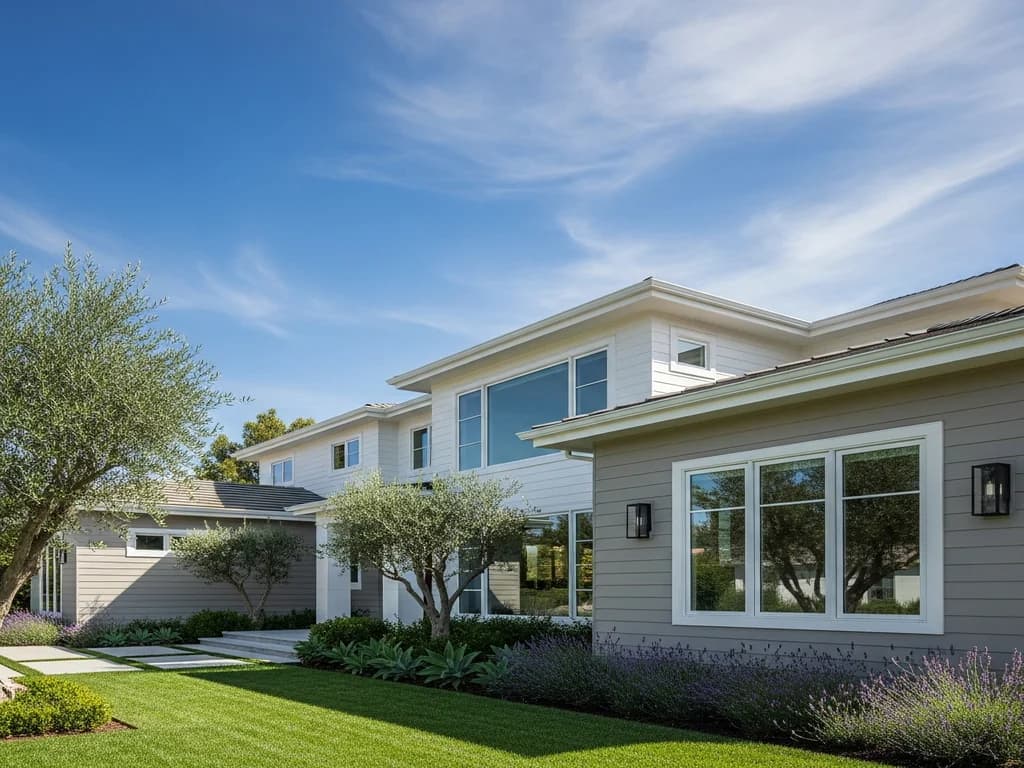
Most California homes have white gutters by default — the standard builder spec from the 1990s and 2000s — and most homeowners never reconsider gutter color during a re-side. That default white is one of the largest unforced visual losses in California exterior design. Gutter color is one of the most-overlooked, highest-leverage exterior design decisions: it costs nothing extra to choose a coordinated color during gutter replacement, and it can transform an otherwise dated composition into something current and intentional. GutterFX, the NorCal gutter specialist we refer to, offers the full California color range; here's the design strategy for choosing.
Why gutter color matters more than people think
Gutters run continuously along every roofline of the home — typically 150-200+ linear feet of visible horizontal element. That's more linear visual surface than the trim, more than the fascia alone, and on many homes more than the front door area. White gutters against a body that isn't white create high-contrast visual fragmentation that breaks the architectural composition. Coordinated gutter color (matched to trim, body, or accent strategy) integrates the gutters into the design rather than fighting it.
Strategy 1 — Black gutters with modern and modern farmhouse
For homes with black window frames, black metal accents, or contemporary architectural direction, black gutters are the strongest coordination move. They visually disappear into the roofline shadow on dark composition shingle roofs, then read as architectural punctuation where they meet the body. Black gutters work with Arctic White, Iron Gray, Boothbay Blue, and Aged Pewter bodies. They're the modern farmhouse default and one of the highest-impact-per-dollar upgrades on a re-side.
Strategy 2 — Body-matched gutters for monolithic composition
For homes where you want the gutters to disappear into the body, matching gutter color to the body color creates a monolithic composition. Iron Gray gutters on Iron Gray body, Cobble Stone gutters on Cobble Stone body, Boothbay Blue gutters on Boothbay Blue body. The gutters become invisible architecturally; the eye reads the form rather than the gutters. Works particularly well on contemporary, transitional, and minimalist architecture.
Strategy 4 — Trim-matched gutters for traditional composition
For homes with strong traditional trim systems (Cobble Stone or Arctic White trim against any body), matching gutter color to trim creates a unified trim system that wraps the entire home. The gutters read as a continuation of the fascia and trim rather than a separate element. Works on craftsman, traditional, and farmhouse architectures where trim is visually prominent.
Common coordination mistakes
White gutters against any non-white body — the standard 1990s spec that breaks every California modern composition. Brown gutters against modern farmhouse — the temperature mismatch reads as unplanned. Bronze or warm-tone gutters against cool-toned bodies (Boothbay Blue, Evening Blue) — the temperature conflict undermines the body color. Matching gutters to roof color when roof and body are cool/warm-mismatched — picks the wrong reference point.
Material color limitations
Aluminum gutters (typical California spec) come in 20+ baked-on factory finishes that hold up to California UV for 25-35 years before any visible fade. The full palette covers black, bronze, gray spectrum, white, and warm earth tones. Steel gutters have a narrower color range and require periodic refinishing. Copper develops natural patina rather than holding a finish. Vinyl gutters have a narrow color range and aren't suitable for California UV exposure on most elevations.
Downspout color and placement
Downspouts are vertical runs of the same material in the same color. Coordinating downspout color with the wall directly behind it can hide the downspout (body-color downspouts against body-color walls) or accentuate it (contrasting downspouts on a feature wall). Avoid white downspouts on dark bodies — visually distracting. Avoid placement at primary visible elevations where possible; reroute to subordinate elevations during gutter install if practical.
Where Sierra Siding and GutterFX fit
On combined gutter+siding projects, we coordinate the gutter color selection with the body, trim, and window frame palette as part of the overall design conversation. GutterFX offers the full California aluminum color palette and copper option across our NorCal service areas. Color decisions get made together with the rest of the exterior palette rather than after the fact.
Key takeaways
- Gutter color is one of the highest-leverage overlooked exterior design decisions
- Black gutters are the modern farmhouse and contemporary default
- Body-matched gutters create monolithic composition; trim-matched create unified trim
- Copper is the craftsman/Mediterranean/Spanish revival traditional choice
- White gutters on non-white bodies break the composition — almost always change them
- Downspout placement and color need coordination too
FAQ
Quick Answers
Almost never if the body isn't white. White gutters against any non-white body create visual fragmentation that breaks the composition. The cost to switch during gutter replacement is zero (same material, factory-finished color); the design impact is substantial.
No — aluminum gutters with factory-baked finish are the same cost across the standard color palette. The cost differential is between aluminum (standard) vs. copper (3-5x premium) vs. steel/specialty materials. Color choice within aluminum is essentially free.
Black gutters (strongest modern coordination), Arctic White trim-matched gutters (classic farmhouse), or body-matched Boothbay Blue gutters (monolithic). All three work; avoid white-default or brown-tone gutters against Boothbay Blue — the temperature conflict undermines the body color.
Depends on the visual strategy. On dark roofs with light bodies, gutters that match the roof tuck visually into the roofline. On bodies with strong color identity (Boothbay Blue, Mountain Sage, Iron Gray), matching the body or trim is usually stronger than matching the roof. The rare case: when roof and body share temperature/tone, matching either works.
On premium craftsman, traditional, and Mediterranean architecture where the patina aesthetic supports the design vocabulary, yes — 50+ year lifespan and natural patina justify the 3-5x cost. On tract two-story modern farmhouse, copper reads as mismatched effort; aluminum in black or trim color is the better design choice.
Aluminum gutters can be painted with proper preparation (cleaning, primer, exterior metal paint) for a temporary color change, but the painted finish doesn't hold up like the factory-baked finish — typically 5-8 years vs. 25-35 for factory color. If gutters are aged and you're considering color change, replacement during a re-side or refresh is the better economic and durability move.
Sources
Authoritative references
External links to government, code, and manufacturer sources. Sierra Siding is not affiliated with these organizations; references are provided for verification.