6 min read · Hardie
Hardie Aspyre is James Hardie's premium wood-look collection; HardiePlank is the standard lap siding most California homes already wear. They share the same fiber cement DNA and the same Class A fire rating, so the real decision is narrower than it sounds: it comes down to how much authentic wood character you need at close range, and whether that detail justifies the premium. Here is how to choose, criterion by criterion.
What each product actually is
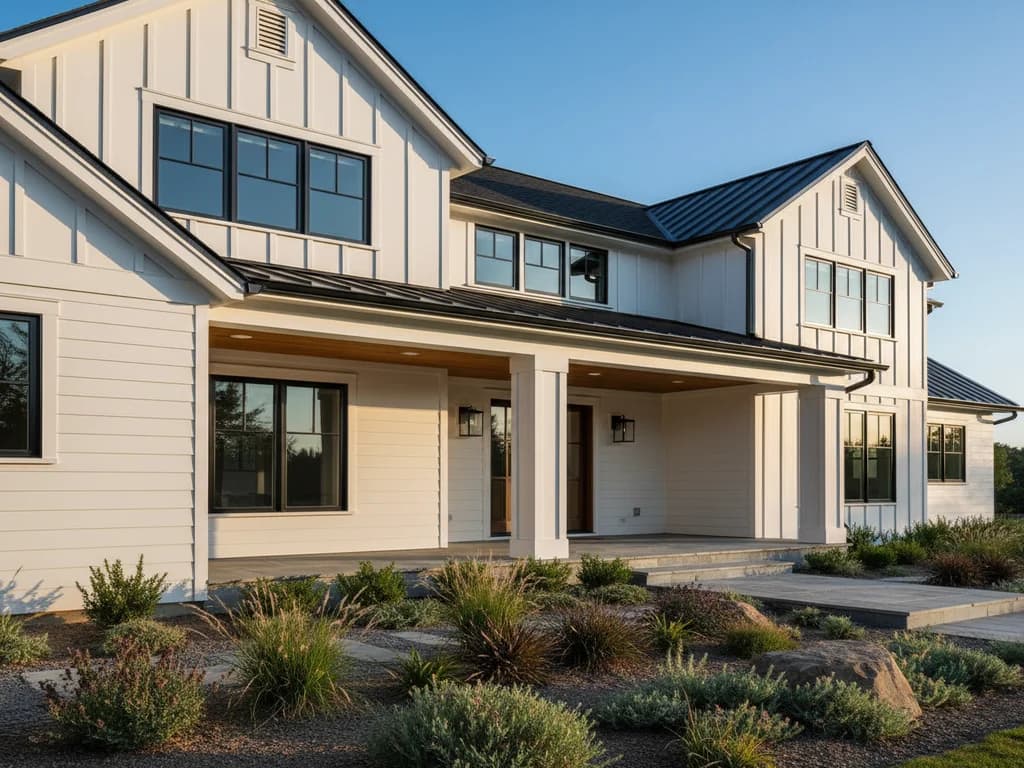
HardiePlank is the workhorse — cement-based lap board with either a smooth face or a wood-grain texture, finished in factory ColorPlus or primed for field paint, and it clads the majority of California homes. From a medium distance its wood-grain reads convincingly as wood; up close the cement base is apparent. Aspyre is a premium line engineered for a closer, more authentic wood read: deeper, more pronounced grain and stain-look ColorPlus colors that lean into the natural-material aesthetic. Both belong to the same James Hardie siding family and share its core properties — non-combustible, dimensionally stable, rot- and pest-resistant — so this is a comparison of appearance and cost, not of durability or fire performance, which are effectively equal.
Durability and fire — effectively a tie
On the two criteria homeowners worry about most, there is no meaningful difference. Both HardiePlank and Aspyre are Class A non-combustible, which means both are equally acceptable under the 2025 California WUI Code on WUI parcels — choosing Aspyre buys you no fire penalty and no fire advantage over standard plank. Both resist rot, swelling, and pests because they are fiber cement rather than wood. Both carry comparable ColorPlus fade life in California's high-UV climate. So if your decision hinges on protection or longevity, you can set the comparison aside: they perform the same. That is precisely why the choice between them is an aesthetic and budget decision rather than a performance one.
Appearance and how close people actually look
Where the two genuinely diverge is the wood-character read at close range. Aspyre's deeper, more pronounced grain looks more convincingly like real wood when you are standing a few feet from the wall — at an entry, on an accent wall, anywhere people pause and look closely. Standard HardiePlank's subtler grain reads beautifully from the street and across a yard, where most of a home is actually viewed, but reveals its cement base under close inspection. The honest test is distance: if the cladding will be experienced primarily from medium range, Aspyre's extra detail is largely invisible and you are paying for grain no one sees. If the wall is a close-up focal point, the difference becomes worth it.
Architectural fit for each
HardiePlank fits essentially all California architecture — modern farmhouse, craftsman, ranch, cottage, and contemporary alike — which is why it is the default. Aspyre fits specifically where wood character is a deliberate design driver: modern homes with wood accents, craftsman work that emphasizes wood detail, mountain-modern projects leaning on natural materials, and contemporary California designs where deep grain reads as intentional richness. The question to ask is whether 'authentic wood look' is a stated goal of the design or just a nice-to-have. If it is central — and especially on a long-tenure or premium custom home — Aspyre earns its place. If the architecture would look just as resolved in standard plank, it usually does.
The smart hybrid: both on one home
The approach that most often wins is not all-or-nothing. Run standard HardiePlank on the body of the house, where it is viewed from distance and where the premium would be wasted, and reserve Aspyre for the focal areas — the entry, a gable, a feature wall people see up close. The body cost stays reasonable, the visual focal point gets the convincing wood detail, and the overall premium stays contained. This is a standard move on custom projects precisely because it spends money where it shows and saves it where it doesn't. Pairing it with a well-chosen ColorPlus palette finishes the look; the most popular Hardie colors for California guide helps land the body-and-accent combination.
Which wins for whom — the honest call
For the typical California homeowner doing a modern or transitional re-side, HardiePlank delivers a comparable visual result from normal viewing distance at substantially lower cost, and it is the right answer. Aspyre wins for a specific buyer: the one building or renovating a premium, long-tenure home where authentic wood character at close range is a primary design intent, or the one targeting that look on a defined accent. There is no universal winner, only a fit question. We won't push Aspyre whole-body when standard plank would read the same on a given home — and we will recommend it without hesitation when the design genuinely calls for it. The on-site scope, and your written estimate, govern the final spec.
Hardie Aspyre vs. HardiePlank comparison
| Attribute | HardiePlank | Hardie Aspyre |
|---|---|---|
| Wood-character close-up | Subtle grain | Deep authentic grain |
| Cost relative | Standard | 30-50% premium |
| Best fit | Most California residential | Wood-character intent; accent or premium body |
| Fire classification | Class A non-combustible | Class A non-combustible |
| Install requirements | Standard | Largely similar |
| California fade life | 15-20 years on ColorPlus | 15-20 years on ColorPlus |
Key takeaways
- Both products are Class A non-combustible and equally WUI-code-acceptable — fire and durability are a tie
- The only real difference is authentic wood-grain read at close range
- Aspyre's premium buys appearance, not longer life or cheaper maintenance
- From medium distance most people can't tell them apart
- Run HardiePlank on the body and Aspyre on focal accents to contain cost
- HardiePlank wins for typical re-sides; Aspyre wins where wood character is the design intent
FAQ
Quick Answers
Honestly, not really. The difference lives in close-up grain detail, so from medium viewing distance the two read very similarly.
Yes. Both share the same fire classification and the same acceptability under the WUI code on WUI parcels, so neither has a fire advantage over the other.
No. Because durability and maintenance are comparable, the premium buys appearance, not a payback. Justify it by design value, not by an eventual return.
Put HardiePlank on the main body and reserve Aspyre for focal areas like the entry or a gable. The body cost stays reasonable and the premium product goes where it shows.
It follows largely similar installation requirements with some Aspyre-specific guidelines. Crews should be familiar with the product, but it is not a fundamentally different install.
Sources
Authoritative references
External links to government, code, and manufacturer sources. Sierra Siding is not affiliated with these organizations; references are provided for verification.