
7 min read · Design
Postwar ranch is the dominant housing stock across Sacramento, the Bay Area, and much of California — millions of long, low, single-story homes that respond beautifully to a confident exterior direction. Because so much of that stock is plain production architecture, it is also one of the most modernization-rich segments in the state: a thoughtful re-side and color choice can transform curb appeal more dramatically here than almost anywhere else. Here is what's working in 2026, profile by profile.
Understanding the ranch silhouette
Ranch homes are fundamentally horizontal — long footprints, shallow rooflines, continuous fascia lines, and a low-slung relationship to the ground. Every good exterior decision starts by respecting that horizontality rather than fighting it. Strong verticals (full-wall board-and-batten, tall narrow accent stacks) tend to argue with the architecture when used as the dominant gesture; they belong as deliberate accents instead. The most common mistake we talk homeowners out of is treating a ranch like a farmhouse or a craftsman and bolting on a vocabulary the silhouette can't carry. Get the horizontal read right first, and the color and trim choices that follow become much easier. Lap siding's natural shadow lines are an asset here — they reinforce the line the architecture already wants.
Direction 1: confident modern lap in a single color
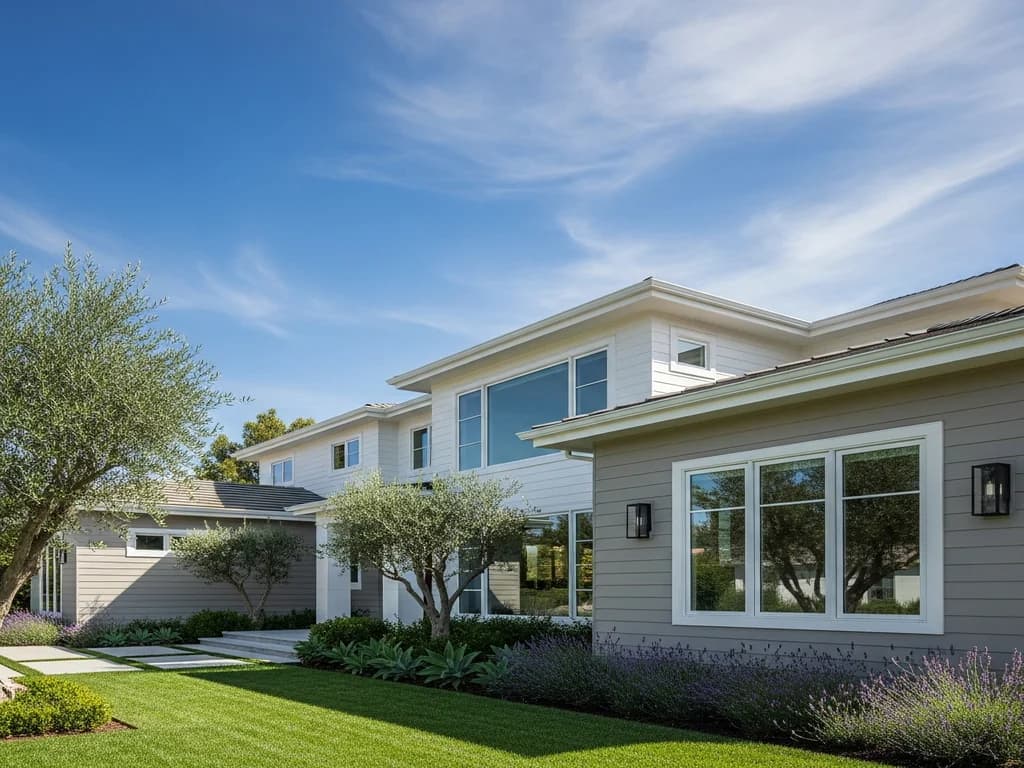
For most production ranch stock, the strongest move is also the simplest: 5-to-7-inch lap in one confident color — slate blue, warm white, charcoal, or sage — with crisp, restrained trim. This reads clean, modern, and architectural without pretending the house is something it isn't. Single-color schemes flatter the long elevation because they let the horizontality and the window rhythm do the work instead of breaking the wall into busy zones. It's the safe-but-strong direction, and it photographs well in real light. Hardie's lap profiles in a factory ColorPlus finish hold that color far longer under California sun than a field-painted wall, which matters on the broad, exposed faces a ranch presents.
Direction 2: board-and-batten accent on one elevation
Board-and-batten earns its place on a ranch as an accent, not a whole-house treatment. Applied to a single elevation — typically the front-facing gable, an entry recess, or a projecting bay — it breaks the relentless all-horizontal read just enough to make a tract ranch look intentional rather than identical to the four neighbors who share its floor plan. The trick is restraint: one accent plane, tied to the color scheme, reading as a designed moment. Run it across the whole house and you've erased the horizontality that defines the style. Done with discipline, this single-elevation accent is the highest-impact, lowest-risk way to give a production ranch a custom, considered front.
Direction 3: mid-century revival where the bones support it
Some California ranches have genuine mid-century-modern bones — clerestory windows, post-and-beam structure, butterfly or low-slope rooflines, and a deliberate indoor-outdoor relationship. On those homes, a horizontal lap with warm wood-look or warm-tone accent panels reads era-correct and premium, and it rewards a slightly warmer palette than the cooler modern direction. The discipline is honesty about the architecture: don't apply a mid-century costume to a generic builder ranch that never had those features, because the look needs the structure to be there to land. When the bones are real, lean into them; when they aren't, Direction 1 or 2 will serve the house better.
Trim and proportions for ranch
Ranch trim is lighter than craftsman by nature. Think 3-to-4-inch corner boards, 1x6 or 1x8 fascia, and modest window casing rather than the deep, layered trim a craftsman bungalow carries. Heavy traditional trim visually fights the clean horizontal architecture and makes the house read confused; lighter, modern proportions respect it and keep the eye moving along the line. The goal is crisp definition at corners and openings without ornament that the silhouette didn't ask for. This is also where a re-side beats a paint job: fresh fiber cement lets you reset trim proportions cleanly. Our James Hardie siding service handles those trim details as part of the package rather than as an afterthought.
Color choices that age well on ranch stock
Warm whites, slate blues, sages, and confident charcoals all wear well on ranch architecture and read current without chasing a trend that will date the house. Stark high-contrast schemes can work specifically as a modernization signal on a plain tract ranch, but busy multi-color schemes — three or four field and accent colors fighting across one elevation — almost always read worse on ranch than they do on craftsman or farmhouse, because the long unbroken wall has nowhere to hide the noise. Pick a confident field, one trim, and at most one accent. If you want to repaint an existing wall instead of re-siding, our exterior painting service can take a tired ranch in that direction; for color specifics, see our guide to the best Hardie colors for California.
Three working directions for California ranch homes
| Direction | When it fits | What it reads as |
|---|---|---|
| Confident modern lap in single color | Most production ranch | Modern, intentional, architectural |
| Board-and-batten accent on one elevation | Tract ranch that wants to break uniform read | Custom, considered, distinctive |
| Mid-century revival with wood-look accents | Ranches with genuine mid-century bones | Era-correct, considered, premium |
Key takeaways
- Respect the horizontality — verticals belong as accents, never as the dominant gesture
- Confident single-color modern lap is the safe, strong direction for most production ranch stock
- Board-and-batten on one accent elevation transforms a tract ranch without erasing its silhouette
- Reserve mid-century revival for ranches that actually have mid-century bones
- Ranch trim is lighter than craftsman — modern, restrained proportions read best
- Pick a confident field, one trim, and at most one accent; busy multi-color schemes read poorly on ranch
FAQ
Quick Answers
Usually yes. Full-elevation board-and-batten works against ranch horizontality and reads as the wrong style. A single accent elevation is the move.
If the architecture supports it, an entry porch can transform a ranch front. That's beyond siding scope, but we coordinate with architects when it's the right call.
Slightly. Mid-century leans warmer — warm whites, soft greens, terracotta accents — while modern ranch leans cooler with slate blues, charcoals, and crisp whites.
No. A single confident color is the lowest-risk strong move on production ranch; it lets the horizontality and window rhythm carry the elevation. Busy multi-color schemes are the real risk.
Yes. A factory ColorPlus finish resists fade far longer under California sun than field paint, which matters on the broad exposed walls a ranch presents.
If the existing siding is sound and you only want a color refresh, painting can work. If the cladding is aging or you want to reset trim proportions, a re-side gives a cleaner, longer-lasting result.
Sources
Authoritative references
External links to government, code, and manufacturer sources. Sierra Siding is not affiliated with these organizations; references are provided for verification.