Exterior renovation in Arnold
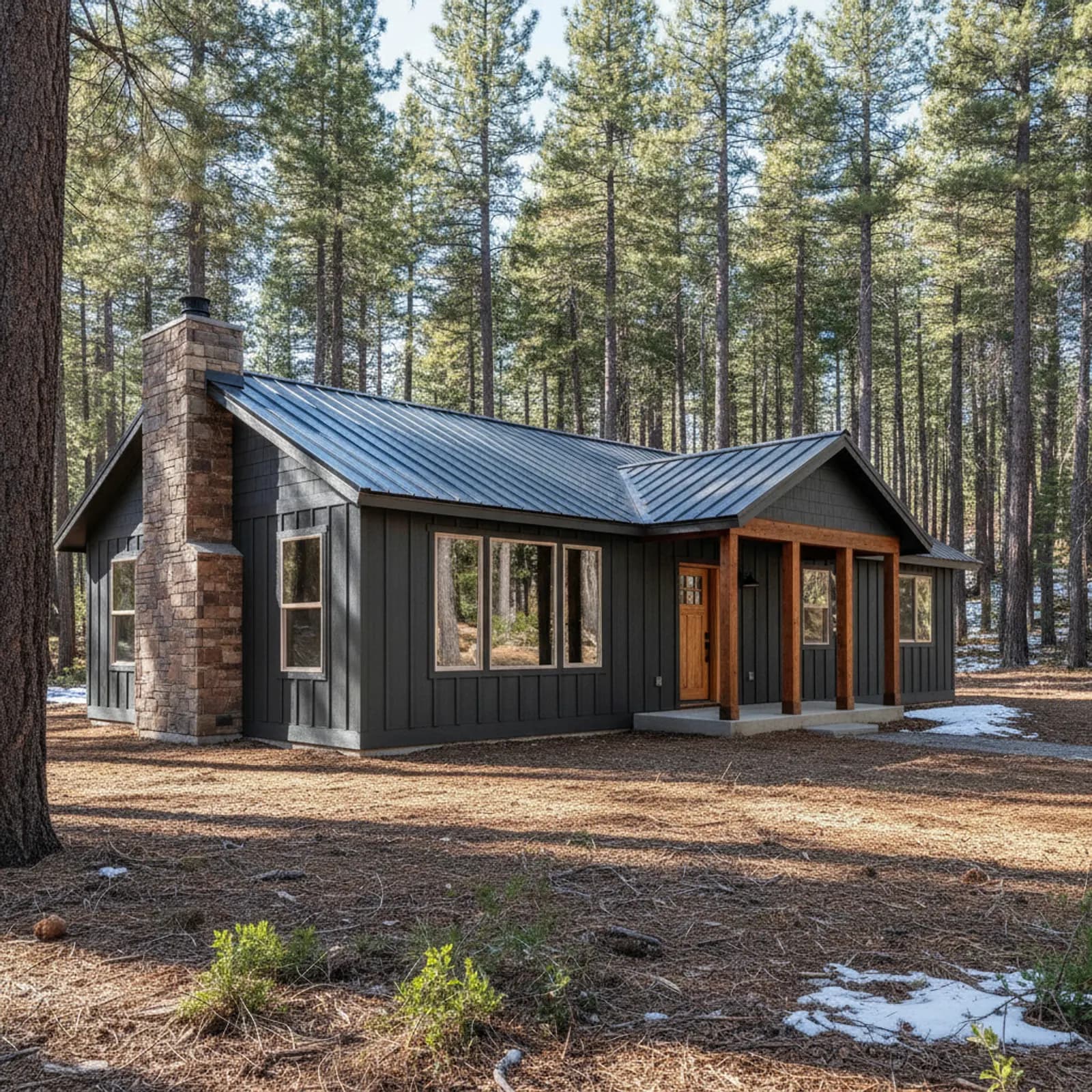
Arnold is a pine-forested mountain community high on Highway 4 — the Ebbetts Pass corridor — at the upper elevations of Calaveras County, near Calaveras Big Trees State Park and on the road up to Bear Valley. Its housing is mountain stock: pine-forest cabins and A-frames, second homes and vacation properties, rural ridge and acreage homes, and newer custom builds, many set deep among conifer. That forest setting makes Arnold one of the higher fire-exposure communities in the county, and its elevation adds a real winter of snow, freeze, and thaw that the lower foothill towns never see. An exterior here has to be engineered for both.
Two climates, one assembly
What sets Arnold apart from the mid- and lower-foothill towns is that it faces two demanding seasons rather than one. Summers bring extreme conifer-and-brush fuel loading and the ember-and-wind behavior that drives aggressive fire hardening; winters bring snow, freeze, and thaw that stress flashing, finishes, and the ground-to-wall transition. The right exterior answers both without compromise — non-combustible cladding detailed to current WUI standards for the fire, and freeze-aware flashing and snow-load-conscious detailing for the winter — in a single, coherent assembly rather than a spec tuned to only half the year.
Considering an exterior project in Arnold?
Arnold housing and architecture
Arnold's stock is classic Sierra mountain construction: pine-forest cabins and A-frames, second homes and vacation properties, rural ridge and acreage homes, and a growing body of newer mountain custom builds, most set among dense conifer. Older cabins were frequently owner-built or expanded over time, often clad in wood, board, or T1-11 with deep wood eaves typical of mountain homes — exactly the combustible detailing that makes a forest cabin vulnerable. Those surviving older homes are the highest-priority hardening targets in Arnold, while the newer custom builds let us set vents, closed eaves, and transitions correctly from the start. We design to the home and to a setting that is both fire- and snow-exposed.
Arnold's forested-mountain climate
Arnold faces the county's most demanding two-season exterior climate. Summers are hot, dry, and high-UV with extreme conifer-and-brush fuel loading, and the forested ridge terrain channels wind in ways that drive aggressive ember behavior — the controlling stressor. Winters are genuinely cold and wet for a Calaveras community, with recurring snow, freeze, and thaw at Arnold's elevation that work at flashing, finishes, and any weak point in the drainage plane. So the exterior has to resist embers above all while also managing snow and meltwater through freeze-aware detailing — two agendas the assembly has to satisfy together.
Aggressive wildfire hardening in Arnold
Arnold warrants the most rigorous hardening practice we have. We specify Class A non-combustible fiber cement and detail uncompromisingly at eaves, soffits, vents, decks, and ground-to-wall transitions, recognizing the conifer forest's extreme ember-and-wind exposure, and we build to current California WUI standards. Combustible wood, board, and T1-11 cladding — common on Arnold's older cabins — is exactly the vulnerability re-cladding removes, making it the single highest-value survival upgrade available to a surviving forest home. We document every assembly so the work supports defensible-space, code, and insurability requirements; insurers set their own criteria. We won't overstate what siding does, but in a dense conifer setting like Arnold there is nothing to overstate — the exposure is genuinely severe.
Recommended materials for Arnold
Non-combustible fiber cement, hardened and detailed to current WUI standards, is the only cladding we recommend in Arnold — combustible cladding is not a category we'll install in this conifer forest, regardless of cost or mountain tradition. Fiber cement also handles Arnold's wet, freezing winters when it's flashed correctly, so the safest material is also the soundest one on every count, with no durability traded to gain the fire performance. High-UV finishes carry the intense summer sun at elevation, and freeze-aware flashing and detailing manage the snow, meltwater, and thaw cycles that define the winter half of the year.
What an exterior project costs in Arnold
Arnold projects carry comprehensive fire-hardening scope and current-code detailing as the baseline, plus a winter dimension the lower towns don't have. On top of the hardening sit deep-forest and ridge access on long or rough drives, snow-influenced scheduling that narrows the working window at Arnold's elevation, freeze-aware flashing detail, and substrate or rot discovery on older cabins once old cladding comes off. Rebuilds and newer custom builds tend to be more predictable; older owner-built cabins carry more discovery. We assess on site and provide a written, itemized estimate — the hardening and winter detailing are the point here, and pricing reflects the detail rather than square footage alone.
Surviving cabins versus newer builds
An older Arnold cabin still clad in wood or T1-11 sits in the same dense conifer terrain as everything around it, only with combustible skin intact — the highest-value survival step available to it is re-cladding in hardened non-combustible fiber cement, and it can often be staged ahead of other work. Newer mountain custom builds, by contrast, let us integrate hardened vents, closed eaves, and ground transitions from the framing up. We scope each path for what it is, holding both to the same WUI standard.
Snow, freeze, and the winter window
Arnold's elevation on the Ebbetts Pass corridor means recurring snow, freeze, and thaw, so we plan the work around the wet season during the on-site visit and detail flashing to handle meltwater and ice at the ground-to-wall transition and around penetrations. Access along forested drives can be complicated by snow and weather, which affects delivery and staging. We won't start a re-side into conditions that would compromise flashing details or strand a delivery on an unpaved mountain approach.
Second homes and documentation
Many Arnold properties are second homes and vacation cabins whose owners aren't on site year-round, which makes a documented, low-maintenance, hardened exterior especially valuable. We record the non-combustible materials and hardened assemblies used so the work supports defensible-space, code, and insurability conversations — increasingly important for forest properties — and so an owner has a clear record of what's on the walls without needing to be there to inspect it.
Calaveras County, CCWD, and Ebbetts Pass Fire / CAL FIRE
Working exteriors in Arnold coordinates with a few local authorities. Arnold is unincorporated Calaveras County — there is no city government, so building permits come through the Calaveras County Building Department rather than a municipal department. Electric and gas are PG&E, and the Highway 4 / Ebbetts Pass corridor is documented high-PSPS territory. Water is supplied by the Calaveras County Water District (CCWD) Ebbetts Pass service area. Fire response is the Ebbetts Pass Fire Protection District alongside CAL FIRE Tuolumne-Calaveras Unit (TCU) on wildland calls, with the Calaveras County Sheriff coordinating events.
HZ10 and the Ebbetts-Pass FHSZ reality
Arnold is in James Hardie's HZ10 climate zone (Arnold at ~4,000 feet sits below the HZ5 high-elevation threshold — HZ5 is reserved for higher-Sierra/Tahoe-basin work); installing HZ5 is a documented warranty misapplication. On the fire side, essentially every parcel in Arnold sits in High or Very High FHSZ territory under California's 2025 LRA Fire Hazard Severity Zone map, with surrounding land in Stanislaus National Forest. The 2015 Butte Fire burned adjacent Calaveras terrain; the corridor has repeatedly seen red-flag events. On these parcels the 2025 California Wildland-Urban Interface Code governs the exterior wall. Chapter 7A moved into the standalone WUI Code on January 1, 2026.
Our process in Arnold
- Step 1
Consultation
We listen to your goals and assess your home on site — exposure, substrate, and architecture.
- Step 2
Design & Proposal
A clear written proposal with the right system specified for your climate and a transparent scope.
- Step 3
Expert Installation
Trained crews install to manufacturer best practices with careful weather-management detailing.
- Step 4
Walkthrough & Support
A final walkthrough, full cleanup, and a clear written record of the scope completed — work we stand behind.
Arnold demands an exterior built for two hard seasons at once — extreme conifer-forest fire in summer and real snow and freeze in winter — and we build to exactly that standard: genuinely hardened, freeze-aware, and detailed to current WUI practice. We scope every Arnold project on site, plan around the forest access and winter window, and your written estimate governs the work.
FAQ
Arnold — Common Questions
Severe — Arnold is a dense conifer-forest community on the Ebbetts Pass corridor, in extreme fuel loading, and the county's 2015 Butte Fire is a plain reminder of the exposure. We apply our most rigorous hardening practice and current WUI standards here.
Yes — at Arnold's elevation winters bring recurring snow, freeze, and thaw, so we add freeze-aware flashing and detailing that manages meltwater and ice alongside the fire hardening. It's a two-season exterior spec.
Re-cladding combustible wood or T1-11 in hardened non-combustible fiber cement is the single highest-value survival upgrade available to a conifer-forest Arnold cabin, and it can often be staged ahead of other improvements.
No — we won't install combustible cladding in Arnold's dense conifer forest given the extreme exposure. Non-combustible, hardened assemblies are the only responsible choice, and fiber cement handles the wet, freezing winters just as well.
Explore
Exterior Services
Helpful Exterior Guides