
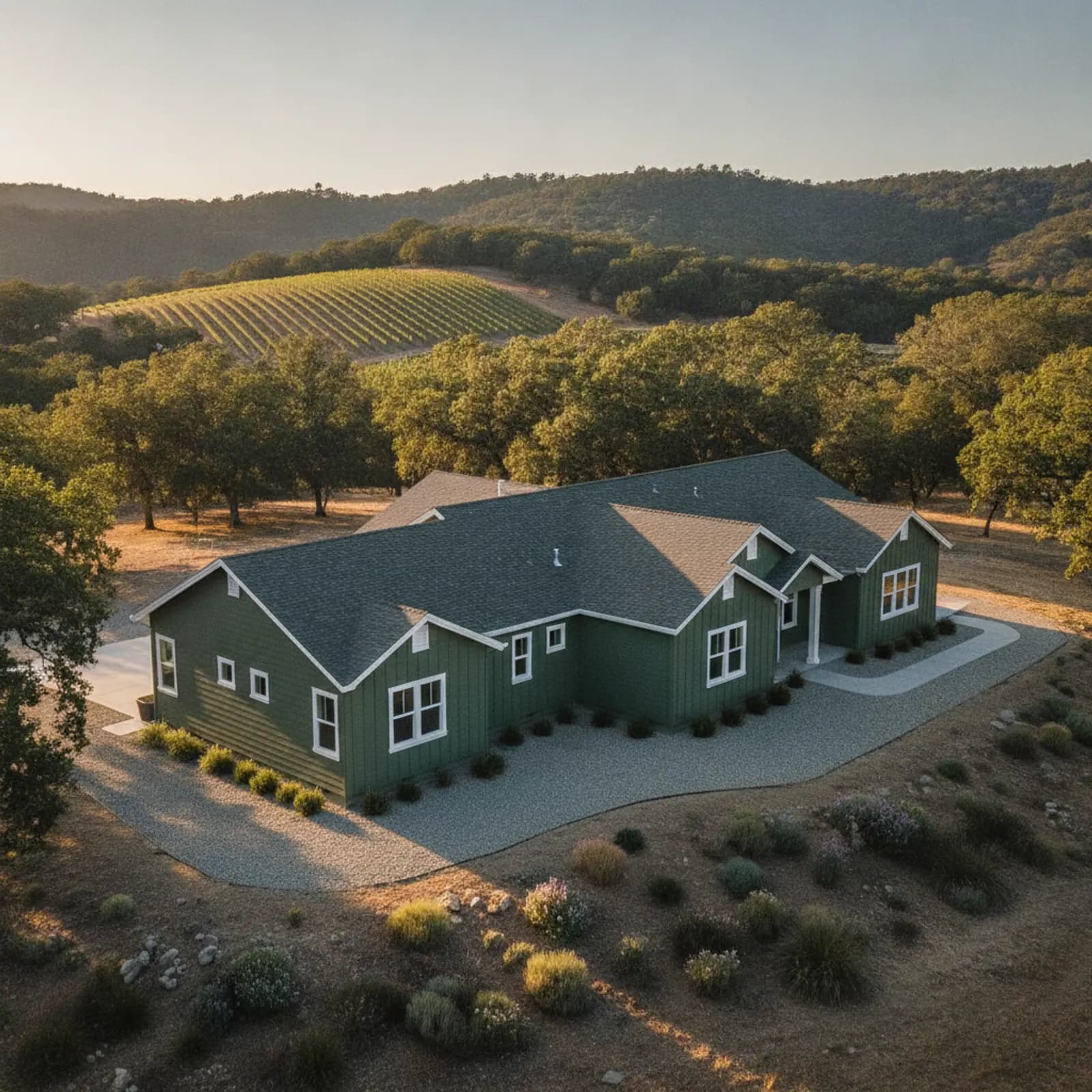
Exterior renovation in Murphys
Murphys sits in the mid-elevation Calaveras foothills off Highway 4, a former Gold Rush camp turned wine-country destination whose preserved Main Street of tasting rooms, the historic Murphys Hotel, and nearby caverns and vineyards draw visitors year-round. Its housing spans 1800s stone-and-wood cottages near the historic core, wine-country custom and estate homes, wooded hillside and vineyard-edge properties, and rural acreage among oak and pine. The setting is genuinely design-conscious — and genuinely fire-exposed, with wooded hillsides and cured summer grass on nearly every side. An exterior here has to satisfy both a discerning aesthetic and a serious hardening standard.
Hardening that reads as architecture
What distinguishes Murphys from the county's more utilitarian towns is the market's expectation that fire hardening arrive as good design. Owners of wine-country and estate homes want non-combustible cladding, refined trim, and finishes chosen to suit a wooded or vineyard setting — a home that is demonstrably hardened yet still reads as architecture rather than armor. We treat the fire and durability engineering as the floor here, not the finished product, pairing genuinely hardened assemblies with the profiles, reveals, and finishes a design-aware Murphys home deserves.
Considering an exterior project in Murphys?
Murphys housing and architecture
Murphys blends preserved history with wine-country custom work: 1800s stone-and-wood cottages and buildings near Main Street, custom and estate homes on wooded and vineyard-edge parcels, and rural acreage homes among oak and pine. The historic core rewards period-correct profiles and restraint, while the custom and estate homes invite refined trim, wider or mixed profiles, and designer finishes that suit an affluent, design-aware market. Nearly all of it sits in wooded foothill terrain that raises the fire stakes. We match the profile and finish to the home — period-sensitive downtown, architecturally refined on the estates — and hold the non-combustible, hardened standard across both.
Murphys's foothill climate
Murphys runs hot and dry through long, high-UV summers that fade and chalk coatings on exposed walls, with cool, wet winters and little to no snow at its mid-foothill elevation. As everywhere in Calaveras, both defer to fire: the surrounding wooded hillsides and cured grass build to real fuel through the dry season, and the terrain and wind drive the ember exposure that governs the exterior spec. The cladding is specified for ember-and-wind behavior first, with non-combustible fiber cement carrying the summer heat and UV and correct drainage detailing handling the wet winter behind refined finishes.
Wildfire hardening in Murphys
Murphys's wooded hillside and vineyard-edge parcels carry high fire exposure, so we specify Class A non-combustible fiber cement and detail aggressively at eaves, soffits, vents, decks, and ground-to-wall transitions to current California WUI standards — the more so on the forested and acreage lots where fuel presses close to the home. The design expectation here doesn't soften the hardening; it raises the bar on doing it well, integrating the fire detailing into a refined exterior rather than bolting it on. We document every assembly so the work supports defensible-space and insurability conversations, and we're clear that siding is one layer of a whole-home and whole-property strategy — hardening the wall matters most alongside the eaves, vents, deck, and defensible space around it.
Recommended materials for Murphys
Class A non-combustible fiber cement is the core recommendation across Murphys, chosen as much for how well it takes a refined, design-conscious finish as for its fire performance. It hardens the home against the wooded foothill exposure while delivering the heat, UV, and wet-winter durability the setting demands, and it accepts custom trim, mixed profiles, and designer color programs cleanly. On the historic core we keep profiles period-correct; on the estate and vineyard-edge homes we lean into refined trim and finishes. Either way the assembly is non-combustible and hardened, so the aesthetic upgrade and the survival upgrade are the same project.
What an exterior project costs in Murphys
Murphys pricing turns on the same drivers as the rest of the county — home size and stories, profile and trim complexity, substrate and dry-rot discovery, window integration, and fire-hardening scope — but two things push it in a particular direction here. The design-conscious market often calls for refined trim, custom profiles, and designer finishes that add scope beyond a straightforward re-side, and the wooded estate and acreage parcels carry heavier fire detailing and sometimes longer access. The historic core adds period-matching and discovery on century-old homes. We provide a written, scoped estimate after an on-site assessment so bids compare on substance rather than a headline number.
Wine-country and estate homes
Murphys's custom and estate homes on wooded and vineyard-edge parcels are the county's most design-driven exterior work. Owners here expect the hardening to arrive as architecture — refined trim, considered profiles, and finishes tuned to a wooded or vineyard setting — over a genuinely non-combustible, WUI-detailed assembly. We scope these projects to deliver both, treating the fire engineering as the non-negotiable floor and the design as the reason the finished home stands out on its street.
The historic Main Street core
Murphys's preserved Main Street and its surrounding 1800s cottages carry a period character that a generic re-side would erase. On these homes we match lap width, trim proportions, and finish to the era while hardening the assembly underneath, and we plan for the dry rot and layered original siding a century-old foothill home often hides. Protecting that character protects one of Gold Country's most-visited streetscapes.
Documentation and insurability
In a high-value, fire-exposed wine-country market, a documented hardening record matters. We record the non-combustible materials and hardened assemblies we install so the work supports defensible-space, code, and insurability conversations on wooded Murphys parcels. Insurers set their own criteria and we won't speak for them, but a clear, current-WUI record is the strongest position a homeowner can bring to that discussion.
Calaveras County, CCWD, and Ebbetts Pass Fire
Working exteriors in Murphys coordinates with a few local authorities. Murphys is unincorporated Calaveras County — there is no city government, so building permits come through the Calaveras County Building Department rather than a municipal department. Electric and gas are PG&E, and the entire Highway 4 corridor is a documented PSPS-shutoff area during red-flag conditions. Water is supplied by the Calaveras County Water District (CCWD), a public agency serving Murphys and the surrounding communities. Fire response is the Ebbetts Pass Fire Protection District alongside CAL FIRE Tuolumne-Calaveras Unit on wildland calls, with the Calaveras County Sheriff coordinating evacuation during major events.
HZ10 and the Butte-Fire-adjacent FHSZ reality
Murphys is in James Hardie's HZ10 climate zone; installing HZ5 is a documented warranty misapplication. On the fire side, the historic Main Street core and the immediately adjacent flat blocks sit in Moderate FHSZ territory under California's 2025 LRA Fire Hazard Severity Zone map, while the wooded hillside and vineyard-edge parcels on every side of town carry High to Very High designations — an exposure profile burned into the county's memory by the 2015 Butte Fire, which destroyed 549 homes across Calaveras. On designated hillside parcels the 2025 California Wildland-Urban Interface Code governs the exterior wall. Chapter 7A moved into the standalone WUI Code on January 1, 2026.
Our process in Murphys
- Step 1
Consultation
We listen to your goals and assess your home on site — exposure, substrate, and architecture.
- Step 2
Design & Proposal
A clear written proposal with the right system specified for your climate and a transparent scope.
- Step 3
Expert Installation
Trained crews install to manufacturer best practices with careful weather-management detailing.
- Step 4
Walkthrough & Support
A final walkthrough, full cleanup, and a clear written record of the scope completed — work we stand behind.
Murphys rewards an exterior strategy that treats fire hardening and refined design as the same goal, whether that's a historic Main Street cottage or a wooded estate on the vineyard edge. We scope every Murphys project on site so the hardening and the finish both meet the mark, and your written, itemized estimate governs the work.
FAQ
Murphys — Common Questions
Class A non-combustible fiber cement — it hardens the home against the wooded foothill fire exposure and also takes refined, design-conscious trim and finishes cleanly, so the survival upgrade and the aesthetic upgrade are the same project.
Yes — that's the core of how we work in Murphys. We integrate non-combustible cladding and WUI detailing into a refined exterior with custom trim and designer finishes, so the home reads as architecture rather than armor while being genuinely hardened.
High on the wooded hillside and vineyard-edge parcels, which press real fuel close to homes, and elevated in town. The 2015 Butte Fire across Calaveras County is a plain reminder. We specify non-combustible cladding and scale the hardening to each parcel.
No — no cladding is fireproof, and we won't claim it is. Fiber cement is noncombustible (Class A when tested per ASTM E84), which is why it leads in fire country, but it's one layer of a whole-home and defensible-space strategy.
Explore