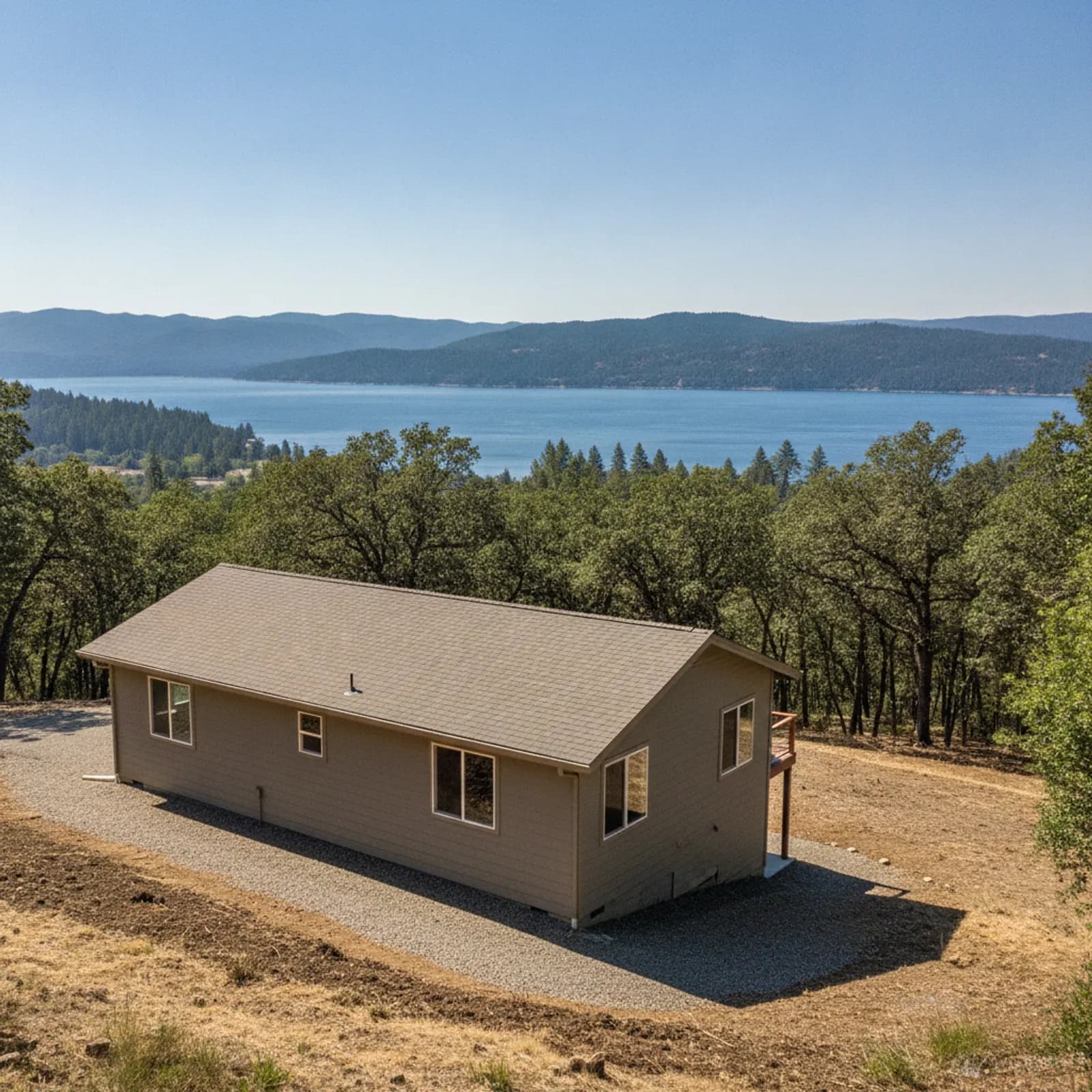
Exterior renovation in Clearlake
Clearlake is the largest city in Lake County, spread along the southeast shore of Clear Lake and up into the surrounding hills. Its housing is unusually varied and value-oriented: older lakeside cottages and vacation cabins that became year-round homes, post-war and economy houses, a large share of manufactured and self-built structures, and newer hillside and infill construction. Much of this stock sits directly in the wildland-urban interface, with oak, chaparral, and cured grass climbing the slopes right behind the streets. A re-side here is first a fire-hardening project and second a repair of decades of lake-basin sun and damp on cladding that was rarely specified for either.
Interface fire, on a lake
What defines Clearlake is that it is both a lakeside community and a wildland-interface one. The same neighborhoods that enjoy the water sit below and among fuel-loaded hills, and the county's recent fire history — including the Mendocino Complex that burned the ranges around Clear Lake in 2018 — makes that exposure concrete rather than hypothetical. At the same time the basin holds humidity, fog, and winter damp longer than the open valley. So the honest Clearlake spec answers two things at once: non-combustible cladding and hardened detailing for the fire, and careful drainage-plane work for the moisture. Neither can be treated as an afterthought.
Considering an exterior project in Clearlake?
Clearlake housing and architecture
Clearlake's stock is practical and eclectic rather than architecturally uniform: older lakeside cottages and former cabins, post-war and economy homes, a significant number of manufactured and owner-built houses, and pockets of newer hillside and infill construction. Many of these homes still wear original wood, hardboard, T1-11, or aging economy cladding — combustible materials sitting in an interface setting. That makes re-cladding in non-combustible fiber cement the single highest-value exterior upgrade available to most of them. We keep profiles simple and durable to suit the community's character and the budgets common here, and we read each parcel for how close it sits to open fuel before finalizing the detailing.
Clearlake's lake-basin fire climate
Clearlake's controlling stressor is foothill fire. Hot, dry, high-UV summers cure the grass and brush on the slopes behind the neighborhoods, and the terrain-and-wind behavior that drives Lake County's fire seasons puts the interface homes at real risk. Layered on top is the lake basin's moisture: cool, damp, foggy winters and lakeside humidity that linger longer than in the open valley, keeping drainage detailing relevant year-round. The exterior here is specified for embers and wind first, then detailed to shed the basin's moisture — a wall that has to resist ignition and manage damp at the same time.
Wildfire hardening in Clearlake
Clearlake's wildland-interface setting warrants rigorous hardening on most parcels. We specify Class A non-combustible fiber cement and detail carefully at eaves, soffits, vents, and the ground-to-wall transition where embers gather, matched to how exposed each home is on its slope. The manufactured and older self-built homes common here often carry the most combustible, least-detailed exteriors in the interface, so they gain the most from re-cladding. We work to current California WUI standards and document the assemblies, and we are direct that siding is one layer — defensible space, roofing, and vents matter alongside it. Fiber cement is non-combustible, not fireproof, and we won't claim otherwise.
Recommended materials for Clearlake
Non-combustible fiber cement is the core recommendation across Clearlake: Class A rated, it removes the wall as an ignition path in an interface city while also standing up to the basin's high-UV summers and damp winters far better than the wood, hardboard, and economy cladding it replaces. Factory-applied finishes hold color through the exposed lakeside sun, and correct weather-resistive barrier, flashing, and bottom-course detailing handle the lake humidity on low-lying and shoreline parcels. On the many manufactured and self-built homes here we keep the system practical and durable while making sure the fire and moisture detailing is done properly rather than skipped.
What an exterior project costs in Clearlake
Clearlake pricing turns on home size and stories, the fire-hardening scope a parcel's interface exposure calls for, substrate and dry-rot condition once cladding is removed, window integration, and access on the hillside and lakeside lots. Two factors are particular to Clearlake: the older self-built and manufactured homes more often reveal irregular framing or dry rot at demolition, and steep or narrow hillside access can affect staging. Homes closer to the open slopes carry more hardening scope than those on interior streets. We assess on site and provide a written, itemized estimate, because the honest number depends heavily on where in the interface a home sits.
Manufactured and self-built homes in the interface
Clearlake has an unusually large share of manufactured and owner-built homes, many of them clad in combustible or economy materials and sitting close to open fuel. These are exactly the structures where a non-combustible re-clad and hardened detailing deliver the biggest survivability gain for the money, and they are also the most likely to reveal irregular framing or dry rot once the old cladding is off. We scope them honestly, plan for substrate discovery, and keep the assembly durable and practical rather than over-specified.
Lakeside damp and shoreline parcels
The homes closest to Clear Lake gain the water's amenity and its moisture. On shoreline and low-lying parcels we pair the non-combustible cladding with more deliberate drainage-plane work — continuous weather-resistive barrier, flashed penetrations, kickout flashings, and correct bottom-course clearances — so the wall manages the basin's humidity and fog as reliably as it resists embers. It is a two-front spec, and we detail for both rather than letting the fire agenda crowd out the moisture one.
Documentation, defensible space, and insurability
Insurance is a live concern for Lake County homeowners, and Clearlake is no exception. We document the non-combustible materials and assemblies we install so the exterior supports defensible-space, code, and insurability conversations. Insurers set their own criteria and we don't speak for them, but a documented, current-WUI non-combustible assembly is a strong position to bring to that discussion — and we're clear that it works alongside vegetation clearance and the rest of the property's hardening, not in place of it.
PG&E + PSPS, Konocti County Water, and Lake County Fire
Working exteriors in the City of Clearlake coordinates with a few local authorities. Electric and gas both come from PG&E, and Clearlake is in one of the highest-PSPS corridors in California — the same dry offshore-wind conditions that drove Lake County's major fires trigger Public Safety Power Shutoffs. Water is supplied by Konocti County Water District, Highlands Mutual Water, or Golden State Water Company depending on the address. Fire response is Lake County Fire Protection District alongside CAL FIRE's Sonoma-Lake-Napa Unit. On the permit side, the City of Clearlake Community Development Department handles building permits. We flag utility, permit, and fire items at the estimate stage.
HZ10, the Valley/Mendocino Complex fires, and Very-High FHSZ
Clearlake is in James Hardie's HZ10 climate zone; installing HZ5 is a documented warranty misapplication. On the fire side, essentially all of Lake County has lived through repeated named events — the 2015 Valley Fire, 2018 Mendocino Complex, and 2020 LNU Complex among them — and Clearlake and its surrounding unincorporated territory sit in Moderate to Very High FHSZ under California's 2025 LRA Fire Hazard Severity Zone map, with substantial areas in State Responsibility Area. The 2025 California Wildland-Urban Interface Code governs the exterior wall on designated parcels. The code frame changed on January 1, 2026, when Chapter 7A moved into the standalone WUI Code.
Our process in Clearlake
- Step 1
Consultation
We listen to your goals and assess your home on site — exposure, substrate, and architecture.
- Step 2
Design & Proposal
A clear written proposal with the right system specified for your climate and a transparent scope.
- Step 3
Expert Installation
Trained crews install to manufacturer best practices with careful weather-management detailing.
- Step 4
Walkthrough & Support
A final walkthrough, full cleanup, and a clear written record of the scope completed — work we stand behind.
Clearlake asks an exterior to do two hard things at once: resist ignition in a wildland-interface setting and manage the moisture of life on the lake. We scope every Clearlake project on site so the fire and drainage detailing match the actual parcel, build non-combustible and hardened to current WUI practice, and your written, itemized estimate governs the work.
FAQ
Clearlake — Common Questions
Non-combustible fiber cement. Clearlake is a wildland-interface city, so Class A cladding that removes the wall as an ignition path is the priority, and it also handles the lake-basin sun and winter damp far better than the wood or economy cladding it replaces.
Yes — Clearlake sits in the interface below fuel-loaded hills, and the Mendocino Complex burned the ranges around Clear Lake in 2018. We specify non-combustible cladding and hardened detailing on most parcels, tailored to how exposed each home is.
No. It is non-combustible with a Class A rating, which removes the wall itself as an ignition path — one important layer of hardening. Nothing on a house is truly fireproof, and defensible space, roofing, and vents matter alongside the siding.
Yes, and these are often where a non-combustible re-clad delivers the biggest survivability gain. We check framing and substrate carefully, plan for dry rot or irregular construction at demolition, and keep the assembly durable and practical.
They do — the Clear Lake basin holds more humidity and fog than the open valley, so shoreline and low-lying homes get extra weather-resistive barrier, flashing, and bottom-course detailing alongside the fire hardening.
We build to current WUI standards and document every assembly so the work supports defensible-space, code, and insurability conversations. Insurers set their own criteria, but a documented non-combustible assembly is a strong position to bring.
A correctly installed fiber cement system commonly performs 30+ years through the basin's hot summers and damp winters, while materially reducing the wall's contribution to ignition risk.
Explore