Exterior renovation in Kelseyville
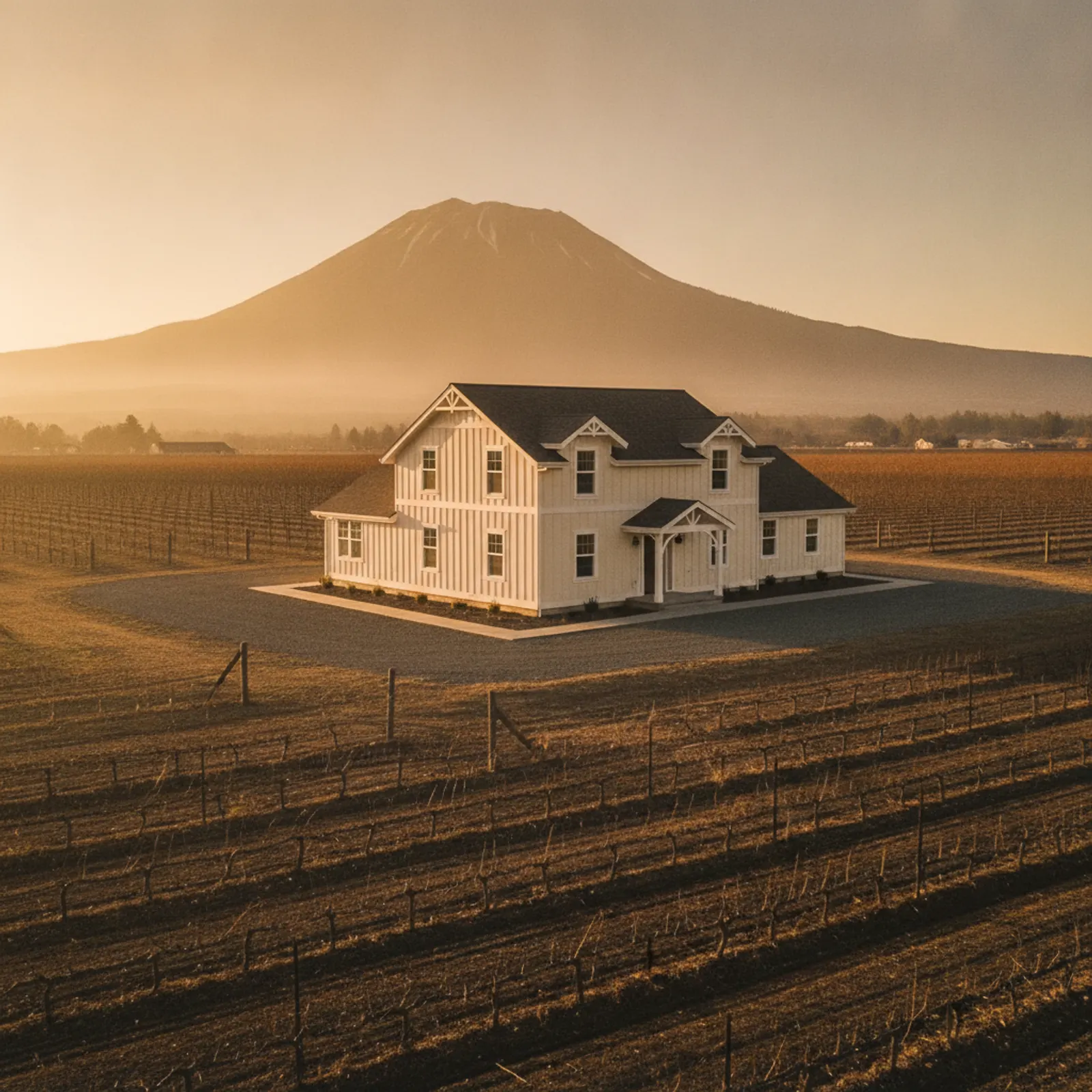
Kelseyville is an unincorporated community on the south shore of Clear Lake, framed by Mount Konocti and by the vineyards, pear and walnut orchards, and grazing land that define its economy. Its housing runs to older farmhouses and small-town homes near the historic center, vineyard and orchard estate homes, rural acreage and hillside houses, and post-war and mid-century cottages. Much of this stock sits in a working agricultural landscape of cured grass, brush, and outbuildings — a high-fire setting where combustible original cladding is a real liability. A re-side here is a fire-hardening decision first, made to suit the rural character rather than to erase it.
Fire in a working ag landscape
What sets Kelseyville apart from the county's lakeside cities is that its fire exposure is bound up with agriculture and terrain. Vineyards and orchards break up some fuel, but the surrounding grass, brush, oak woodland, and the slopes of Mount Konocti carry real wildfire risk, and Lake County's recent fire seasons have proven it. Homes here often sit on acreage among barns, sheds, and other outbuildings, so hardening is a property-wide question, not just a wall question. The basin's damp winters add a moisture layer. The honest Kelseyville spec is non-combustible cladding, ember-aware detailing, and a clear-eyed look at everything standing near the house.
Considering an exterior project in Kelseyville?
Kelseyville housing and architecture
Kelseyville's stock reflects its farm-town roots: older farmhouses and small-town homes near the historic center, vineyard and orchard estate homes on the surrounding land, rural acreage and hillside houses climbing toward Mount Konocti, and post-war and mid-century cottages. Many carry wood, board-and-batten, or T1-11 cladding well suited to their rural character but combustible in a high-fire setting. Fiber cement is made in board-and-batten and lap profiles that preserve that farmhouse and estate look while removing the fire liability, which is the right move here. On acreage parcels the outbuildings and their transitions factor in too. We design to the home's character and its exposure together.
Kelseyville's foothill-and-ag fire climate
Kelseyville's controlling stressor is foothill fire in an agricultural setting. Hot, dry, high-UV summers cure the grass and brush across the orchards, vineyards, and hillsides, and the terrain around Mount Konocti and the county's wind behavior drive the fire seasons that have repeatedly threatened the region. The Clear Lake basin adds cool, damp, foggy winters that keep drainage detailing relevant. The exterior here is specified for embers and radiant heat first — with particular attention to homes backing onto open fuel and to the outbuildings around them — then detailed to handle the basin's UV and winter moisture on the same wall.
Fire hardening in Kelseyville
Kelseyville's rural, high-fire setting warrants serious hardening. We specify Class A non-combustible fiber cement and detail at eaves, soffits, vents, and the ground-to-wall transition where embers collect, scaled to how exposed each parcel is on its slope or field edge. On acreage we talk through hardening the outbuildings and the immediate defensible zone too, since a home is only as defensible as the barn or shed beside it. We work to current California WUI standards and document the assemblies. And we are candid: fiber cement is non-combustible, not fireproof, and it is one layer of a strategy that also depends on defensible space, roofing, vents, and vegetation management across the property.
Recommended materials for Kelseyville
Non-combustible fiber cement is the core recommendation across Kelseyville: Class A rated, it removes the wall as an ignition path in a high-fire ag landscape while standing up to the exposed summer UV and the basin's damp winters. Critically, it is available in board-and-batten and lap profiles that keep the farmhouse, estate, and rural character homeowners here value — so hardening does not mean giving up the look. Factory finishes hold color through the strong hillside sun, and correct flashing and bottom-course detailing handle the winter moisture. On working parcels we keep the same non-combustible standard in view for outbuildings and transitions, not just the main house.
What an exterior project costs in Kelseyville
Kelseyville pricing turns on home size and stories, the fire-hardening scope the parcel's exposure calls for, substrate and dry-rot condition once cladding is removed, window integration, and rural access and staging on acreage. Two factors are particular here: hardening scope can extend beyond the main house to outbuildings on working parcels, and long or rough farm driveways affect material delivery and debris removal. The older farmhouses more often reveal layered siding or dry rot at demolition. We assess on site and provide a written, itemized estimate, because a vineyard-estate re-clad and an in-town cottage re-side are genuinely different jobs.
Vineyard, orchard, and estate homes
Kelseyville's wine-and-ag identity brings estate and farmhouse homes set among vineyards and orchards, where owners want a look that belongs in that landscape. Fiber cement's board-and-batten and lap profiles let us deliver a hardened, non-combustible exterior that still reads as a proper country home. On these parcels we also weigh the surrounding fuel and the outbuildings, since the fire strategy is property-wide. The result is character preserved and liability reduced, documented for the code and insurance conversations these owners increasingly face.
Acreage, outbuildings, and the defensible zone
Many Kelseyville homes sit on acreage with barns, sheds, shops, and other structures. Hardening the house alone leaves obvious gaps, so we talk through the outbuildings and the immediate defensible zone as part of a sensible exterior strategy. Access on long farm drives shapes staging and debris logistics, which we plan during the site walk so the crew sequences work efficiently across the structures that matter on the property.
Mount Konocti and the hillside edge
Homes climbing the slopes below Mount Konocti sit closest to the woodland and carry the most acute ember and radiant-heat exposure in the Kelseyville area. For those parcels the hardening scope is heaviest — non-combustible cladding, uncompromising eave and vent detailing, and close attention to the ground-to-wall transition. We won't overstate the risk on an in-town lot or understate it on a hillside home backing onto open fuel; the spec follows the parcel.
Lake County, Kelseyville water, and Kelseyville Fire
Working exteriors in Kelseyville coordinates with a few local authorities. Kelseyville is unincorporated Lake County — there is no city government, so building permits come through the Lake County Community Development Department rather than a municipal department. Electric and gas are PG&E, and the entire Highway 29 corridor around Clear Lake is documented high-PSPS territory. Water is supplied by the Kelseyville County Waterworks District (a small county-managed district serving the town); private wells serve rural acreage and the vineyard corridor. Fire response is the Kelseyville Fire Protection District alongside CAL FIRE Sonoma-Lake-Napa Unit (LNU) on wildland calls into the Mount Konocti and Konocti Wildlife Area corridor.
HZ10 and the LNU-Complex FHSZ reality
Kelseyville is in James Hardie's HZ10 climate zone; installing HZ5 is a documented warranty misapplication. On the fire side, essentially every parcel in and around Kelseyville sits in High or Very High FHSZ territory under California's 2025 LRA Fire Hazard Severity Zone map — the Clear Lake basin is high-fire country. The 2018 Mendocino Complex (Ranch + River Fires, 459,123 acres, California's third-largest recorded fire), the 2015 Valley Fire (76,067 acres, 1,955 structures), and the 2020 LNU Lightning Complex all burned Lake County terrain within recent memory. On these parcels the 2025 California Wildland-Urban Interface Code governs the exterior wall. Chapter 7A moved into the standalone WUI Code on January 1, 2026.
Our process in Kelseyville
- Step 1
Consultation
We listen to your goals and assess your home on site — exposure, substrate, and architecture.
- Step 2
Design & Proposal
A clear written proposal with the right system specified for your climate and a transparent scope.
- Step 3
Expert Installation
Trained crews install to manufacturer best practices with careful weather-management detailing.
- Step 4
Walkthrough & Support
A final walkthrough, full cleanup, and a clear written record of the scope completed — work we stand behind.
Kelseyville rewards an exterior approach that takes its high-fire, agricultural setting seriously while honoring the rural and estate character homeowners value here. We scope every Kelseyville project on site — house and outbuildings alike — build non-combustible and hardened to current WUI practice, and your written, itemized estimate governs the work.
FAQ
Kelseyville — Common Questions
Non-combustible fiber cement. Kelseyville sits in a high-fire agricultural landscape below Mount Konocti, so Class A cladding is the priority — and it comes in board-and-batten and lap profiles that keep the farmhouse and estate character.
Serious. The surrounding grass, brush, orchards, and the slopes of Mount Konocti carry real exposure, and Lake County's recent fire seasons have proven it. We specify non-combustible cladding and ember-aware detailing scaled to each parcel.
Yes — fiber cement is made in board-and-batten and lap profiles that preserve the farmhouse and estate character while removing the fire liability of wood or T1-11 cladding.
On working parcels, yes. A home is only as defensible as the barn or shed beside it, so we talk through the outbuildings and the immediate defensible zone as part of a property-wide fire strategy.
No — it is non-combustible with a Class A rating, which removes the wall as an ignition path. It is one layer of hardening that works alongside defensible space, roofing, vents, and vegetation management across the property.
Generally yes — hillside homes closest to the woodland carry the most acute ember and radiant-heat exposure, so their hardening scope is heaviest. In-town lots well away from open fuel warrant less. The spec follows the parcel.
A correctly installed fiber cement system commonly performs 30+ years through the exposed summer UV and damp basin winters, while materially reducing the wall's contribution to ignition risk.
Explore
Exterior Services
Helpful Exterior Guides