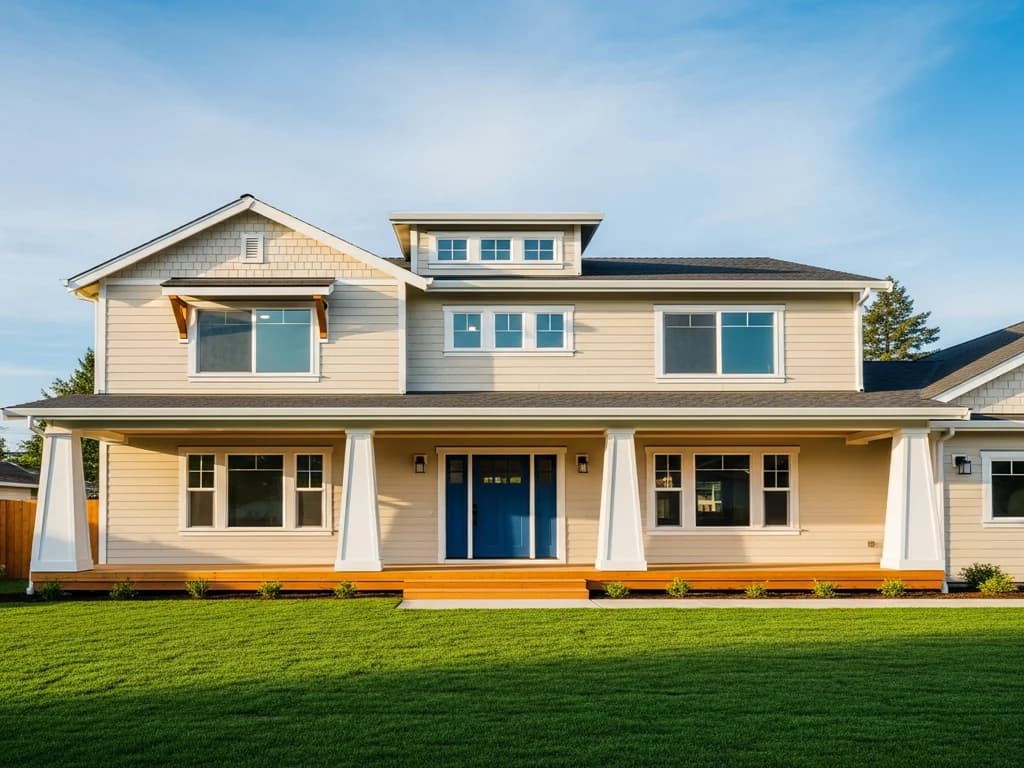
Siding in Foresthill
Foresthill sits out on a forested ridge between the North and Middle Fork American River canyons, reached by the long span of the Foresthill Bridge, and a re-side here is unlike anything we do down in Auburn or Newcastle. This is deep wildland-urban interface — cabins, acreage homesteads, and custom homes tucked under a dense conifer canopy, with the river canyons funneling wind and fuel on three sides. For a Foresthill home, replacing the cladding is first and foremost a chance to harden the structure against the extreme ember exposure that defines this ridge.
So we scope a Foresthill re-side fire-first and access-second: the cladding, the eave and vent details, and the long haul up the ridge all get planned before anyone talks about color.
Re-siding a ridge home as extreme-WUI hardening
On a ridge this deep into the forest, a wind-driven ember storm — not a passing flame front — is what threatens the home. We strip combustible wood, T1-11, board-and-batten, and old hardboard that so many Foresthill cabins still wear, correct the weather barrier, and re-clad in Class A non-combustible material with hardened eaves and ember-resistant vents. On this ridge the visible boards are almost beside the point; surviving the ember shower is the whole job.
Forest cabins, acreage, and custom ridge homes
Foresthill's stock runs from older A-frame and log-look cabins along Foresthill Road to large custom homes on multi-acre parcels deep in the trees. Cabins often need full removal of decades-old combustible siding; the newer custom homes need the most rigorous interface detailing because they sit isolated under heavy canopy with no neighboring structures to slow a fire. We write the spec to where the home sits on the ridge and how much forest crowds the walls.
Class A cladding for a deep-canopy ridge lot
Foresthill is among the most fire-exposed communities we serve anywhere, and that classification dictates what can sensibly go on a wall up here. Under a closed conifer canopy with the canyons feeding wind, we steer Foresthill homeowners firmly toward non-combustible or ignition-resistant cladding — fiber cement lap, panel-and-batten, and mineral-based systems carrying a Class A rating that will not feed a fire an ember has already lit against the wall. But the board is only half of it. We pair it with the interface details that actually decide whether a ridge home survives: ember-resistant vents, fire-blocked or boxed eaves, non-combustible trim at every penetration, and a hardened lower three feet where pine needles and duff pile against the foundation. On a canopy lot, the re-side has to be a continuous non-combustible envelope, not look-alike boards bolted over old vulnerabilities.
Getting a re-side up the ridge to Foresthill
A Foresthill re-side is a logistics project as much as a building one, and the access is unlike any valley job. Material and crews come up the long climb of Foresthill Road and across the bridge, so deliveries are staged, not casual — a forgotten box of trim is an hour each way, and we plan material lists accordingly. Many parcels sit a quarter mile or more off the county road down a single forest drive, with no turnaround for a delivery truck and tree limbs that won't clear a tall load. Steep, duff-covered grades dictate scaffold engineering and fall protection a flat lot never needs. And defensible-space clearance often has to happen around the structure before we can safely work, then be respected as we finish, so the new non-combustible wall and the cleared zero-to-five-foot zone reinforce each other. We walk every Foresthill site for the drive, the turnaround, the canopy, and the grade before we build a phasing plan.
Why this matters in Foresthill
- Specified for Sierra Foothills conditions
- Class A non-combustible fiber cement as the recommended system
- Correctly detailed weather-resistive barrier and flashing
- Installed by a crew with 20 years combined experience
Recommended systems for Foresthill
- Class A non-combustible fiber cement
- James Hardie fiber cement
- fire-hardened eave and vent detailing
- robust flashing for seasonal swings
Fiber Cement Siding for Foresthill homes
The full fiber cement siding approach — materials, weather-resistive detailing, and the manufacturer standards we install to — is covered on the main service page, then specified for Foresthill's conditions on this one.
Our Foresthill process
- Step 1
Consultation
We listen to your goals and assess your home on site — exposure, substrate, and architecture.
- Step 2
Design & Proposal
A clear written proposal with the right system specified for your climate and a transparent scope.
- Step 3
Expert Installation
Trained crews install to manufacturer best practices with careful weather-management detailing.
- Step 4
Walkthrough & Support
A final walkthrough, full cleanup, and a clear written record of the scope completed — work we stand behind.
FAQ
Siding in Foresthill — FAQ
Emphatically yes — on this deep-WUI ridge, re-cladding combustible siding in Class A non-combustible material with hardened eaves and ember-resistant vents is one of the highest-value ignition-resistance steps a homeowner can take.
In Foresthill's extreme ember environment, combustible cladding is a serious liability. Replacing it with non-combustible material under a dense canopy is a hardening priority, not a cosmetic refresh.
Yes — long forest drives, no truck turnaround, overhead limbs, and the haul up Foresthill Road all shape staging and scheduling. We plan access before we plan the wall.
Yes — isolated ridge homes get the most rigorous interface detailing because they stand on their own defense, while older cabins usually need full removal of aging combustible siding first.
Keep Exploring
More for Foresthill homeowners
More in Foresthill
Other exterior services in Foresthill
Nearby Service Areas
Siding near Foresthill
Helpful Exterior Guides