Fiber Cement Siding in Foresthill
On the Foresthill ridge, fiber cement is recommended first and foremost because it is Class A non-combustible — its heat and weather durability are a welcome bonus, not the headline. That ordering matters up here: in a deep-canopy, extreme-WUI community surrounded by river-canyon fuel, the fire performance of the board is the reason to choose it, and the same panel happens to shrug off the mountain sun and the light snow that reaches the higher elevations.
Why combustible cladding doesn't belong on this ridge
Engineered wood and the wood-look products some homeowners ask about are combustible, and on a Foresthill lot under closed canopy we'll say plainly that we advise against them. The ember exposure here is too severe to trade ignition resistance for grain texture. Non-combustible fiber cement carries no real durability penalty in this climate, so the materially safer board is also the long-term-sound one.
Fiber cement detailing for a forested interface
Beyond the panel, Foresthill fiber cement work concentrates on the points fire actually exploits in the forest — boxed or carefully fire-blocked eaves, ember-resistant venting, and a non-combustible ground-to-wall band kept clear of needle litter — coordinated with soffit and fascia so the whole lower assembly resists embers as one system rather than a fire-rated board surrounded by weak detailing.
Matching fiber cement to Foresthill's cabins and custom homes
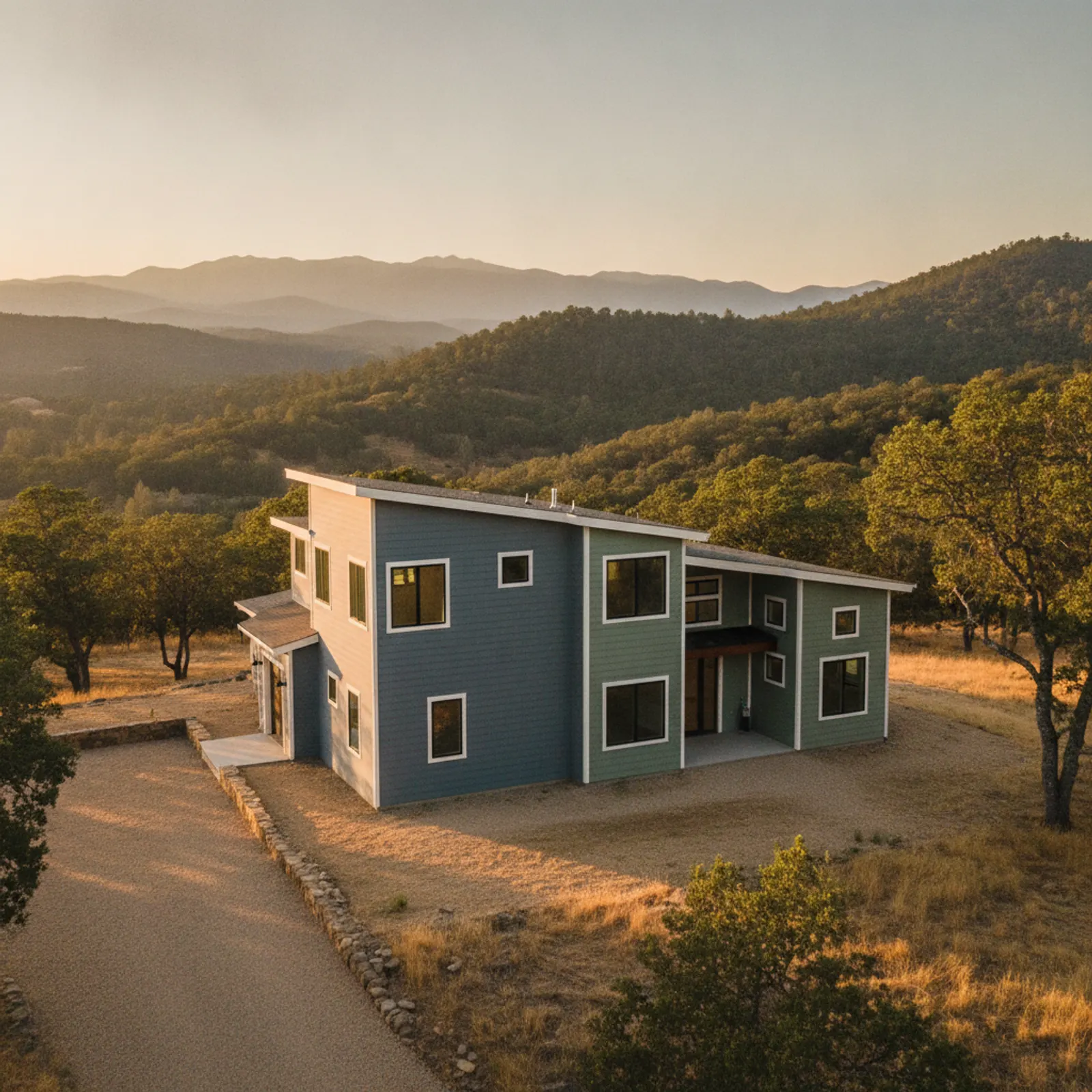
The right fiber cement spec on the ridge depends heavily on which Foresthill home it's for. The older cabins and A-frames along the road often wore decades-old board-and-batten or T1-11 that has cupped and split under the canopy's freeze-thaw and summer heat; a re-side there is mostly clean tear-off, sheathing inspection, and a profile that reads cabin-appropriate — vertical panel-and-batten or a rustic lap rather than suburban wide plank. The larger custom homes deeper in the trees carry long uninterrupted wall runs, dormers, and substantial trim, which change panel layout, joint placement, and reveal selection. Tall conifers also mean shaded, slow-drying north walls where we weight the spec toward moisture-tolerant detailing. We walk each property before quoting, because a ridge cabin and a custom forest home need different reveals, trim packages, and fastening schedules, and treating them the same is how a re-side ends up looking wrong for the setting.
Building the wall as an ember-resistant assembly
Choosing Class A fiber cement is only the first decision in Foresthill's interface; how the wall is assembled around it decides whether wind-driven embers find a way in. On canyon-edge and canopy lots, we treat cladding, trim, and penetrations as one continuous defense. That means closing the gaps embers actually accumulate in: tight non-combustible trim at eaves and gable ends, careful sealing where boards meet windows and dryer or utility penetrations, and metal flashing instead of exposed combustible edges at horizontal transitions. We pay particular attention to the bottom course and to any wood-framed deck, stair, or wraparound porch — fixtures on nearly every Foresthill home — since those connections are a common ignition path that defeats an otherwise good wall. The goal is an exterior that resists ember intrusion at every seam, which on this ridge is the difference between a cosmetic re-side and one that genuinely lowers the home's risk.
Why this matters in Foresthill
- Specified for Sierra Foothills conditions
- Class A non-combustible fiber cement as the recommended system
- Correctly detailed weather-resistive barrier and flashing
- Installed by a crew with 20 years combined experience
Recommended systems for Foresthill
- Class A non-combustible fiber cement
- James Hardie fiber cement
- fire-hardened eave and vent detailing
- robust flashing for seasonal swings
Fiber Cement Siding for Foresthill homes
The full fiber cement siding approach — materials, weather-resistive detailing, and the manufacturer standards we install to — is covered on the main service page, then specified for Foresthill's conditions on this one.
Our Foresthill process
- Step 1
Consultation
We listen to your goals and assess your home on site — exposure, substrate, and architecture.
- Step 2
Design & Proposal
A clear written proposal with the right system specified for your climate and a transparent scope.
- Step 3
Expert Installation
Trained crews install to manufacturer best practices with careful weather-management detailing.
- Step 4
Walkthrough & Support
A final walkthrough, full cleanup, and a clear written record of the scope completed — work we stand behind.
FAQ
Fiber Cement Siding in Foresthill — FAQ
Yes — Class A non-combustible fiber cement, hardened at eaves, vents, and the ground-to-wall band, is the leading practical choice for Foresthill's extreme deep-canopy ember exposure.
We advise against combustible cladding on the Foresthill ridge given the severe wildfire exposure; fiber cement carries no durability penalty, so the safer choice is also the sound one.
No — the board is necessary but not sufficient. Eave, vent, deck-connection, and ground-transition detailing complete the protection, and we treat them as one assembly.
Yes — fiber cement tolerates the damp, shaded north elevations common under Foresthill's canopy well, and we detail those walls for drainage and drying.
Keep Exploring
More for Foresthill homeowners
More in Foresthill
Other exterior services in Foresthill
Nearby Service Areas
Fiber Cement Siding near Foresthill
Helpful Exterior Guides