
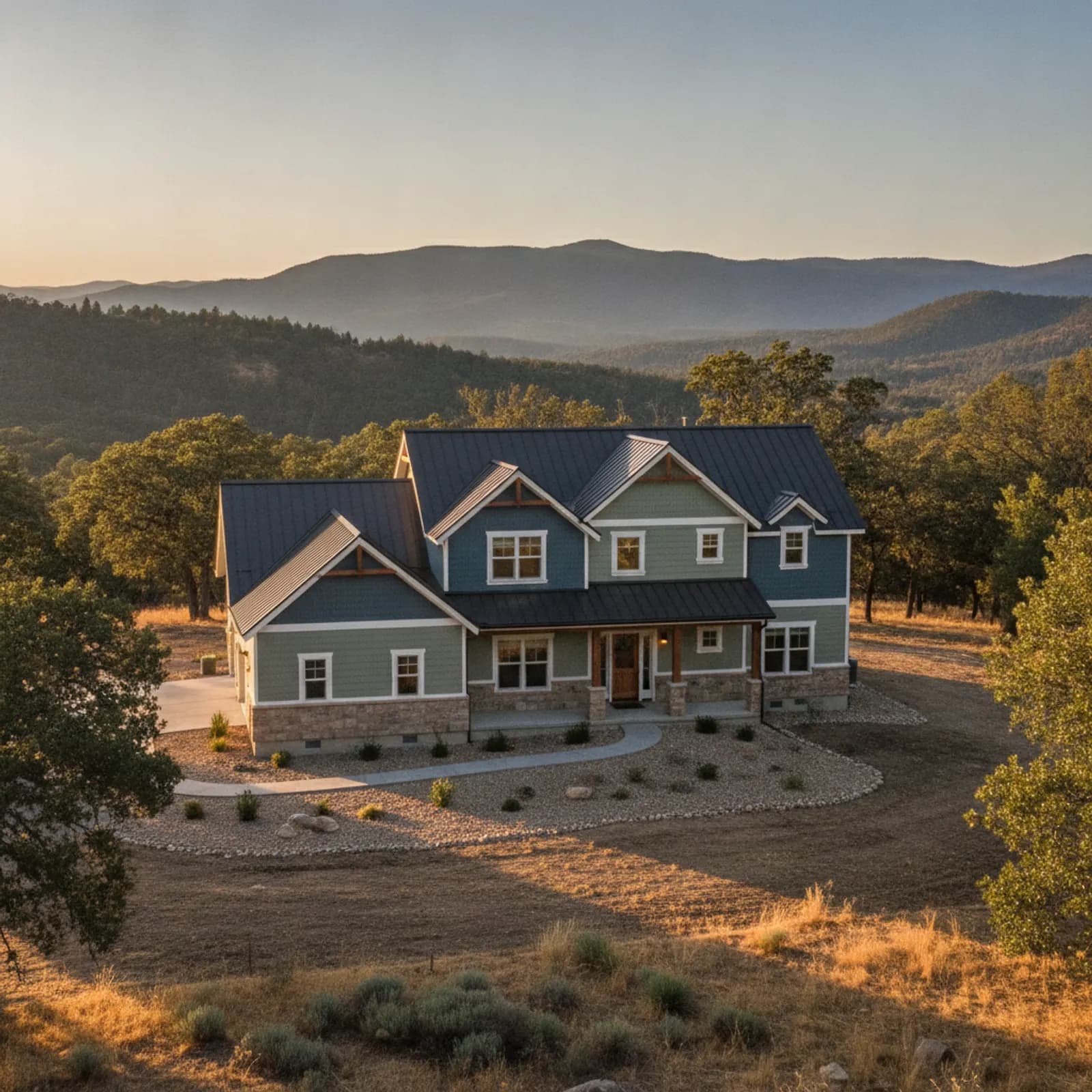
Fire-Resistant Siding in Foresthill
This is the core service for Foresthill, and it is not close. The town sits on an isolated forested ridge between the North and Middle Fork American River canyons, under closed conifer canopy, with wildland fuel on nearly every side — among the most extreme wildfire-exposure communities we serve anywhere. Fire-resistant siding here is not a low-regret upgrade or a nuance; it is the central exterior decision, and we treat the exterior as defensive infrastructure for the structure's survival.
The exterior as a defense system on the ridge
Wind-driven embers, not the flame front, ignite most homes lost in these canyons. On a Foresthill lot we specify Class A non-combustible cladding and then harden the points embers actually exploit — eaves, soffits, vents, decks, porches, and the ground-to-wall transition — coordinating cladding with soffit, fascia, and venting so the assembly works as one continuous defense. On this ridge that is the design premise from the first walkthrough, never an upsell.
The WUI code and the canopy lot
Foresthill's deep-interface setting puts new and replacement exterior work squarely in the world of California's wildland-urban-interface building standards — ignition-resistant cladding, ember-resistant vents, and hardened eaves and decks. We build to that intent and hand over a clear record of the Class A materials and the eave, vent, deck, and ground assemblies used. That documentation has practical value on the ridge for defensible-space inspections and insurance, and we're candid that it strengthens the case while insurers still set their own criteria.
Why one Foresthill fire-siding spec never fits every lot
Foresthill's terrain pulls fire-resistant siding in several directions, and the right answer depends on where on the ridge a home sits. A house perched near the canyon rim faces rising heat and ember showers concentrating against its downhill and canyon-facing walls, so we weight non-combustible cladding and detailing toward those exposures. A custom home set deep in the trees on acreage stands largely on its own defense, with no neighbors or cleared distance to slow a fire, so the full envelope is treated as the last line. An older cabin owner wanting to keep the rustic board-and-batten look gets fiber cement and mineral-based boards that read as traditional wood while carrying a non-combustible rating. We walk the actual lot, note the prevailing slope, the canopy density, and the fuel approaching the walls, and write a spec for that property instead of stamping one ridge template across homes that face very different fire behavior.
Tying fire siding into the five-foot ember zone
A Foresthill re-side only pays off if it respects the non-combustible zone immediately around the house, and in deep canopy that zone is constantly under attack from falling needles and duff. Because embers landing in the first five feet of the wall start most home losses, we plan the cladding swap alongside what touches that ground-to-wall band. That means specifying the bottom course to hold clearance above grade and litter, detailing the base and kick-out flashing so ignitable debris can't pack against the boards, and flagging wood fencing, gates, decks, and the wraparound porches common on ridge homes that would otherwise carry flame straight to the new wall. We coordinate with the soffit, vent, and trim work so the lower assembly leaves no gap an ember can ride through. Homeowners pursuing this in Foresthill should expect us to ask early about defensible-space maintenance and combustible attachments, because the best Class A wall on the ridge is undercut if a needle-packed deck or a wood gate still bridges the non-combustible zone.
Why this matters in Foresthill
- Specified for Sierra Foothills conditions
- Class A non-combustible fiber cement as the recommended system
- Correctly detailed weather-resistive barrier and flashing
- Installed by a crew with 20 years combined experience
Recommended systems for Foresthill
- Class A non-combustible fiber cement
- James Hardie fiber cement
- fire-hardened eave and vent detailing
- robust flashing for seasonal swings
Fire-Resistant Siding for Foresthill homes
The full fire-resistant siding approach — materials, weather-resistive detailing, and the manufacturer standards we install to — is covered on the main service page, then specified for Foresthill's conditions on this one.
Our Foresthill process
- Step 1
Consultation
We listen to your goals and assess your home on site — exposure, substrate, and architecture.
- Step 2
Design & Proposal
A clear written proposal with the right system specified for your climate and a transparent scope.
- Step 3
Expert Installation
Trained crews install to manufacturer best practices with careful weather-management detailing.
- Step 4
Walkthrough & Support
A final walkthrough, full cleanup, and a clear written record of the scope completed — work we stand behind.
FAQ
Fire-Resistant Siding in Foresthill — FAQ
Extreme — an isolated forested ridge between two river canyons under closed canopy, among the most fire-exposed communities we serve. Non-combustible, hardened exteriors are the baseline here, not an option.
Class A non-combustible cladding plus hardened eaves, soffits, ember-resistant vents, decks, porches, and ground-to-wall transitions — the points embers exploit — designed and built to WUI-code intent as one assembly.
It can support insurability and resilience in this deep-interface terrain. We document the materials and assemblies used, but insurers set their own criteria.
No — eaves, vents, decks, and the ground transition complete the protection. On a canopy ridge, a Class A wall undermined by an open eave or a needle-packed deck is not a hardened home.
Keep Exploring
More for Foresthill homeowners
More in Foresthill
Other exterior services in Foresthill
Nearby Service Areas
Fire-Resistant Siding near Foresthill
Helpful Exterior Guides