7 min read · Cost
Redding bakes harder than any market we serve — sustained triple-digit stretches that turn the formulation and finish questions on a James Hardie quote from academic details into the difference between a wall that holds and one that chalks out early. This guide prices the brand itself: what genuine Hardie components add over a look-alike fiber-cement board at the extreme end of the HZ10 envelope, how the ColorPlus decision plays out under the state's fiercest UV, and what the 2018 Carr Fire changed about speccing the city's western and northern edges. For the whole-project view that sets Hardie beside vinyl and engineered wood, start with our Redding siding replacement cost guide instead.
Why the brand question is sharper in Redding than anywhere we work
Redding is the largest city between Sacramento and the Oregon line, and its summers are among the hottest recorded anywhere in California. On a mild-climate wall, the gap between genuine James Hardie and a bargain fiber-cement look-alike might take twenty years to show; Redding's UV load and daily thermal cycling compress that timeline dramatically, which is why the brand question carries more weight here than in gentler markets. What the premium actually buys: the Hardie Zone 10 formulation built specifically for hot, high-ultraviolet climates, the matched HardieTrim, soffit, and accessory ecosystem that makes the envelope one warrantied assembly, and a product warranty backed by published performance data that only holds when genuine components go up to spec. A cut-rate board wearing a Hardie-shaped profile is a different purchase in this climate, and our James Hardie siding installation scope is written around the real thing for exactly that reason.
HZ10 at its outer edge: heat, movement, and fastening
The HZ10 designation covers all of hot-climate California, but Redding pushes it toward the top of its operating envelope, and the spec has to respect that. Boards here swing through enormous daily temperature ranges — cool river-canyon mornings into blistering afternoons — so joint gapping, fastener schedule, and flashing details that tolerate constant expansion and contraction are not optional refinements; they are what keeps joints from opening and finishes from stress-cracking within a few seasons. Color selection is part of the engineering too: a deep charcoal on an unshaded west elevation in Redding absorbs and holds heat in a way the same color never would in the Bay Area, punishing both the finish and the trim behind it. What Redding does not need is just as useful to know — there is no freeze-thaw or snow-load case for HZ5 detailing, and no coastal salt exposure — so an honest spec spends the budget on movement tolerance and fade resistance rather than protections this climate never calls on.
The ColorPlus payback curve on Redding's sun-loaded walls
Everywhere in the valley the factory-versus-field finish choice is an economics question; in Redding the curve simply bends faster. A field-applied coat on a Redding south or west wall faces the shortest realistic repaint interval in our territory, because sustained extreme UV breaks down field coatings quicker than anywhere else we quote. ColorPlus — Hardie's baked-on, plant-cured multi-coat finish — costs more on day one, but each repaint cycle it eliminates claws back a meaningful slice of that premium, and in this specific climate the crossover arrives years earlier than it does downstate. It also carries its own finish warranty, which no field coat matches. There are still honest reasons to choose primed board — a custom color the ColorPlus palette lacks, or a hard budget ceiling — and our exterior painting crews handle that work without apology. But if a Redding bid quietly swaps factory finish for paint-grade to hit a number, that is not a discount; it is a shorter service life sold at a lower sticker.
Matching profile to Redding's housing stock
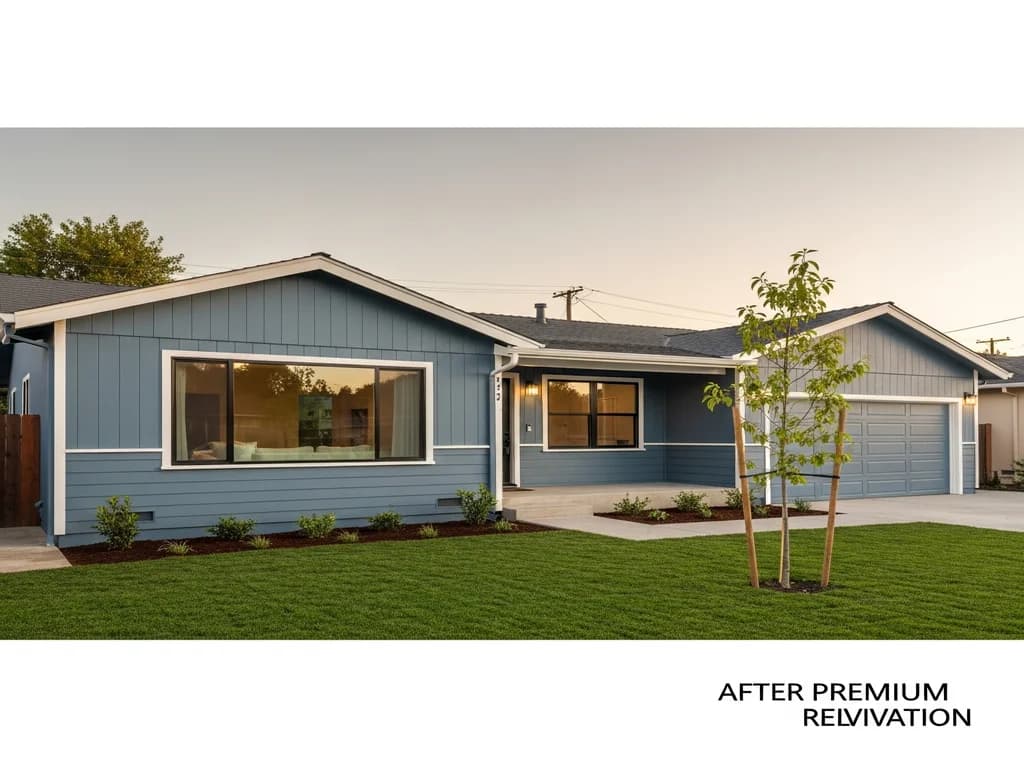
Redding's neighborhoods sort into three broad profile programs. The mid-century ranch belt — long, low, mostly single-story elevations — is the efficient end of the band: HardiePlank lap in steady horizontal runs that a crew can move through quickly, which is where the value pricing lives. The 1970s-through-1990s tract subdivisions bring predictable two-story walls that add staging and lift time but estimate cleanly because the footprints repeat. The custom and acreage homes climbing the western and northern edges — including the post-Carr rebuilds — are the deliberate end: mixed profiles, board-and-batten from HardiePanel, deeper trim packages, and lots where a long drive or uneven terrain adds material-handling hours before a single plank is hung. Older downtown and river-area homes add a fourth wrinkle: period trim that HardieTrim has to reproduce rather than merely replace. We price profile by elevation and neighborhood rather than flattening the city into one per-foot figure.
Noncombustible board, the west side, and the paper trail
In 2018 the Carr Fire crossed the Sacramento River into western Redding and destroyed over a thousand homes, and that history is now a permanent part of the exterior conversation on the city's wildland-facing fringes. For those parcels, the fact that Hardie fiber cement is noncombustible — a Class A material the UC ANR Fire Network names among the compliant cladding options for wildfire exposure — is a real part of what the brand premium buys. We are precise about what that means: noncombustible is not fireproof, and cladding is one hardened layer of a whole-property strategy alongside vents, eaves, roof, decks, and defensible space. On wildland-edge jobs the board is only the start; hardened eave, vent, and ground-transition detailing through our fire-resistant siding scope adds genuine line items an interior tract home never carries. What edge-parcel owners increasingly ask for — and what we document on every hardened assembly — is the paper trail that supports code and insurability conversations, though insurers set their own criteria and we never speak for them.
How we schedule Redding work from the Sacramento region
We will be straightforward about geography, because it affects how a Redding project runs. Sierra Siding operates from the Sacramento region; we do not have a Redding office, and any contractor traveling to Shasta County who implies otherwise is telling you something about how they will handle the rest of the job. What distance actually changes is scheduling, not honesty: Redding projects are planned as committed blocks so the crew mobilizes once, works the job continuously to completion, and is not splitting weeks between your walls and a job two hours south. Expect that to show up as lead time on the calendar rather than as padding on the rate. Before signing with anyone — local or traveling — confirm their standing through the CSLB license lookup, ask how they sequence out-of-area work, and get the itemized written estimate that actually governs the price.
What moves a Redding Hardie number
| Cost driver | Effect |
|---|---|
| Finish choice under extreme UV | ColorPlus premium up front; shortest field-repaint cycles in our territory otherwise |
| Fire-hardening detailing on edge parcels | Eave, vent, and ground-transition scope interior tracts never carry |
| Profile and neighborhood program | Ranch lap runs are the value end; edge customs and rebuilds price higher |
| Substrate under sun-cooked cladding | Decades of extreme heat leave repair scope that surfaces at tear-off |
| Acreage access and staging | Long drives and uneven terrain add handling hours |
James Hardie scope bands for the Redding area (for planning)
| Scope | Per sq ft of wall | Typical project total |
|---|---|---|
| Single-story ranch, HardiePlank ColorPlus | $13–$20 | $28,000–$58,000 |
| Two-story or complex trim | $17–$24+ | $48,000–$84,000+ |
| Mixed profile / board-and-batten | $15–$22 | $38,000–$70,000 |
These are general California planning ranges, NOT a Sierra Siding quote — every project is scoped on site. Redding numbers land within the same statewide bands; where a project sits inside them is driven by fire-hardening scope on edge parcels, finish choice, substrate condition, and lot access, and your written estimate is what governs.
Key takeaways
- Redding's extreme heat and UV widen the service-life gap between genuine HZ10 Hardie and look-alike fiber cement faster than any milder market
- ColorPlus recovers its premium quickest here because field-paint repaint intervals are the shortest in our territory
- Hardie fiber cement is noncombustible, not fireproof — west- and north-edge parcels add hardening scope and documentation value beyond the board
- Profile follows the stock: ranch-belt lap runs anchor the value end; foothill-edge customs and Carr rebuilds price deliberately higher
- We run Redding as committed scheduling blocks from the Sacramento region — it shows up as lead time, not rate padding; verify any contractor via CSLB
FAQ
Quick Answers
Redding is the strongest case for it in our territory. The HZ10 board is formulated for exactly this climate, the factory ColorPlus finish resists the UV breakdown that eats field paint here fastest, and the warranty stands behind the assembly. A cheaper look-alike board saves money on day one and gives it back in early fading, joint movement, and repaint cycles.
On wildland-edge and rebuild parcels, yes — not because the board changes, but because the detailing does. Hardened eaves, vents, and ground transitions are real added line items, and we document those assemblies to support code and insurability conversations. Interior valley neighborhoods carry the heat spec without that fire-hardening scope.
No, and we say so plainly: we serve Redding from the Sacramento region. We schedule Redding projects as committed blocks so the crew mobilizes once and works continuously to completion. Practically, that means more lead time on the calendar, not a padded rate — and it is a fair question to put to every bidder you talk to.
On sun-exposed elevations, ColorPlus almost always wins the lifetime math here, because Redding's UV shortens field-coat repaint cycles more than anywhere else we work. Field-painted primed board still makes sense for custom colors outside the ColorPlus palette or a firm budget cap — we quote both honestly rather than steering.
It adds real scope and it is one of the more common cost surprises in Redding, where solar adoption is high because of the cooling load. Panels themselves stay on the roof, but the conduit, combiner boxes and any wall-mounted inverter usually have to be detached and reset so the cladding can run behind them, and that is electrical work rather than siding work. Get it identified at estimate stage — a bid that never mentions your solar has almost certainly not priced it.
Crew safety governs it more than the material does. Redding summers run hot enough that afternoon work becomes genuinely unsafe on unshaded elevations, so productive days get shifted earlier and the schedule stretches. Fiber cement itself is unbothered by the heat, but some sealants and field-applied finishes have upper application temperatures, which is one more argument for a factory finish here. A contractor who quotes a fixed July completion date without mentioning heat has not worked many Redding summers.
Sources
Authoritative references
- James Hardie — performance & durability (noncombustible/Class A per ASTM E84; built for extreme heat & UV)
- UC ANR Fire Network — Siding (noncombustible cladding options for wildfire exposure)
- Contractors State License Board (CSLB) — verify a California contractor
External links to government, code, and manufacturer sources. Sierra Siding is not affiliated with these organizations; references are provided for verification.