
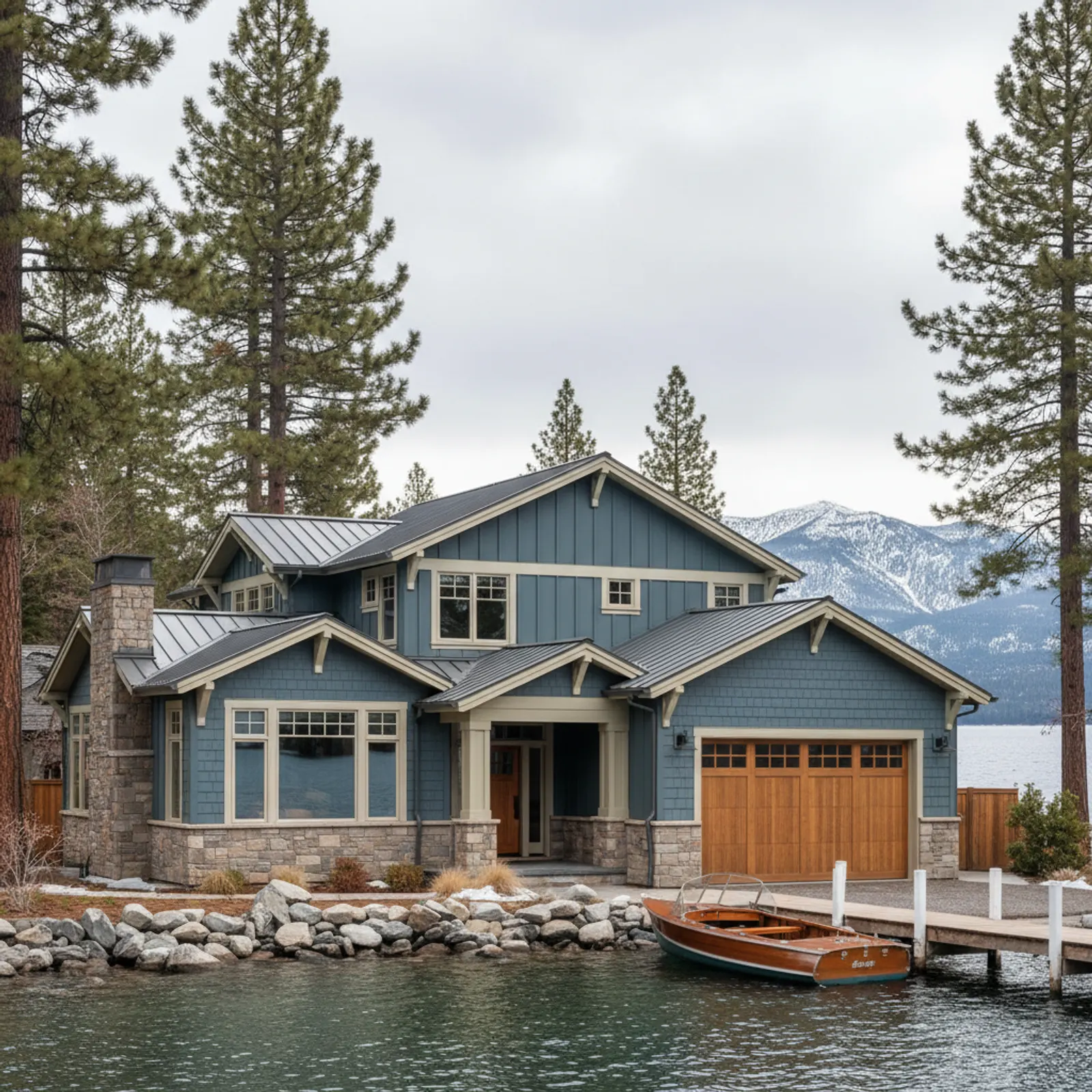
Exterior Contractor in Tahoe City
Tahoe City exteriors fail at the assembly seams. Alpine snow load, prolonged freeze-thaw cycling, and high-altitude UV combine to find every reverse-lapped piece of housewrap, every missed head flashing, and every gap in the ground-to-wall snow detail. Add the area's real wildfire exposure on the forested ridges above the lake and the right Tahoe City exterior has to manage two opposed extremes — moisture and freeze in one season, fire risk in another — as one coherent system.
An exterior contractor's value at altitude is owning the whole assembly: WRB, flashing, snow detail, cladding, fire-aware materials, and the integration of all of them. Splitting that across trades is how Tahoe City homes get ice-dam intrusion at the window heads, snow lift at the bottom course of cladding, and ember vulnerability at vents and eaves — three different failure modes that all trace back to the same root cause of no single party owning the envelope.
What an integrated Tahoe City exterior includes
On a Tahoe City home an integrated scope addresses cladding with mountain-grade clearances and fastening, WRB and flashing detailed for ice-dam and meltwater exposure, snow-detail at the bottom course and ground-to-wall transition, freeze-thaw-aware trim and corner-board work, hardened eaves and ember-resistant vents on parcels with ridge or forest exposure, and window flashing integrated into the same WRB rather than separately retrofitted. The assembly is designed for both seasons at once.
Where the split-trade exterior fails in Tahoe City
Tahoe City is the clearest example of how alpine assemblies fail at trade interfaces. Cladding installed too low to the deck or roof catches snow lift and water intrusion. Window flashing not integrated into the WRB lets ice-dam meltwater into the wall at the heads. Vents not specified for ember resistance leave the ridge homes exposed to summer wildfire. No single trade owned the whole story, and the failures show up in different seasons over different years. An integrator scopes all of it at once.
Materials and detailing we specify for Tahoe City
For Tahoe City we specify non-combustible cladding (James Hardie or equivalent) for the dual fire-and-finish-life advantage at altitude, mountain-grade flashing detail, expansion gapping and fastening for freeze-thaw range, and hardened eave, vent, and ground-to-wall detailing on ridge and forest-exposed parcels. Color selection accounts for high-altitude UV which can age finishes faster than at valley elevations.
Why this matters in Tahoe City
- Specified for Lake Tahoe / Sierra Alpine conditions
- non-combustible fiber cement as the recommended system
- Correctly detailed weather-resistive barrier and flashing
- Installed by a crew with 20 years combined experience
Recommended systems for Tahoe City
- non-combustible fiber cement
- mountain-grade clearances and flashing
- freeze-thaw-durable detailing
- high-UV factory finishes
Exterior Contractor for Tahoe City homes
The full exterior contractor approach — materials, weather-resistive detailing, and the manufacturer standards we install to — is covered on the main service page, then specified for Tahoe City's conditions on this one.
Our Tahoe City process
- Step 1
Consultation
We listen to your goals and assess your home on site — exposure, substrate, and architecture.
- Step 2
Design & Proposal
A clear written proposal with the right system specified for your climate and a transparent scope.
- Step 3
Expert Installation
Trained crews install to manufacturer best practices with careful weather-management detailing.
- Step 4
Walkthrough & Support
A final walkthrough, full cleanup, and a clear written record of the scope completed — work we stand behind.
FAQ
Exterior Contractor in Tahoe City — FAQ
Many are. Ridge parcels above the lake and homes in the forested neighborhoods around Tahoe City pick up serious summer wildfire exposure. We scope per parcel — some shoreline lots are essentially low-risk; some ridge lots warrant full foothill-grade hardening.
Snow detail at the bottom course of cladding and at ground-to-wall transitions. Many builders install boards to standard valley clearances and then watch ice-dam meltwater find every joint in the assembly. We detail those transitions specifically for alpine snow load.
We schedule around the season. Most active exterior work happens between late spring and early fall; we plan tear-off and re-clad timing to land the dry-in well before first snow. We confirm a realistic schedule after the on-site assessment.
Yes — repeated freeze-thaw cycling drives moisture into any uncorrected joint or unflashed penetration and then expands as it freezes. Correct gapping, fastening, and flashing detail is what prevents that failure mode, and it's an assembly decision, not a material decision alone.
Most Tahoe City projects are four to eight weeks of active work depending on size, story count, and the scope of snow and fire detailing. We plan around the construction season and dry-in well before winter.
Keep Exploring
More for Tahoe City homeowners
More in Tahoe City
Other exterior services in Tahoe City
Nearby Service Areas
Exterior Contractor near Tahoe City
Helpful Exterior Guides