Fiber Cement Siding in Antelope
Fiber cement is the core Antelope recommendation because it is the durable permanent replacement for the failing 1990s–2000s builder-grade hardboard/composite — dimensionally stable through full valley heat, moisture-stable where the old cladding swelled, and low-maintenance for decades.
The right fix for the era's failure
Antelope's swelling, delaminating builder-grade cladding needs replacement, not overcoating. Fiber cement resists the moisture-swelling and heat cycling that defeated the original product, ending the failure cycle permanently.
Efficient on uniform tracts
Because Antelope's stock is single-era and repetitive, a fiber cement re-clad is efficient and cost-effective, with a refreshed palette that modernizes a dated street.
It ends the hardboard failure for good
Antelope's real problem is pressed builder hardboard that wicks, swells, and delaminates. Fiber cement is the permanent fix because it doesn't wick — installed to clearance and flashing spec, the moisture-failure cycle simply stops rather than returning a few years after a repaint.
Spec'd for the valley heat belt, not the coast
Antelope sits in the Sacramento Valley heat belt, where summer afternoons bake exterior walls and overnight temperatures swing hard. That thermal cycling, not rain, is what fatigues cladding here. The original builder-grade product on these tracts expanded and contracted until joints opened and fasteners worked loose. We spec fiber cement specifically for that punishing heat profile: gapped and caulked butt joints sized for movement, corrosion-resistant fasteners set to manufacturer torque so boards can shift without splitting, and a baked finish rated to hold color under relentless valley sun. Because Antelope's moisture and wildfire exposure both run low, the priority is dimensional stability and UV durability rather than the heavy rainscreen or fire-hardened detailing a coastal or foothill home would demand. South and west elevations, which absorb the worst of the afternoon load, get the closest attention during layout and flashing. Spec'd this way, the cladding stays flat and tight through decades of triple-digit summers, which is exactly the failure mode the early tract product never survived.
Working a tract street where every house looks alike
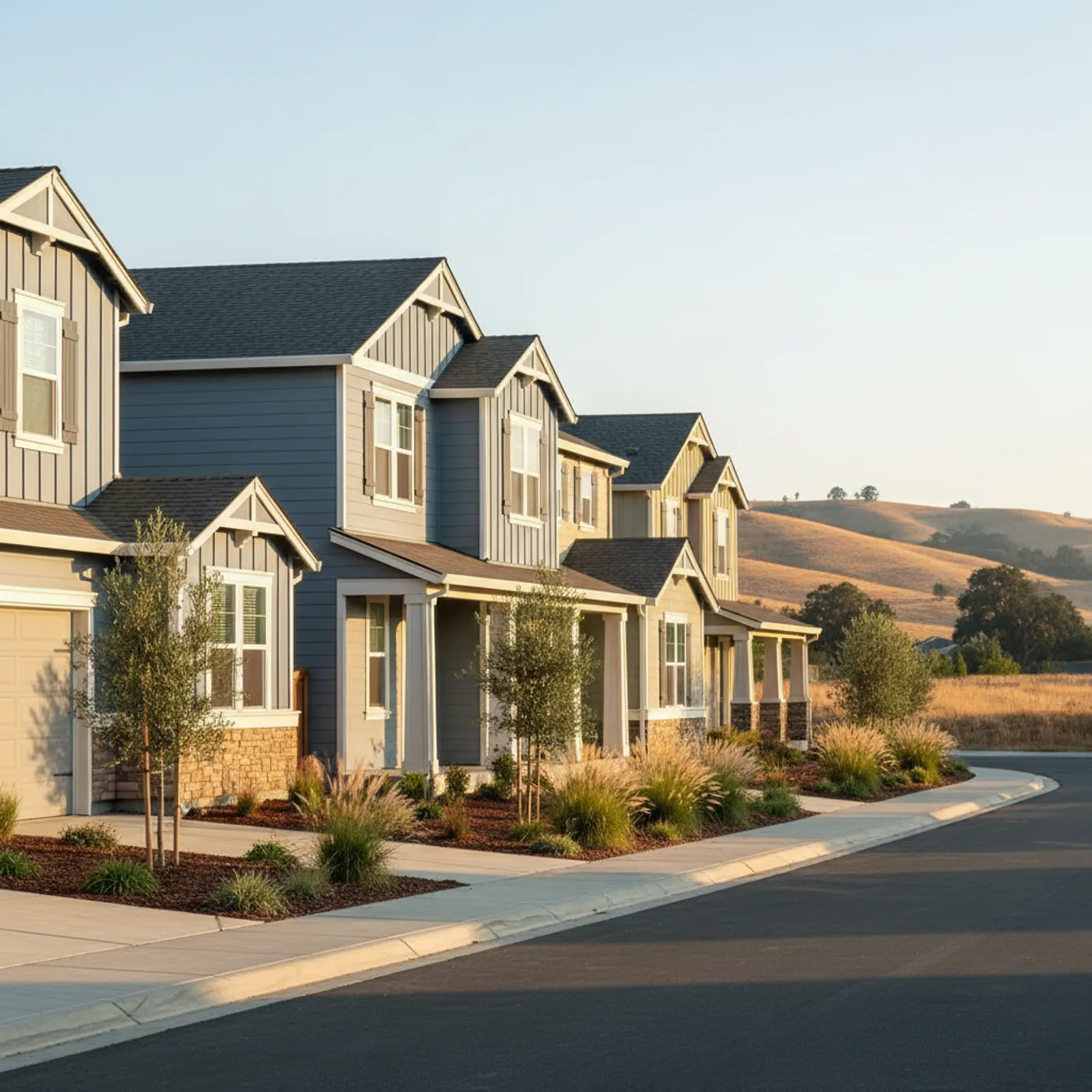
Antelope was built out almost entirely as repeating production floor plans straddling the Sacramento and Placer county line, so a re-side here rarely happens in isolation. Neighbors compare elevations, and a fiber cement job that ignores the original tract design reads as out of place on the block. We treat each home as part of its streetscape: matching the existing lap exposure and trim proportions where they work, and where they failed, choosing board profiles and a color that sit comfortably alongside the surrounding 1980s-through-early-2000s homes rather than fighting them. Many of these tracts also fall under an HOA, so before fabrication we confirm whether color and profile changes need architectural-committee sign-off, which can run on its own timeline. Access on these lots is typically straightforward, with standard side yards and driveways that let us stage tear-off and new board efficiently. The payoff for a uniform neighborhood is consistency: once one home replaces its tired original cladding with properly detailed fiber cement, the upgrade is visible from the street and sets a clear benchmark for the rest of the block.
Why this matters in Antelope
- Specified for Sacramento Valley conditions
- James Hardie fiber cement as the recommended system
- Correctly detailed weather-resistive barrier and flashing
- Installed by a crew with 20 years combined experience
Recommended systems for Antelope
- James Hardie fiber cement
- factory finishes
- board-and-batten accents
Fiber Cement Siding for Antelope homes
The full fiber cement siding approach — materials, weather-resistive detailing, and the manufacturer standards we install to — is covered on the main service page, then specified for Antelope's conditions on this one.
Our Antelope process
- Step 1
Consultation
We listen to your goals and assess your home on site — exposure, substrate, and architecture.
- Step 2
Design & Proposal
A clear written proposal with the right system specified for your climate and a transparent scope.
- Step 3
Expert Installation
Trained crews install to manufacturer best practices with careful weather-management detailing.
- Step 4
Walkthrough & Support
A final walkthrough, full cleanup, and a clear written record of the scope completed — work we stand behind.
FAQ
Fiber Cement Siding in Antelope — FAQ
Decisively — it resists the moisture-swelling and heat cycling that caused the 1990s–2000s builder-grade hardboard/composite to fail, ending the cycle permanently.
Yes — it is dimensionally stable through hot thermal cycling and holds a baked finish far longer than the failing original cladding.
Not durably — swelling/delaminating builder-grade cladding needs replacement; overcoating hides, doesn't fix, the failure.
Low — unlike the swelling hardboard it replaces, fiber cement with a baked finish needs little upkeep through Antelope's hard valley sun for many years.
Keep Exploring
More for Antelope homeowners
More in Antelope
Other exterior services in Antelope
Nearby Service Areas
Fiber Cement Siding near Antelope
Helpful Exterior Guides