
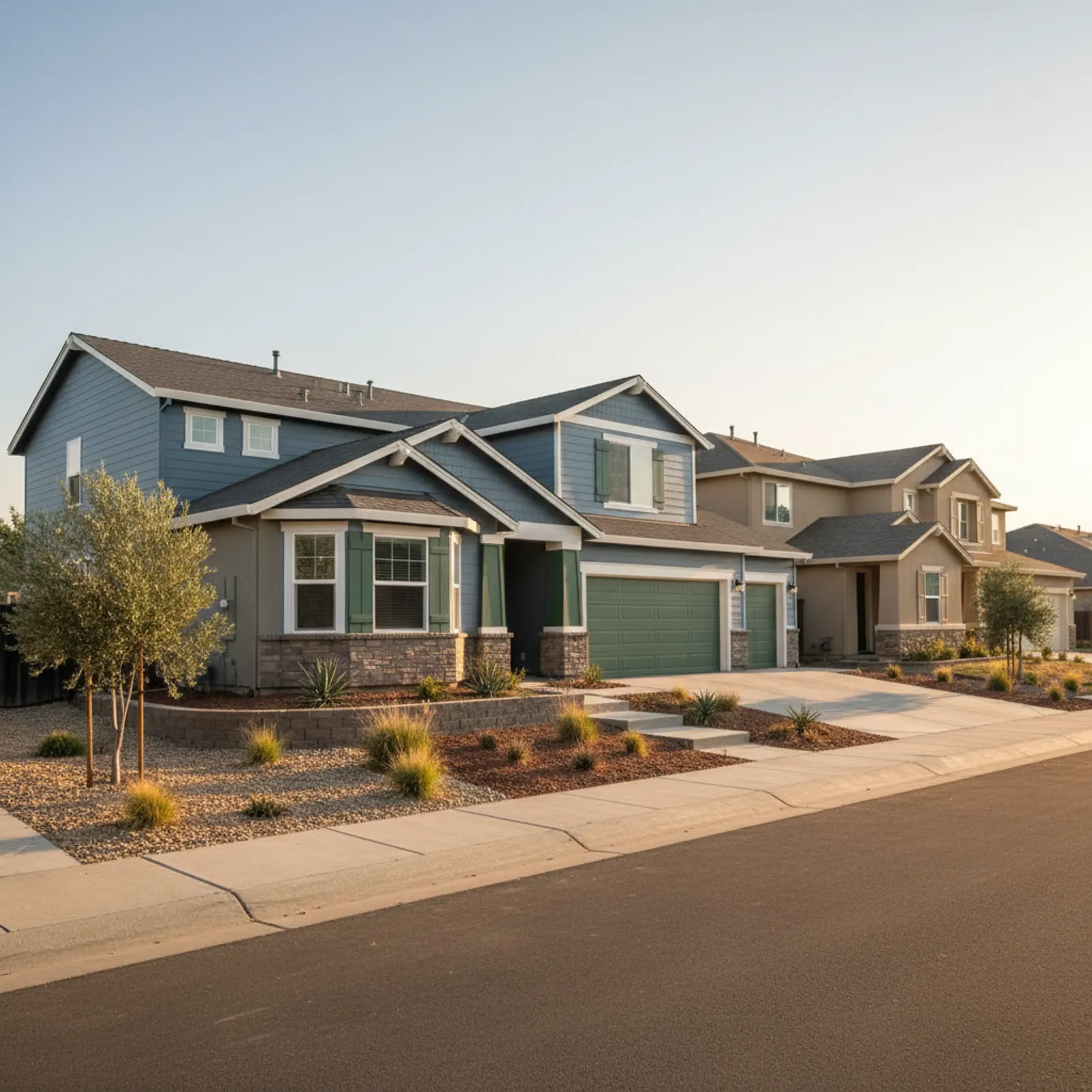
Siding in Antelope
An Antelope re-side is a first-generation-replacement story. Antelope is an almost uniformly 1990s–2000s production-tract community now reaching its very first re-side age — and much of that era's builder-grade hardboard/early-composite siding is failing in textbook fashion (swelling, delamination at the bottom courses, paint failure) under full Sacramento Valley heat. Low fire, flat valley floor.
So an Antelope project is the classic builder-grade-to-permanent upgrade: strip the failing original cladding, correct any moisture-damaged substrate, and re-clad in durable heat-stable fiber cement.
The 90s/2000s builder-grade failure wave
Antelope's production tracts went up fast with the cheapest cladding of the era; that hardboard/composite is now delaminating and swelling on schedule. These homes are prime, almost uniform re-side candidates — we replace the root cause, not patch it.
Uniform tracts, valley heat
Because the stock is single-era and repetitive, the work is efficient and repeatable: a heat-stable fiber cement re-clad with a refreshed palette that modernizes a dated tract street, built for the hot valley summers.
Antelope's split-jurisdiction permits and tract-lot access
Because Antelope sits right on the Sacramento County and Placer County boundary, a re-side here can fall under either building department depending on where the parcel lands, and that determines which permit office issues the over-clad or full-replacement approval. Knowing which side of the line a home is on before scheduling matters, since inspection scheduling and re-roof-edge flashing details are handled differently between the two. The production tracts off Antelope Road and around Dutch Haven also carry their own access quirks: zero-lot-line setbacks and shared side fences leave narrow work corridors for scaffold and material staging, and many homes share an HOA that reviews exterior color and material changes. We confirm the governing jurisdiction, pull the correct permit, and verify any architectural-review requirements before fiber cement arrives on site. That up-front check keeps an Antelope siding job from stalling at rough inspection or triggering an HOA complaint after the new cladding is already hung.
Spec'ing the sun-beaten elevations on a valley tract home
On an Antelope home the south and west walls take a punishing load of afternoon Sacramento Valley sun, and that is where the original builder-grade cladding fails first and hardest. Those elevations drive the spec for a re-side here. Fiber cement is dimensionally stable through the heat swings that pop and cup the old hardboard, but the finish choice carries the rest of the burden: factory-baked color holds far better than field paint against UV that fades dark tones quickly on west walls. We steer Antelope owners toward lighter or mid-tone palettes that shed heat and age evenly, and we detail expansion gaps and butt joints for thermal movement rather than a tight East Coast install. Eave and gable-end venting also gets attention, since the attic behind a sun-loaded wall runs hot in these single-story and two-story tract plans. The result is an exterior matched to how heat actually moves across an Antelope lot, not a one-size install that looks fine in spring and bakes by July.
Why this matters in Antelope
- Specified for Sacramento Valley conditions
- James Hardie fiber cement as the recommended system
- Correctly detailed weather-resistive barrier and flashing
- Installed by a crew with 20 years combined experience
Recommended systems for Antelope
- James Hardie fiber cement
- factory finishes
- board-and-batten accents
Fiber Cement Siding for Antelope homes
The full fiber cement siding approach — materials, weather-resistive detailing, and the manufacturer standards we install to — is covered on the main service page, then specified for Antelope's conditions on this one.
Our Antelope process
- Step 1
Consultation
We listen to your goals and assess your home on site — exposure, substrate, and architecture.
- Step 2
Design & Proposal
A clear written proposal with the right system specified for your climate and a transparent scope.
- Step 3
Expert Installation
Trained crews install to manufacturer best practices with careful weather-management detailing.
- Step 4
Walkthrough & Support
A final walkthrough, full cleanup, and a clear written record of the scope completed — work we stand behind.
FAQ
Siding in Antelope — FAQ
It's almost certainly the 1990s–2000s builder-grade hardboard/composite cladding failing on schedule — a documented era problem, fixed by re-cladding in durable fiber cement, not by patching.
Yes — Antelope is specifically the 1990s–2000s production-tract era hitting its first replacement wave off failing builder-grade siding, distinct from Citrus Heights' 60s–80s ranch or Rancho Cordova's aerospace-postwar split.
Low — Antelope is flat valley floor with no wildland interface. Heat and the failing original cladding, not fire, are the issues. Non-combustible fiber cement is still a sound default.
Yes — a heat-stable fiber cement re-clad with a refreshed palette substantially updates a repetitive 90s/2000s tract street while fixing the failing cladding.
Usually not once the era cladding is visibly swelling or delaminating — that progresses and can damage the substrate; addressing it promptly is the cost-effective path.
Keep Exploring
More for Antelope homeowners
More in Antelope
Other exterior services in Antelope
Nearby Service Areas
Siding near Antelope
Helpful Exterior Guides