
6 min read · Cost
Anderson is a practical town, and it deserves a practical answer to the Hardie question. The city sits on the open valley floor just south of Redding, sharing the North Valley's extreme heat and UV with almost none of its neighbor's wildland-edge pressure — which makes the brand decision here a clean durability-per-dollar calculation rather than a status purchase. This guide works that calculation honestly: what the system premium buys on a workaday housing stock, why Anderson's single-story streets install efficiently, and how the finish choice plays out under some of the hardest sun in California. For the whole-project view across every material, start with our Anderson siding replacement cost guide.
Single-story economics: Anderson's built-in install advantage
Anderson carries a structural cost advantage most markets would envy: its housing stock is heavily single-story, its lots are flat, and its streets are open. That combination strips the expensive friction out of a Hardie install. No second-story staging or lift time, material stacked feet from the wall instead of carried down a slope, dumpsters parked at the driveway rather than half a block away — the labor hours that inflate a foothill or hillside quote simply are not present here, and a fair Anderson bid should reflect their absence rather than quietly pocketing it. The repetitive 1970s-through-1990s tract elevations compound the advantage, because repeated builder floor plans estimate cleanly and crews find their rhythm fast. The practical takeaway for a homeowner: Anderson projects belong at the efficient end of the planning bands more often than not, and a quote pushed toward the top of the band should be able to point at the specific scope — substrate, trim, detailing — that put it there.
Repaint cycles versus a factory finish south of Redding
Anderson shares Redding's brutal UV season, and the flat, low-shade layout of its streets means most walls take that season without relief — which is precisely the exposure where the finish decision earns or loses the most money. Field paint on an unshaded Anderson elevation lives on a short repaint clock; the sun that chalked the original cladding does the same work on every site-applied coat that follows it. ColorPlus, baked on and cured at the factory, holds color through that exposure far longer and carries its own finish warranty — so while it raises the day-one number, it removes recurring four-figure repaint events from the ownership ledger, and in this climate the crossover comes early. For a value market the framing matters: the factory finish is not the luxury option here; it is the low-total-cost option for anyone holding the home past a handful of years. A tight initial budget or a custom color can still argue for primed board honestly quoted — but the bid should show both numbers, not decide for you.
A lap-and-batten refresh for tract-built streets
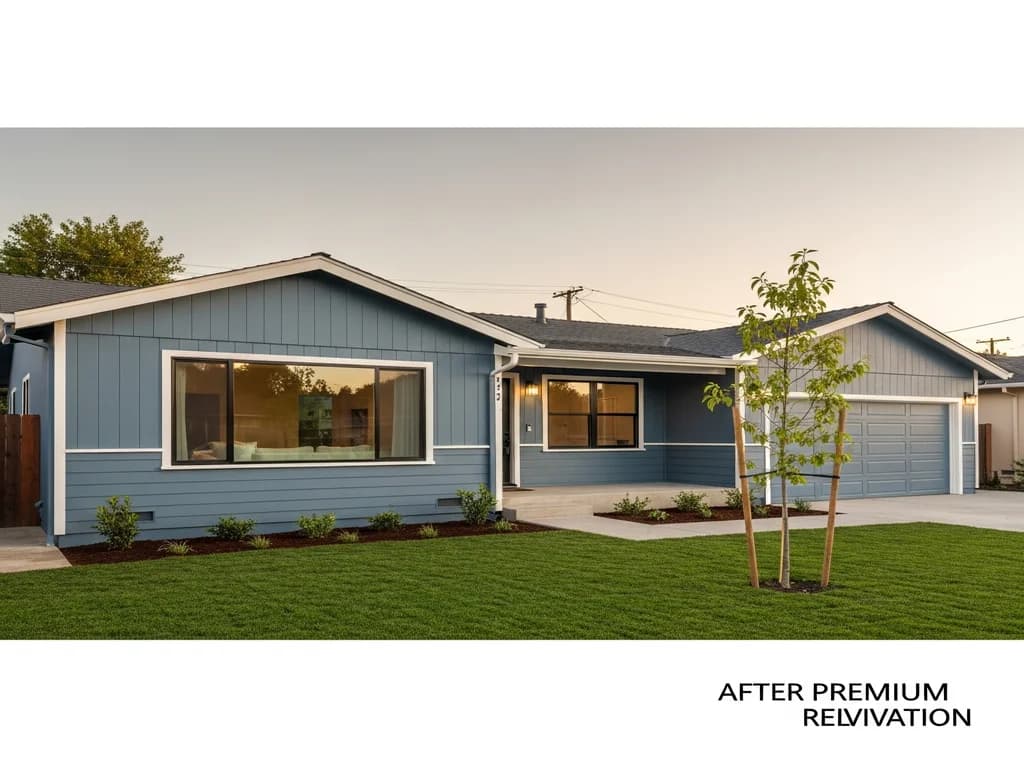
Anderson's profile conversation is refreshingly unpretentious. The post-war and mid-century homes near the older core and the tract subdivisions that built the city out are straightforward, modest elevations — no Victorian trim programs, no historic-district review — and they respond to a clean HardiePlank lap field, or a modern lap-and-batten combination that breaks the builder uniformity a whole street has worn for forty years. That simplicity is money: uncomplicated profiles on uncomplicated walls keep labor at the base of the Hardie ladder, and the modest footprints common here keep totals toward the low end of the planning bands. Where a step up earns its cost is deliberate contrast — a HardiePanel batten accent on a street of identical lap facades is a visible identity upgrade for limited added layout time, and on a street where every comparable home wears faded original siding, it is the kind of curb-appeal move that shows up at resale. Farmhouses on the rural fringe take the same honest treatment with heavier attention to their exposure than their ornament.
Where the spec bends: grass margins and the river bottom
Two edges of Anderson pull the standard heat spec in different directions, and a fair quote adjusts only where the parcel warrants. On the rural, grass-facing margins toward the surrounding ranch country, summer-cured grassland carries a real moderate ember exposure in the dry season; the Hardie board's noncombustible rating — never to be confused with fireproof — comes standard, and the paid upgrade is detailing at eaves, vents, and the ground-to-wall transition under our fire-resistant siding detailing. Along the Sacramento River, the adjustment is water rather than fire: river-adjacent lots hold more ambient moisture through the cool, wet winter, so bottom-course flashing and barrier detailing get heavier attention there. The rest of the city — the great majority of it — needs neither surcharge, and we say so plainly. A quote that spreads edge-parcel detailing across a central Anderson tract home is charging for exposure the address does not have, which is exactly the kind of padding a value market should refuse.
Vetting bids where every dollar is argued
Price-sensitive markets attract substitution, so an Anderson Hardie bid deserves a harder read than its total. Component names first: genuine HardiePlank, HardiePanel, and HardieTrim in writing, because the cheapest path to a winning number is a commodity fiber-cement board with no HZ10 rating behind it and no Hardie warranty attached, indistinguishable on a sample. Finish line second: ColorPlus versus primed-and-field-painted is a four-figure difference that a vague quote can blur, and under Anderson's sun the gap widens every year afterward. Trim third, since generic stock beside brand board undercuts the warranty the premium was supposed to buy. Then two checks that cost nothing: the CSLB license lookup on every bidder, and a written, itemized estimate — the document that governs — before any deposit. A contractor confident in a value market welcomes that scrutiny, because honest scope is the only advantage that survives it. When the question is still which material rather than which bid, our Anderson siding replacement cost guide is the wider frame.
What drives an Anderson Hardie price
| Cost driver | Effect |
|---|---|
| Single-story, flat-lot logistics | Strips staging and handling hours out of the labor line |
| Factory finish vs. field repaint clock | The finish decision carries the biggest lifetime swing under this sun |
| Edge-parcel detailing (grass margin / river lot) | Real scope where the exposure is real; padding anywhere else |
| Profile contrast on uniform tract streets | Modest batten-accent cost for a visible resale edge |
| Substrate under failed hardboard | Older core homes carry more discovery risk than the tracts |
James Hardie scope bands in the Anderson area (for planning)
| Scope | Per sq ft of wall | Typical project total |
|---|---|---|
| Single-story HardiePlank, ColorPlus | $13–$20 | $28,000–$58,000 |
| Two-story / complex trim | $17–$24+ | $48,000–$84,000+ |
| Board-and-batten / mixed profile | $15–$22 | $38,000–$70,000 |
General California market planning bands applied to the North Valley — not a Sierra Siding quote. Anderson's single-story stock often lands projects toward the efficient end, but footage, substrate condition, finish choice, and edge-parcel detailing set the real figure on-site, and the written itemized estimate governs.
Key takeaways
- In Anderson the Hardie premium pencils as durability per dollar: the HZ10 system corrects exactly the UV failure that ended the original builder-grade cladding
- Single-story homes, flat lots, and repeated tract elevations put Anderson at the efficient end of the planning bands — a top-of-band quote should show the scope that justifies it
- Under Redding-grade sun on low-shade streets, the factory ColorPlus finish is the low-total-cost choice, not the luxury one, for any hold past a few years
- The spec bends only at the edges: ember detailing on grass-facing rural margins, heavier moisture detailing on Sacramento River lots — never padded citywide
- Read bids for named components, an explicit finish line, and genuine trim, then verify the license through CSLB before comparing totals
FAQ
Quick Answers
Planning bands sit around $13–$20 per foot of wall for single-story ColorPlus lap, $15–$22 for lap-and-batten programs, and $17–$24+ where a second story or complex trim adds hours. Anderson's single-story, flat-lot stock keeps many projects toward the efficient end — typical totals from the high $20,000s — and the written on-site estimate is the real number.
No — it is arguably better matched here than on a showpiece. The failure being corrected is UV-driven, Anderson's exposure is as hard as Redding's, and a modest single-story footprint keeps the system's total cost down while the durability benefit stays full-size. Priced per year of service, the durable board usually wins on a working budget.
Mostly logistics and scope. Anderson's flat lots, single-story elevations, and open streets cut staging and handling hours, and most of the city carries none of the wildland-edge hardening scope that west Redding parcels add. Same board, same climate — fewer labor hours and fewer detailing line items.
The grass-facing margins toward the surrounding ranch country do carry a real moderate ember exposure in the dry season, and eave, vent, and ground-transition detailing is worth its line there. The board itself is noncombustible either way — which is not the same as fireproof — and central town lots should not be charged for edge-parcel scope.
California limits the down payment on a home improvement contract to ten percent of the price or one thousand dollars, whichever is less. That is a statutory cap rather than a norm, and it surprises people because larger deposits are commonly requested. After that, payments should follow completed and visible stages of work. Check the licence on the CSLB lookup at the same time — the two checks together take a few minutes.
Often not, and that is worth saying plainly. A re-side is a twenty-to-forty-year decision, and if a sale is likely within a year or two, the return rarely justifies the outlay compared with pricing the property to reflect its condition. Where it does make sense on a short horizon is when cladding failure is letting water in, because concealed rot found by a buyer's inspector is a more expensive conversation than the repair.
Sources
Authoritative references
- James Hardie — official product & installation resources
- James Hardie ColorPlus Technology
- Contractors State License Board (CSLB) — verify a California contractor
External links to government, code, and manufacturer sources. Sierra Siding is not affiliated with these organizations; references are provided for verification.