
6 min read · Design
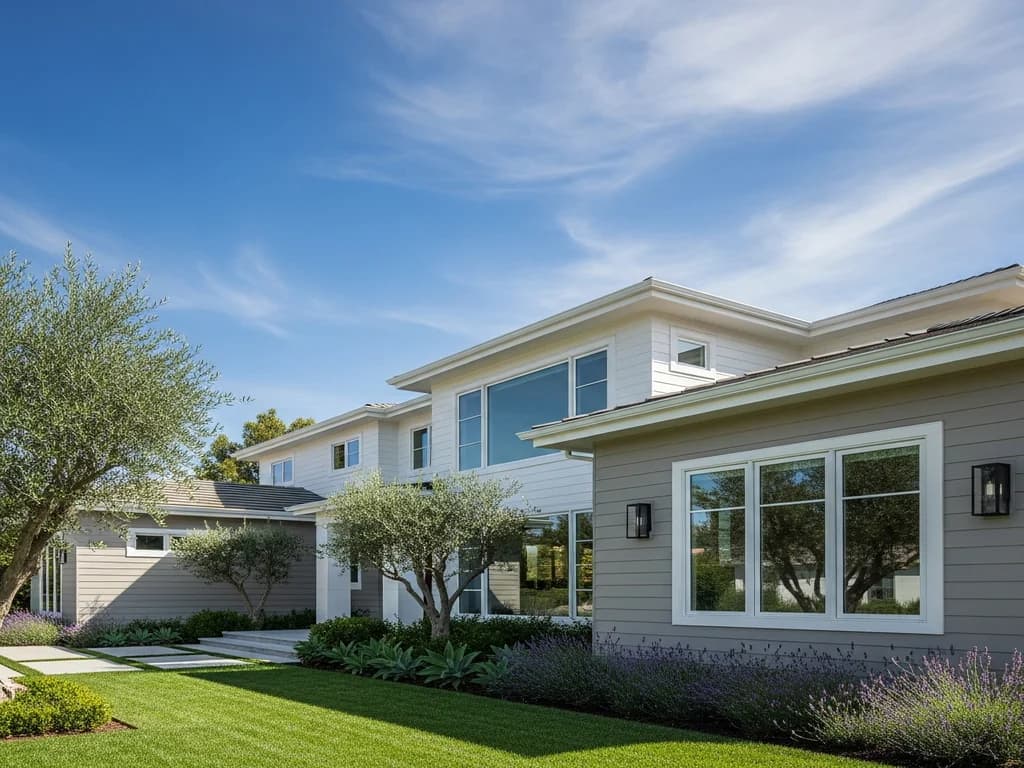
California modern architecture increasingly mixes exterior materials: fiber cement with stone, wood-look accents, and metal in considered combinations. Done with intent, this layering adds depth and reads genuinely architectural; done as one-of-everything, it reads busy and accidental. The difference is rarely budget and almost always discipline. Here is the framework we use to decide what to combine, where each material belongs, and when a single clean material is the better call.
Why mixed-material works when it works
A pure single-material exterior can read flat unless the architecture is already visually rich with massing, rooflines, and shadow. Introducing a second or third material adds depth, texture contrast, and a sense of deliberate design. The catch is that the benefit comes entirely from intentional combination, not from quantity. A home with one cladding, one well-placed accent, and a strong door looks more architectural than a home wearing five materials with no hierarchy. The goal is layering that supports the architecture's story, which is why we start every mixed-material conversation by asking what the home is trying to be before we talk about which products go where.
The three-material discipline
The most reliable mixed-material exteriors stop at three materials: a primary cladding, usually fiber cement; a secondary accent such as stone, wood-look, or metal; and a tertiary detail like the door, a trim accent, or a single architectural element. Four or more competing materials almost always read busy because the eye has no clear hierarchy to rest on. The discipline is not arbitrary; it mirrors how composed architecture actually reads, with one dominant surface, one supporting texture, and one point of emphasis. When clients want more, we usually find the design improves by removing a material rather than adding one. Our modern exterior design guide walks through this hierarchy in practice.
Coordinate by temperature
Materials must agree on temperature, warm or cool, or the composition reads disjointed no matter how good each piece is. A warm stone, a warm-toned fiber cement body, and natural wood accents combine into a cohesive warm composition. A cool gray stone, a cool fiber cement body, and black metal read as a cohesive cool composition. The common failure is mixing a warm stucco or wood with a distinctly cool gray cladding, which produces a clash the eye registers even when the homeowner cannot name it. We hold material samples together in real daylight before committing, because temperature mismatches that look subtle on a screen become obvious at full scale on the wall.
Put each material in its right zone
Every material has zones where it reads correctly and zones where it reads wrong. Stone belongs at the base, on a foundation wainscot, or on a deliberate accent wall, where it visually grounds the home. Wood-look accents belong in protected zones: an entry recess, a gable face, a soffit. Metal belongs in architectural details rather than broad fields. Materials applied in unsuitable zones, such as wood at grade in contact with soil and moisture, or stone scattered arbitrarily across a full elevation, read wrong and often invite maintenance problems. Zone logic is both an aesthetic and a durability decision, and getting the transitions and flashing right at those zone boundaries is where execution quality shows.
Combinations that work, and ones that don't
Proven California compositions include modern farmhouse with a fiber cement body, a stone foundation base, a wood entry recess, and black metal accents; wine-country estate with a stone base, fiber cement body, warm wood, and iron details; and mountain modern with a fiber cement body, warm wood accents, a stone fireplace face, and a metal roof. Each is a deliberate, working composition. The failures are predictable: too many materials with no hierarchy, a temperature conflict such as warm stucco against cool cladding against warm wood, or stone used as an arbitrary full-elevation siding substitute that competes with rather than supports the primary material. We help homeowners sort working combinations from busy ones before product is ordered, and we encourage you to confirm any specialty trade's standing on the CSLB license lookup.
What mixed-material does to budget and warranty
Mixed-material projects cost more than single-material equivalents because each added material brings its own installation specialty, its own coordination scope, and additional transition flashing where surfaces meet. The cost drivers are the extra trades, the detailing at every material junction, and the slower, more careful sequencing. We won't quote a precise premium sight-unseen because it depends entirely on how much accent material is involved and how complex the transitions are; your written estimate governs. On warranty, each material carries its own coverage, and the integration flashing between them must be executed correctly, because most mixed-material problems originate at the transitions rather than within any single product. Our weather-resistant exteriors work focuses on exactly those junctions.
Architectural intent comes first
Before any material is chosen, the question is what the home is trying to be: modern farmhouse, wine-country estate, mountain modern, or Mediterranean. That intent guides every downstream decision about which materials to combine and how. Without a clear intent, mixed materials read as decoration applied to a surface rather than as architecture, and no amount of quality product fixes that. We install the fiber cement and coordinate with stone, metal, and other specialty trades, working alongside architects when they're involved and helping guide material decisions directly when they're not. The honest test is simple: every material should earn its place by serving the home's intent, or it should come off the plan.
Successful mixed-material California compositions
| Combination | Architectural intent |
|---|---|
| Hardie + stone base + wood entry + black metal | Modern farmhouse |
| Stone base + Hardie + warm wood + iron | Wine country estate |
| Hardie + warm wood + stone fireplace + metal roof | Mountain modern |
| Stucco + Hardie + warm wood + wrought iron | Mediterranean/Spanish |
| Hardie + smooth panel accent + matched trim + black accent | Modern minimalist |
Key takeaways
- Cap most exteriors at three materials so a clear hierarchy reads
- Coordinate all materials by temperature, warm or cool, never both
- Place stone, wood, and metal in zones where they read and last
- Architectural intent should drive material choice, not the reverse
- Most failures and warranty issues start at material transitions
- Expect higher cost for added trades, detailing, and flashing
FAQ
Quick Answers
No. Simpler architecture often reads better with a single clean material; mixing is a design statement, not a requirement, and adding materials can hurt more than help.
Beyond three primary materials, most exteriors lose hierarchy and read busy. The discipline is usually to subtract a material rather than add one.
Each material carries its own warranty, and the integration flashing between them must be done correctly, since most mixed-material problems begin at the transitions.
Yes. Added trades, junction detailing, and transition flashing all raise cost; how much depends on the extent of accent material, which is why your written estimate governs.
We install the fiber cement and coordinate with stone, metal, and other specialty trades, and we can help guide material decisions on direct-to-homeowner projects.
Sources
Authoritative references
- James Hardie — official product & installation resources
- Contractors State License Board (CSLB) — verify a California contractor
External links to government, code, and manufacturer sources. Sierra Siding is not affiliated with these organizations; references are provided for verification.