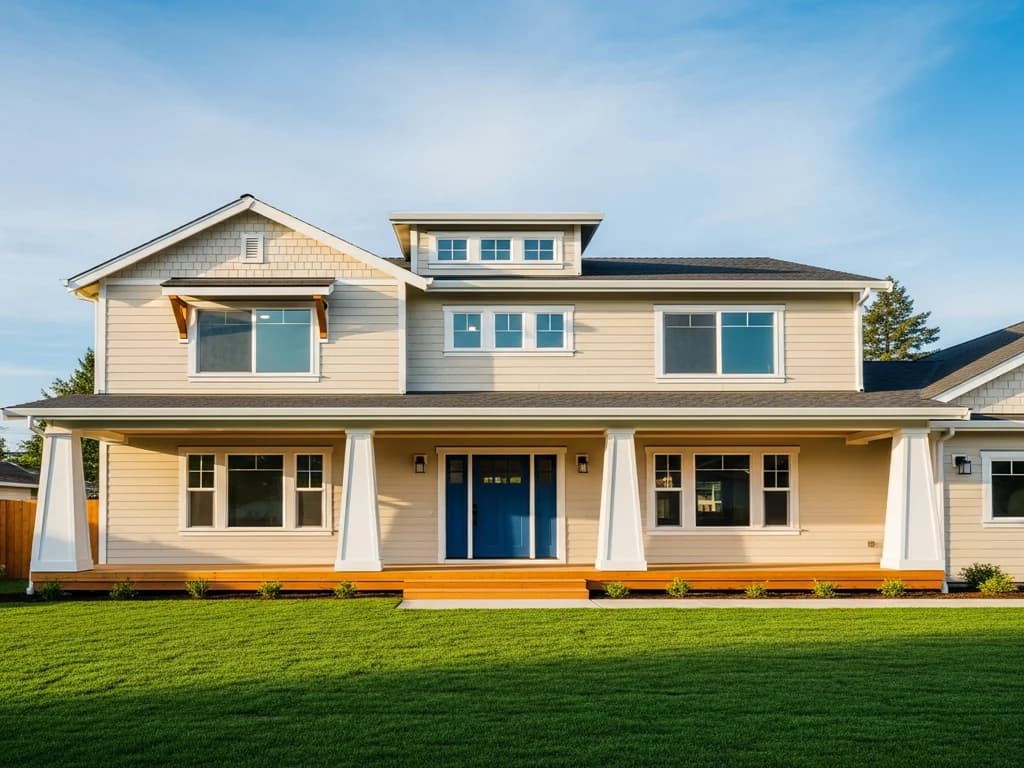
Siding in Angwin
Angwin is a small Howell Mountain community perched above St. Helena, a Pacific Union College town threaded through standing conifer and oak with vineyard rows breaking the canopy at the edges. A re-side here is fundamentally a forested-ridge job: homes sit among mature trees on a hilltop that the 2020 Glass Fire pushed across, under hot, dry upvalley summers. Cladding has to answer ember exposure first, then the timber-shaded moisture and the college-town mix of campus-adjacent residences and rural parcels.
We scope an Angwin re-side as a wildland-interface envelope, not a cosmetic refresh — the trees that make the place beautiful are also the fuel parked against the wall.
Re-siding a home inside standing timber
What separates an Angwin re-side from the valley floor below is that most homes here are surrounded by their own forest. Conifers and oaks crowd close to elevations, drop needle and leaf litter into wall-to-grade transitions, and shed a constant rain of fine fuel onto soffits and roof junctions. On Howell Mountain we treat the canopy as a permanent condition the cladding has to live with: non-combustible board carried tight to a clean ground line so litter cannot pile and smolder against a combustible base, joints and butt seams detailed so wind-borne embers find no ledge, and the shaded north and east faces specified for the damp that timber cover holds long after a valley wall has dried. A re-side that ignores the trees looks fine the first summer and starts failing at the bottom courses by the third.
The Glass Fire reality on Howell Mountain
Angwin is not theoretical fire country. The 2020 Glass Fire burned across Howell Mountain and through this area, and that history sets the baseline for every re-side we scope on the ridge. Embers ride the upslope and canyon drafts here rather than arriving as a single front, so the most vulnerable faces are the ones looking into the forest and down the slopes that funnel wind. We carry Class A non-combustible cladding such as fiber cement across those elevations, harden the eave, soffit, and vent detailing that embers actually exploit, and review decks, fences, and woodpiles that abut the wall as part of the same skin. A hardened wall behind a combustible deck or a stacked cord of firewood is a half-measure on a parcel that has already seen fire come through once.
College community and rural-parcel stock
Angwin's housing splits into two readable groups, and a re-side reads each differently. Near the Pacific Union College core are campus-adjacent residences and modest mid-century and later homes, often on smaller lots with simpler elevations and tighter neighbor spacing. Spread out from there are rural and forest-edge parcels — custom homes, older mountain houses, and properties where vineyard meets timber — on generous, harder-to-reach ground. The campus-side work tends to be straightforward plane-and-trim replacement where consistency across a block matters; the rural work is more varied, with steeper grades, longer material handling, and elevations that face directly into fuel. We match the spec and the staging to which Angwin you are in rather than applying one approach to a community that is really two.
Hilltop access and the upvalley re-side sequence
Getting a re-side done well on Howell Mountain is partly a logistics problem. The mountain is reached by climbing routes off the valley floor, and many Angwin parcels sit behind long drives, on grades that won't take a lift parked anywhere, and among trees that limit where scaffold and material drops can land. We plan access and staging before tear-off, stepping scaffold down slope where the ground demands it and protecting established plantings and septic fields during demolition. Material lead times matter here too, because the architectural-grade non-combustible cladding and matched trim these homes call for are not always stocked locally, and ordering before the old siding comes off keeps a hilltop job from stalling once the walls are open. Confirming the route up, the drop zones, and the delivery timing up front is what lets an Angwin re-side move at the pace the mountain allows.
Why this matters in Angwin
- Specified for Wine Country / North Bay conditions
- Class A non-combustible fiber cement as the recommended system
- Correctly detailed weather-resistive barrier and flashing
- Installed by a crew with 20 years combined experience
Recommended systems for Angwin
- Class A non-combustible fiber cement
- fire-hardened detailing
- James Hardie
Fiber Cement Siding for Angwin homes
The full fiber cement siding approach — materials, weather-resistive detailing, and the manufacturer standards we install to — is covered on the main service page, then specified for Angwin's conditions on this one.
Our Angwin process
- Step 1
Consultation
We listen to your goals and assess your home on site — exposure, substrate, and architecture.
- Step 2
Design & Proposal
A clear written proposal with the right system specified for your climate and a transparent scope.
- Step 3
Expert Installation
Trained crews install to manufacturer best practices with careful weather-management detailing.
- Step 4
Walkthrough & Support
A final walkthrough, full cleanup, and a clear written record of the scope completed — work we stand behind.
FAQ
Siding in Angwin — FAQ
Because Howell Mountain is genuine wildland-interface terrain and the 2020 Glass Fire burned through the area. Homes here sit inside standing timber, so non-combustible cladding and hardened detailing are the baseline for a ridge re-side, not an upgrade.
Angwin sits on top of Howell Mountain in standing forest and is a small Pacific Union College community, where St. Helena is the valley-floor town with a protected historic Main Street. The Angwin job contends with surrounding trees, hilltop access, and slope-driven ember exposure rather than a downtown streetscape.
Directly. The canopy keeps shaded walls damp longer, drops fine fuel into wall-to-grade transitions, and is the fuel ember exposure rides on. We detail the bottom courses, joints, and ground line specifically for a home living inside forest.
Yes — those rural parcels are exactly where we plan staging around grade, long drives, and plantings, and where ridge-facing elevations get the most hardening. The spec follows the terrain rather than the address.
Through a written proposal after an on-site walk; hilltop access, slope, hardening scope, and substrate condition vary enough on Howell Mountain that a number off a plan would be a guess.
Keep Exploring
More for Angwin homeowners
More in Angwin
Other exterior services in Angwin
Nearby Service Areas
Siding near Angwin
Helpful Exterior Guides