Exterior renovation in Angwin
Angwin is a small, tucked-away community on the wooded crown of Howell Mountain, above and east of St. Helena, organized for generations around Pacific Union College. Unlike the valley-floor towns below it, Angwin is genuinely a forest community: homes sit among standing pine, fir, and oak on a ridge that runs hot and dry through the long Napa summer. That setting gives Angwin a distinct exterior reality. The cladding on a home here is not a cosmetic line item; on this ridge it is the outermost layer of the home's defense against the fire behavior the mountain has already shown it can produce.
Why Angwin exteriors come first to fire
Most upvalley towns ask us to balance fire, sun, and curb appeal. Angwin tilts that balance hard toward fire, because the 2020 Glass Fire burned across Howell Mountain and through this very area, and the community now lives with that memory rather than as an abstraction. Older Angwin homes were frequently clad in wood, board-and-batten, or T1-11 chosen for a modest college-town budget decades ago, long before anyone specified for ember intrusion. Re-cladding those walls in hardened, non-combustible fiber cement is, for many homes here, the single most consequential improvement an owner can make to the structure.
Considering an exterior project in Angwin?
Angwin housing and architecture
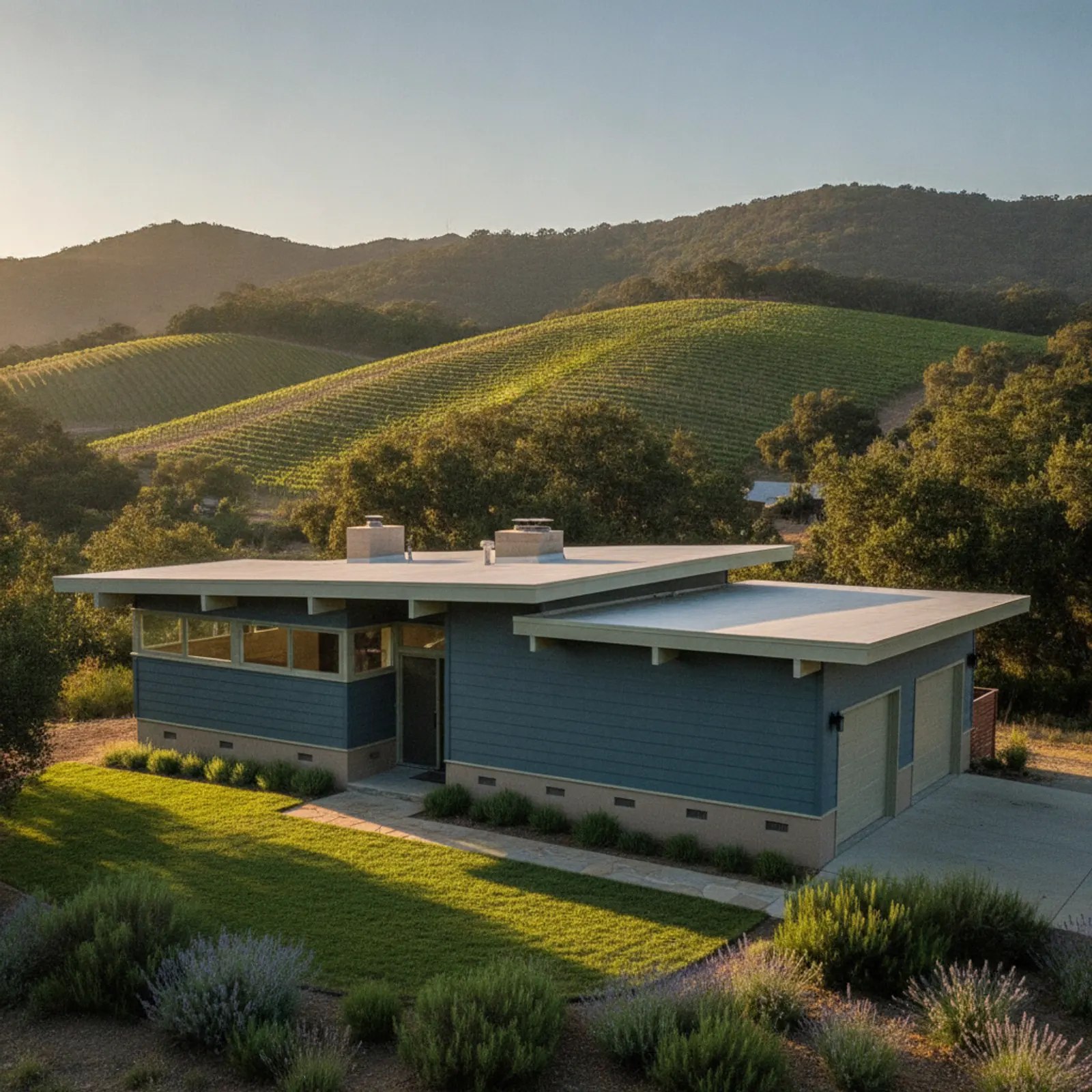
Angwin's housing reflects its character as a small, faith-affiliated college community rather than a moneyed wine-country enclave. The stock leans toward modest mid-century homes built for college staff and families, simple ranch forms, and a scattering of newer wooded hillside residences and rural acreage parcels spread out under the tree canopy. These are practical homes on forested lots, not show estates. That makes the re-side approach here functional and durability-driven: we favor clean, straightforward lap and trim that suits an unpretentious mountain community, while the real investment goes into the non-combustible assembly and the detailing behind it rather than into ornamental flourish.
Angwin's Howell Mountain climate
The controlling stressor in Angwin is wildland fire driven by the mountain's terrain, fuel, and exposure. At elevation on Howell Mountain, Angwin's summers are hot, dry, and high in UV, with heavy standing timber and brush surrounding the homes — the exact fuel-and-dryness combination that fed the Glass Fire across this ridge. The forest canopy shades many walls and keeps moisture a minor, detailing-managed concern, but it also means embers and radiant heat travel through dense vegetation right up to the structure. Every exterior decision in Angwin defers to that ember-and-radiant-heat reality before any other consideration.
Wildfire hardening in Angwin
Angwin warrants rigorous, fire-first hardening. We specify Class A non-combustible fiber cement and detail uncompromisingly at the points embers actually exploit on a forested ridge — eaves, soffits, vents, deck-to-wall junctions, and the ground-to-wall transition where leaf litter collects under the canopy. Because the Glass Fire demonstrated real fire behavior on Howell Mountain, we work to current California WUI standards and document the assemblies we install so the work supports defensible-space, code, and insurability conversations. We are clear about scope: siding is one critical layer of a whole-home and whole-property hardening strategy, not a standalone guarantee.
Recommended materials for Angwin
On Howell Mountain we recommend non-combustible fiber cement, hardened and detailed to current WUI practice — for many Angwin homes, James Hardie fiber cement with a factory finish. Combustible cladding is not something we will install on this ridge given the surrounding timber. Fiber cement also handles the elevation's intense summer UV and dry-season swings well, so the most fire-defensible material is also the most durable choice for the climate. Corrosion-aware fasteners and high-UV finishes round out a system meant to perform through Angwin's long dry seasons under heavy tree cover.
What an exterior project costs in Angwin
Angwin pricing turns on the depth of the fire-hardening scope, current-code WUI detailing, and the access realities of forested mountain parcels — narrow, tree-lined roads and long driveways that complicate material delivery and debris removal. Older college-community homes also tend to reveal substrate and dry-rot surprises once wood or T1-11 cladding comes off, so we keep that discovery contingency visible rather than buried. We assess each Angwin property on site and provide a written, itemized estimate, so bids can be compared on the actual hardening and substrate scope rather than on a headline figure, and that written estimate governs the work.
The college community and its homes
Angwin's identity is bound up with Pacific Union College, and much of the housing was built for the staff, faculty, and families connected to it. That gives the community a steady, owner-occupied character and a stock of practical, decades-old homes whose original modest cladding is now well past its service life. These owners tend to value durability, fire safety, and honest workmanship over showpiece detailing, which suits how we scope work here: a clean, well-detailed non-combustible re-side that protects the home and respects a budget-conscious community.
Living after the Glass Fire
The 2020 Glass Fire is not a distant statistic in Angwin; it moved across Howell Mountain and reshaped how this community thinks about its homes. Owners here arrive at the conversation already expecting non-combustible cladding and serious detailing, the way Paradise residents do after their own fire. Our role is to deliver that correctly and to be honest about what cladding does and does not do, rather than to persuade anyone that the risk is real — the mountain already made that case.
Mountain access and staging
Angwin's forested geography shapes every project. Homes sit on wooded lots reached by narrow ridge roads and sometimes long private driveways, with standing timber crowding the work zone and dropping debris that has to be managed during finish work. We plan staging, scaffold placement, and material handling during the site visit so the schedule reflects the real approach to a mountain parcel, and so the work protects the surrounding trees and neighbors rather than fighting the terrain blind.
Napa County, PG&E, and CAL FIRE LNU
Working exteriors in Angwin coordinates with a few local authorities. Angwin is unincorporated Napa County — there is no city government, so building permits come through the Napa County Planning, Building, and Environmental Services Department rather than a municipal department. Electric and gas are PG&E, and the entire Howell Mountain corridor is documented high-PSPS territory since the 2017 and 2020 fire seasons. Water on the Howell Mountain ridge is largely from private wells and small mutual systems, with Pacific Union College maintaining its own campus water. Fire response is CAL FIRE Sonoma-Lake-Napa Unit (LNU) alongside Napa County Fire and adjacent volunteer companies on structure calls, with the Napa County Sheriff coordinating evacuations during red-flag events.
HZ10 and the Glass-Fire FHSZ reality
Angwin is in James Hardie's HZ10 climate zone; installing HZ5 is a documented warranty misapplication. On the fire side, essentially every parcel in and around Angwin sits in High or Very High FHSZ territory under California's 2025 LRA Fire Hazard Severity Zone map, with most surrounding land in State Responsibility Area (SRA). The 2020 Glass Fire (67,484 acres) moved directly across Howell Mountain and reshaped how this community thinks about its homes; the 2017 Atlas Fire and Nuns Fire burned adjacent Napa terrain. On every parcel here the 2025 California Wildland-Urban Interface Code governs the exterior wall. Chapter 7A moved into the standalone WUI Code on January 1, 2026.
Our process in Angwin
- Step 1
Consultation
We listen to your goals and assess your home on site — exposure, substrate, and architecture.
- Step 2
Design & Proposal
A clear written proposal with the right system specified for your climate and a transparent scope.
- Step 3
Expert Installation
Trained crews install to manufacturer best practices with careful weather-management detailing.
- Step 4
Walkthrough & Support
A final walkthrough, full cleanup, and a clear written record of the scope completed — work we stand behind.
Angwin sits in real fire country on Howell Mountain, and its exteriors have to be built that way — genuinely non-combustible, detailed to current WUI practice, and documented. We scope every Angwin project on site, talk straight about what siding can and cannot do, and your written estimate governs the work.
FAQ
Angwin — Common Questions
It is the defining factor. Angwin sits in dense forest on Howell Mountain, and the 2020 Glass Fire burned across this area, so we apply rigorous fire-first hardening and current WUI standards on every project here.
Class A non-combustible fiber cement, detailed uncompromisingly at eaves, soffits, vents, decks, and ground-to-wall transitions where embers and leaf litter collect under the tree canopy.
No. Given the standing timber surrounding homes on Howell Mountain, we will not install combustible cladding here — hardened, non-combustible assemblies are the only responsible choice.
Re-cladding combustible wood or T1-11 in hardened non-combustible fiber cement is typically the single highest-value structural improvement available to a forested ridge home.
Yes — the ridge runs hot, dry, and high-UV in summer, so we pair fire hardening with high-UV factory finishes and corrosion-aware fasteners built for sustained dry-season exposure.
We build to current WUI standards and document every assembly so the work supports defensible-space, code, and insurability conversations; insurers set their own criteria, which we don't speak for.
Yes — we work throughout Angwin, from the college-community homes to the wooded hillside residences and rural acreage parcels across Howell Mountain.
A correctly installed non-combustible fiber cement system commonly performs 30+ years on the ridge while materially reducing the home's ignition risk.
Explore
Exterior Services
Helpful Exterior Guides