Exterior renovation in Deer Park
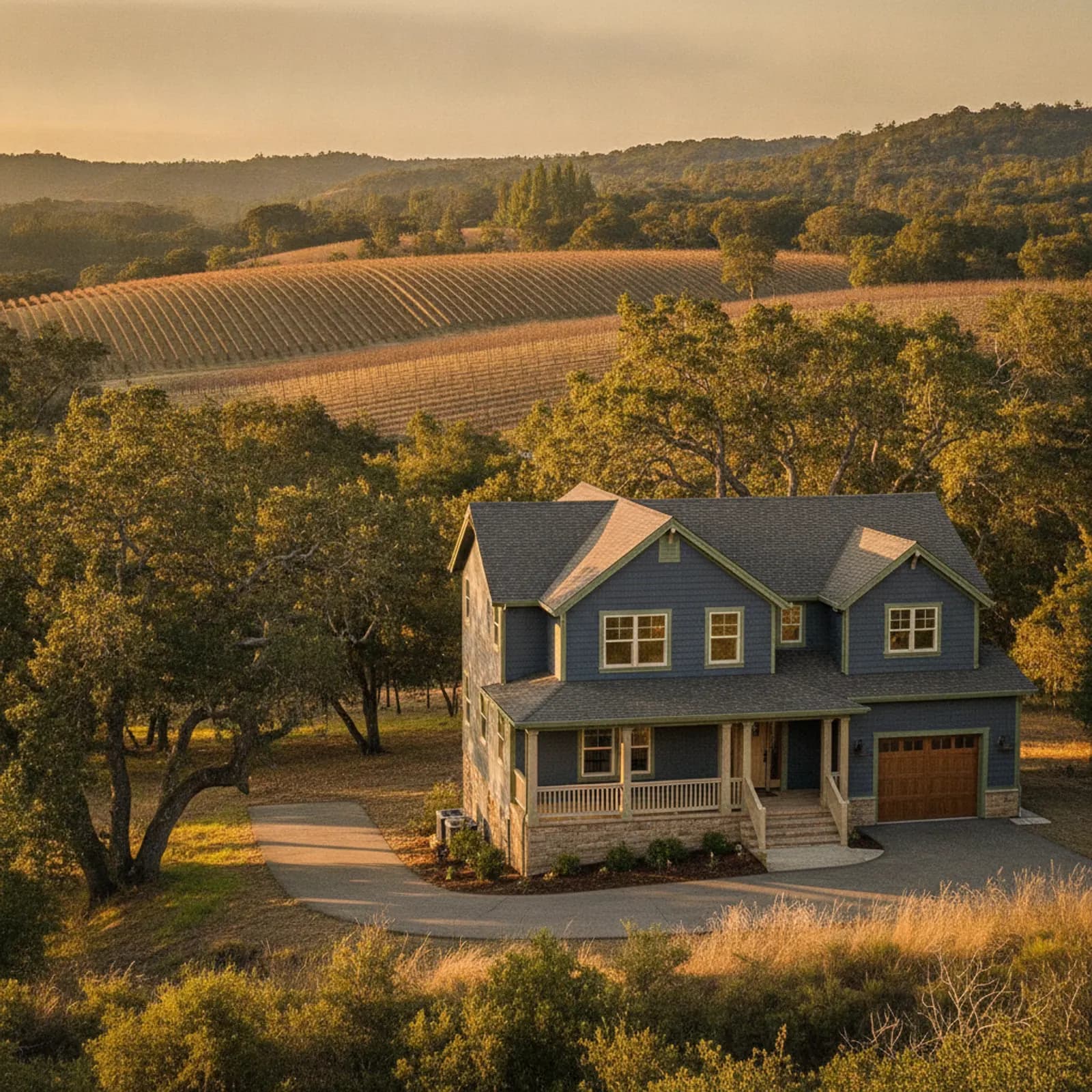
Deer Park is a quiet, wooded residential area on the slopes northeast of St. Helena, where the upvalley floor gives way to the wooded base of Howell Mountain. It is a leafier, more secluded place than the town below — homes set among oaks and conifers on larger, tree-shaded lots, many reached by winding roads that climb toward the mountain. That wooded, semi-rural setting is what defines exterior work in Deer Park. The cladding here has to answer to dense surrounding vegetation and the upvalley fire history at the same time as it carries the polished look this part of Napa expects.
Where the trees meet the wine country
Deer Park occupies an in-between zone: it shares St. Helena's premium upvalley market but sits in noticeably heavier tree cover and closer to the wildland than the valley floor. The 2020 Glass Fire moved through this upvalley terrain, and Deer Park's wooded lots put structures in genuine contact with the fuel that drives that risk. So a re-side here is a two-part assignment — deliver the refined, architectural exterior the upvalley value justifies, and do it in a hardened, non-combustible system that earns its place in the trees. We scope every Deer Park home to satisfy both demands at once.
Considering an exterior project in Deer Park?
Deer Park housing and architecture
Deer Park's stock spans older upvalley homes from earlier decades, wooded foothill residences, custom hillside homes, and rural acreage estates spread among the trees toward Howell Mountain. The setting attracts owners who want privacy and character over street presence, so the homes range from updated mid-century forms to substantial custom builds tucked into the canopy. That mix calls for a re-side that respects each home's level of finish — clean architectural lap and proportioned trim on the simpler homes, and premium custom trim packages on the hillside and estate properties — while the underlying non-combustible assembly stays constant across all of them given the shared wooded exposure.
Deer Park's wooded upvalley climate
Deer Park's controlling stressor is wildland fire arising from its wooded position at the foot of Howell Mountain. Summers here are hot, dry, and high-UV in classic upvalley fashion, and the heavy tree and brush cover surrounding the homes supplies exactly the fuel that fire behavior feeds on — as the Glass Fire demonstrated across this terrain in 2020. The canopy keeps walls shaded and makes moisture a secondary, detailing-managed concern, but it also delivers embers, radiant heat, and accumulated leaf litter right to the structure. The exterior spec in Deer Park is set for that ember-and-fuel reality before anything else.
Wildfire hardening in Deer Park
Deer Park's wooded lots warrant serious, fire-first hardening. We specify Class A non-combustible fiber cement and detail rigorously at the junctions embers exploit on a tree-surrounded parcel — eaves, soffits, vents, deck-to-wall connections, and the ground-to-wall transition where canopy litter gathers. Because the Glass Fire showed real fire behavior across this upvalley terrain, we build to current California WUI standards and document the assemblies so the work supports defensible-space, code, and insurability conversations. We're candid about scope: hardened siding is one essential layer of a whole-home and whole-property strategy, not a complete answer on its own.
Recommended materials for Deer Park
In Deer Park's tree cover we recommend non-combustible fiber cement, hardened and detailed to current WUI practice, with James Hardie fiber cement and premium custom trim suiting the upvalley homes and estates here. We do not install combustible cladding on these wooded lots given the surrounding fuel. Fiber cement also stands up to the upvalley's intense summer UV and dry-season movement, so the most fire-defensible material is also the most durable and the most refined, holding factory color and architectural lines far longer than field-painted wood would under this exposure. Corrosion-aware fasteners complete a system built for the long dry seasons.
What an exterior project costs in Deer Park
Deer Park pricing is driven by the fire-hardening scope, current-code WUI detailing, the level of architectural finish on more substantial hillside and estate homes, and the access realities of wooded, winding-road parcels that complicate delivery and staging. Older upvalley homes frequently reveal substrate and dry-rot surprises once original cladding is removed, so we keep that discovery contingency visible. We assess each property on site and provide a written, itemized estimate so bids can be weighed on the real hardening, finish, and substrate scope rather than a headline number — and in this upvalley market, that written estimate governs the work.
Distinct from St. Helena below
Deer Park shares St. Helena's premium upvalley market but is a different animal on the ground: more trees, more seclusion, larger wooded lots, and closer contact with the wildland than the town's flatter, more open parcels. That changes the work. Where a St. Helena town home may emphasize period sensitivity, a Deer Park home emphasizes hardened performance in the canopy first and architectural finish second. We treat Deer Park as its own context rather than as an extension of the town below it.
Living with upvalley fire history
The 2020 Glass Fire reshaped how this stretch of upvalley Napa thinks about its homes, and Deer Park's wooded position kept it in the conversation. Owners here generally arrive expecting non-combustible cladding and serious detailing rather than needing to be persuaded. Our job is to deliver that to current standards and to be honest about the limits of what siding alone accomplishes within a larger defensible-space and whole-property effort that the terrain demands.
Wooded access and staging
Deer Park's geography governs the logistics of every job. Homes sit on tree-shaded lots reached by winding roads climbing toward Howell Mountain, with standing trees crowding the work zone, narrow approaches limiting lift and scaffold placement, and canopy debris that must be managed during finish work. We plan staging and material handling during the site visit so the schedule reflects the real approach to a wooded parcel and so the work protects the surrounding trees and neighbors.
Napa County, private wells, and CAL FIRE LNU
Working exteriors in Deer Park coordinates with a few local authorities. Deer Park is unincorporated Napa County — there is no city government, so building permits come through the Napa County Planning, Building, and Environmental Services Department rather than a municipal department. Electric and gas are PG&E, and the Deer Park / Howell Mountain corridor is documented high-PSPS territory since the 2017 and 2020 fire seasons. Water on most parcels comes from private wells or small mutual systems, with St. Helena Hospital / Adventist Health Vallejo campus maintaining its own supply. Fire response is CAL FIRE Sonoma-Lake-Napa Unit (LNU) alongside Napa County Fire and adjacent volunteer companies, with the Napa County Sheriff coordinating evacuations.
HZ10 and the Glass-Fire FHSZ reality
Deer Park is in James Hardie's HZ10 climate zone; installing HZ5 is a documented warranty misapplication. On the fire side, essentially every parcel in and around Deer Park sits in High or Very High FHSZ territory under California's 2025 LRA Fire Hazard Severity Zone map, with most surrounding land in State Responsibility Area. The 2020 Glass Fire (67,484 acres) burned across the Howell Mountain corridor and reshaped how upvalley Napa thinks about exteriors; the 2017 Atlas Fire, Tubbs Fire, and Nuns Fire together burned much of the surrounding North Bay. On every parcel here the 2025 California Wildland-Urban Interface Code governs the exterior wall. Chapter 7A moved into the standalone WUI Code on January 1, 2026.
Our process in Deer Park
- Step 1
Consultation
We listen to your goals and assess your home on site — exposure, substrate, and architecture.
- Step 2
Design & Proposal
A clear written proposal with the right system specified for your climate and a transparent scope.
- Step 3
Expert Installation
Trained crews install to manufacturer best practices with careful weather-management detailing.
- Step 4
Walkthrough & Support
A final walkthrough, full cleanup, and a clear written record of the scope completed — work we stand behind.
Deer Park asks for both the refined upvalley exterior its market expects and the hardened, non-combustible performance its wooded setting demands — and we build for both. We scope every Deer Park project on site, talk straight about what hardened siding does within a whole-property strategy, and your written estimate governs the work.
FAQ
Deer Park — Common Questions
It is the controlling concern. Deer Park's wooded lots sit at the foot of Howell Mountain in the upvalley terrain the 2020 Glass Fire swept through, so we lead with fire hardening and current WUI standards on every project.
Yes — it shares St. Helena's premium market but sits in heavier tree cover, closer to the wildland, so we prioritize hardened, non-combustible performance in the canopy on top of architectural finish.
Class A non-combustible fiber cement, detailed rigorously at eaves, soffits, vents, decks, and ground-to-wall transitions where embers and canopy litter accumulate on wooded lots.
No. Given the surrounding trees and brush, we will not install combustible cladding here — hardened, non-combustible assemblies are the only responsible choice on these lots.
Yes — fiber cement with premium custom trim gives Deer Park's hillside and estate homes a refined exterior while keeping the assembly fully non-combustible.
We build to current WUI standards and document every assembly so the work supports defensible-space, code, and insurability conversations; insurers set their own criteria, which we don't speak for.
Often, yes — wooded lots on winding roads can limit material delivery, lift, and scaffold placement, so we plan staging during the site visit to reflect the real approach.
A correctly installed non-combustible fiber cement system commonly performs 30+ years in this upvalley climate while materially reducing the home's ignition risk.
Explore
Exterior Services
Helpful Exterior Guides