10 min read · Siding Replacement
A generation of Sierra foothill homes wears cedar. Through the 1970s, '80s, and '90s, when the custom and semi-custom stock of El Dorado Hills, Cameron Park, Shingle Springs, and the Placerville hills was built, western red cedar was the natural choice — locally plentiful, beautiful against the oaks, and suited to the informal architecture the foothills favored. Forty years on, those same homes sit in mapped fire-hazard terrain under some of the strongest sun in Northern California, and their owners face a decision the original builders never had to price: maintain the cedar, or retire it. Our statewide guide to replacing cedar siding in California covers the material itself — its genuine durability, its honest maintenance cost, its failure modes. This guide is the foothill-corridor version: what this specific elevation and this specific fire geography do to the math, and where the answer differs from the state-level one.
Why cedar is everywhere on foothill customs
The pattern is era plus setting. The foothill corridor built out in a window when cedar was the prestige cladding for custom work — diagonal and vertical board treatments, deep lap, shake accents — and the wooded lots made it look inevitable. The early custom neighborhoods of El Dorado Hills, the acreage properties around Cameron Park and its airpark, the Shingle Springs ranchettes, and the hillside homes ringing Placerville all drew from the same palette. Many of these exteriors are original: forty-plus years of service, which is a genuine testament to the material and to the builders who detailed it. But an original 1980s cedar wall is now decades past its designed finish cycles, often carrying sapwood-heavy replacement boards from past repairs, and — the part the original spec never contemplated — hanging on a home whose parcel now carries a formal fire-hazard designation.
What foothill exposure does that the coast never did
Cedar's reference literature was written for gentler places. In the corridor's climate — hotter and drier than the valley floor, with UV that strengthens as the elevation climbs — finish life runs to the short end of every published range. The USDA Forest Products Laboratory's service-life figures put semitransparent stains at roughly two to four years on smooth wood, and foothill south and west walls reliably hit the bottom of that window; the long rainless summer opens checks and butt joints that the first autumn storms then exploit. The failure geography is predictable: soft spots concentrate at end-grain and lower courses, especially where irrigation overspray or grade-level splash keeps the bottom of the wall damp through the dry season while everything above it bakes. None of this means foothill cedar is doomed — the Western Red Cedar Lumber Association is candid that all cedar finishes need regular renewal, and owners who keep that schedule keep sound walls. It means the maintenance contract the material demands is more expensive to honor at 1,500 feet than at sea level, and every year of deferral here costs more wood.
The fire map changes the arithmetic
At the state level, keeping well-maintained cedar is often the defensible call. On this corridor, the fire geography leans harder on the scale. Cedar is combustible, and the parcels where it is most common — oak-canopy acreage in Cameron Park, open-space-adjacent El Dorado Hills lots, the wooded hills around Placerville — sit in high and very-high Fire Hazard Severity Zones along the same Highway 50 corridor the Caldor Fire burned up in 2021. The UC ANR Fire Network's siding guidance is direct: combustible cladding is a vulnerability, and noncombustible or ignition-resistant siding is the recommendation for exposed parcels and anywhere structures stand close together. The code points the same way — since January 1, 2026, the California Wildland-Urban Interface Code (which absorbed the old Chapter 7A provisions) requires noncombustible or ignition-resistant wall coverings on designated parcels, a standard cedar does not meet on its own. So the foothill version of the keep-or-replace question is not just "is the wood sound and am I willing to maintain it" but "is a combustible skin the right long-term position on this parcel" — and on much of the corridor, the honest answer is no.
Keeping the look: what passes design review
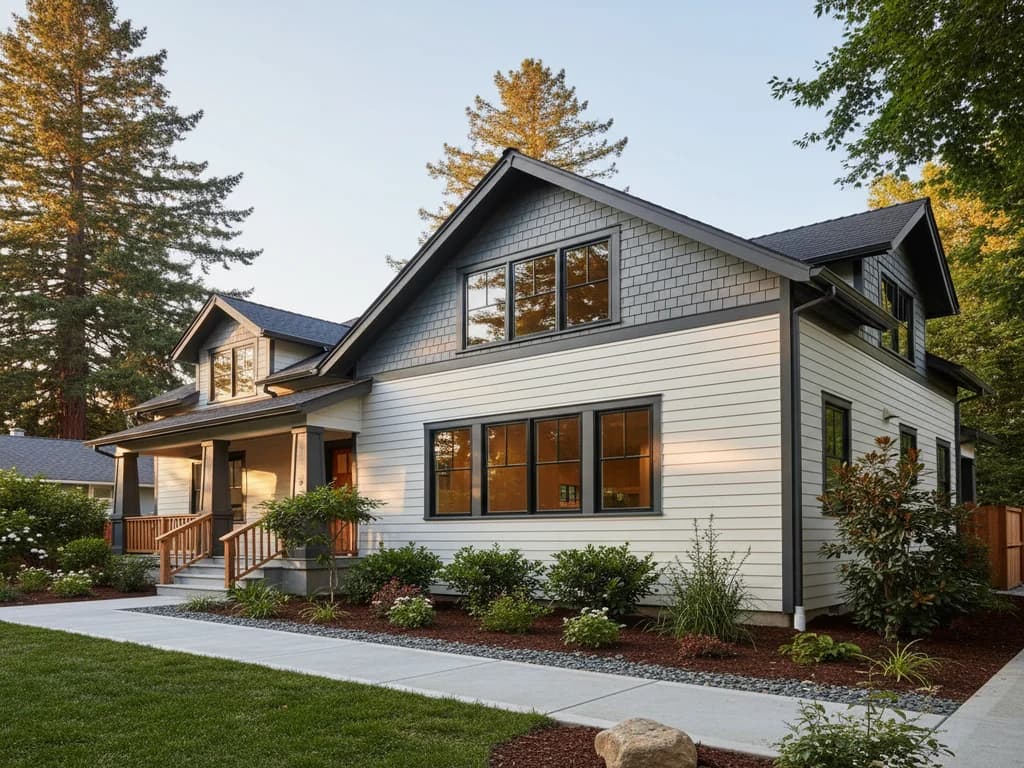
The good news for owners who love what cedar looks like is that the replacement conversation is no longer a style sacrifice. Cedarmill-textured fiber cement lap, vertical panel-and-batten, and shingle-look profiles reproduce the foothill vocabulary closely enough that finished elevations read as intended from the street — while the wall itself becomes noncombustible, Class A material per James Hardie's published performance data. That matters practically in El Dorado Hills, where Serrano's design guidelines and the gated communities' architectural committees review material and color changes: woodgrain-textured fiber cement in an approved palette is a submittal that passes, precisely because it preserves the neighborhood's intended character. Our experience is that the review process is smoother for a cedar-to-fiber-cement conversion than owners expect — committees in fire country increasingly understand exactly why the request is being made — but the submittal still has to be prepared and approved before ordering, so we fold it into the project schedule rather than treating it as the owner's errand.
Staged re-sides on acreage properties
Foothill cedar homes are frequently large, and acreage parcels often carry a shop, barn, or hangar wearing the same boards. Replacing everything at once is not always the right cash-flow answer, and a staged program is legitimate if it is sequenced by exposure rather than by convenience. The order that earns its keep: start with the elevations that take the afternoon sun and the walls that face the parcel's fuel — the grassland edge, the oak line, the slope — because those carry both the worst weathering and the worst ember exposure. Detached structures deserve a place in the sequence too; an outbuilding twenty feet upwind of the house is part of the house's fire problem. What a staged plan must not do is stall indefinitely at phase one, leaving a half-combustible perimeter for years. We write staged scopes with the full sequence priced and the transitions between old and new cladding properly flashed, so each phase stands on its own and the parcel's risk actually declines with every stage.
When cedar honestly stays
Replacement is not the universal answer, and we will say so on the site walk. Cedar stays defensibly when the parcel's exposure is genuinely low — an interior lot in an established neighborhood, well inside the fire map's calmer designations, without heavy adjacent fuel; when the wood itself is sound heartwood with a maintained finish rather than a patchwork of decayed sapwood; and when the owner is truthfully committed to the refinishing cadence the foothill sun sets, which is shorter than the brochure interval. Some owners keep cedar on those terms with clear eyes, pairing it with rigorous defensible space and hardened vents and eaves, and that is a coherent position — hardening is a system, and the cladding is one layer of it. What we counsel against is the middle path: neglected cedar on an exposed parcel, kept because replacement feels expensive. That wall is paying cedar's maintenance price in decay while forgoing its beauty, and carrying combustible cladding in ember country while forgoing the fix. For the county-wide picture that frames this decision — fire zones, code, permits, and the elevation bands — see the El Dorado County siding guide.
Keep vs. replace: how the foothill corridor shifts the cedar decision
| Factor | State-level baseline | Sierra foothill corridor |
|---|---|---|
| Finish life | FPL ranges apply broadly | Short end of every range; south/west walls first |
| Fire exposure | Varies parcel to parcel | Much of the corridor is mapped high/very-high hazard |
| Code pressure | WUI Code on designated parcels | Designations common; re-sides steered noncombustible |
| Keeping cedar | Legitimate with maintenance | Defensible mainly on low-exposure interior lots |
| Replacement look | Wood-look profiles available | Cedarmill fiber cement passes EDH design review |
Key takeaways
- Cedar was the prestige cladding of the corridor's 1970s–90s custom era, and much of it is original — decades past its designed finish cycles on parcels that now carry formal fire-hazard designations.
- Foothill sun pushes cedar finish life to the bottom of the published FPL ranges, and the dry-summer/wet-autumn cycle concentrates decay at end-grain, lower courses, and irrigation splash zones.
- On high-hazard corridor parcels the question shifts from maintenance appetite to whether a combustible skin is the right position — UC ANR guidance and the 2026 WUI code both point to noncombustible cladding.
- Cedarmill-textured fiber cement keeps the foothill look, passes El Dorado Hills design review, and converts the wall to Class A noncombustible material.
- Cedar honestly stays on low-exposure parcels with sound heartwood and a committed maintainer; staged re-sides on acreage should sequence by sun and fuel exposure, not convenience.
FAQ
Quick Answers
It depends on three things: the parcel's fire exposure, the wood's actual condition, and your appetite for the maintenance cycle. On high-hazard parcels along the Highway 50 corridor, the fire case for noncombustible cladding usually decides it. On a low-exposure lot with sound, maintained heartwood, keeping the cedar is a legitimate choice — we give the honest read on site rather than defaulting to replacement.
Not retroactively — existing walls are not ordered off a house. But substantial re-siding work on a designated parcel falls under the 2025 California WUI Code (which replaced the WUI code on January 1, 2026), and that requires noncombustible or ignition-resistant wall coverings. In practice, once a corridor cedar wall is worn enough to need major work, the code steers the replacement to noncombustible material.
The woodgrain-textured lap, vertical, and shingle-style profiles get close enough that finished foothill elevations read as intended from the street, and El Dorado Hills design-review committees routinely approve them for exactly that reason. Up close, natural cedar has a character no manufactured board fully replicates — we say that plainly. The trade is that character for a Class A noncombustible wall with a factory finish instead of a two-to-four-year stain cycle.
Yes, and on acreage it is often the sensible plan — sequenced by exposure: sun-hammered and fuel-facing elevations first, detached outbuildings included in the program, and every phase transition properly flashed so each stage stands alone. What we advise against is an open-ended phase one that leaves a half-combustible perimeter for years.
Published intervals are national averages; foothill elevation strengthens UV, and the corridor's long rainless summers work joints and checks harder than milder climates do. South- and west-facing walls here reliably land at the short end of the USDA Forest Products Laboratory's stain-life ranges. It is exposure, not a defect — but it is a real, recurring cost that belongs in the keep-or-replace math.
Sources
Authoritative references
- USDA Forest Products Laboratory — FinishLine: exterior finish service-life by product type
- USDA Forest Products Laboratory — Wood Handbook Ch. 14: Biodeterioration of Wood (decay resistance, moisture thresholds)
- Western Red Cedar Lumber Association — siding care & maintenance
- UC ANR Fire Network — Siding (combustible cladding & wildfire; noncombustible options)
- 2025 California Wildland-Urban Interface Code (Title 24, Part 7) — full text
- James Hardie — performance & durability (noncombustible per ASTM E136; Class A per ASTM E84)
External links to government, code, and manufacturer sources. Sierra Siding is not affiliated with these organizations; references are provided for verification.