9 min read · HOA & Multifamily
Short answer: dry rot is more dangerous for a community than for a single home because the same construction details repeat across every unit, so when one building hides systemic moisture damage, the others usually share the vulnerability. It concentrates in predictable places — decks and balconies, shared party walls, and anywhere cladding meets the ground — and it stays invisible behind the siding until a board goes looking or a wall is opened. The board's job isn't to diagnose rot personally; it's to detect that it may be present, scope it competently before bidding, and carry the budget contingency that hidden damage demands. Get those three right and dry rot becomes a planned-for line item instead of an ambush. For the underlying signs and mechanics, we link the general guide rather than repeat it. Want a community-wide moisture and condition read? Schedule an HOA exterior assessment.
Why community buildings hide systemic damage
On a single-family home, dry rot is one home's problem with one set of details. On an HOA or multifamily property, every building was constructed from the same plans, by the same crews, with the same flashing and clearance details — so a weakness that produces rot in one location tends to repeat across the whole community. That repetition is what makes the damage systemic rather than isolated: it's not one rotting wall, it's the same vulnerability quietly progressing in dozens of identical assemblies. Boards that assume a problem found in one building is contained to that building are usually wrong. The starting assumption on a multi-unit property should be that a systemic detail is systemic until inspection proves otherwise.
Where dry rot concentrates in a community
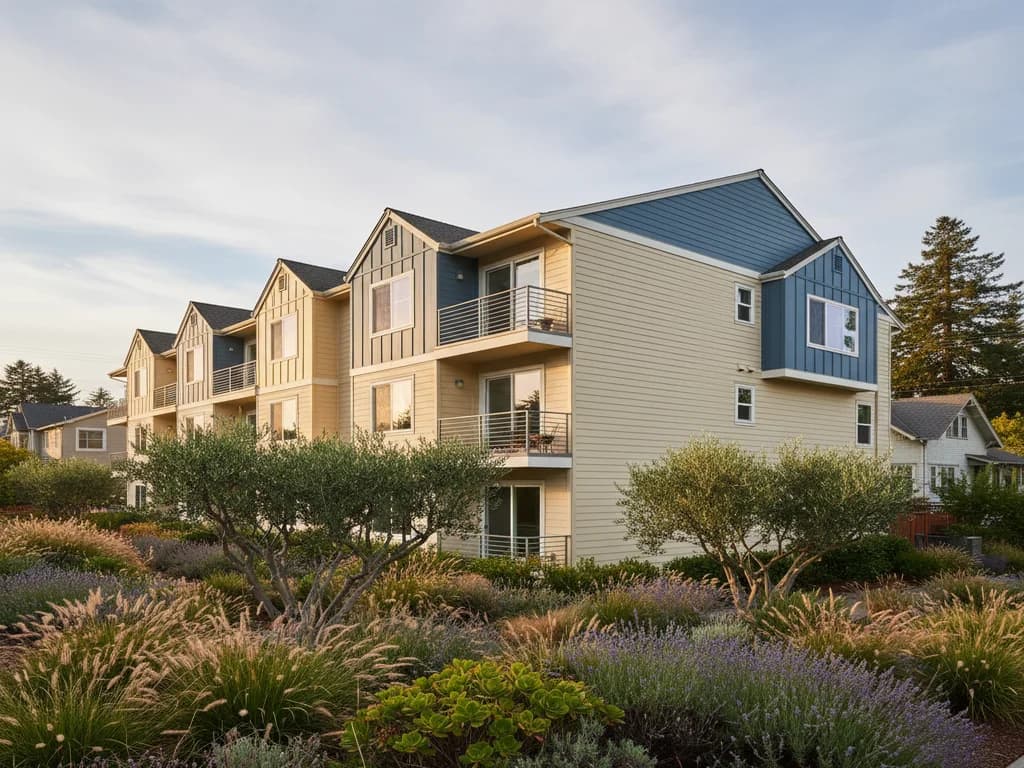
Because rot follows water, it concentrates in predictable, water-loving locations — and on a multi-unit property those locations repeat at every building. Decks and balconies are the classic high-risk zone: their ledger connections, waterproofing, and the wall behind them are a frequent source of serious, hidden structural decay, and they carry real safety weight as well. Shared party walls and the transitions between units can trap moisture where two assemblies meet. Anywhere cladding sits too close to grade, roofing, or hardscape, it wicks ground moisture. Penetrations — hose bibs, vents, light fixtures, railings — are repeated leak points. Knowing these concentration zones lets a board target inspection where rot is most likely rather than checking walls at random.
How a board detects it before bidding
A board doesn't need to be a building scientist, but it does need to trigger a competent look before money is committed. That means a documented exterior condition assessment that goes beyond a curb-side glance — checking the concentration zones, probing suspect areas, and where warranted opening a representative sample of walls to confirm what's behind the cladding. The goal is to convert 'we think some buildings have rot' into 'here is documented evidence of what's there and where,' so the project can be scoped on facts. Our guides on water intrusion behind siding and flashing failure explain the failure points an assessment should examine. The detection step is what separates a board that's guessing from one that's planning.
Scoping it before you bid the project
Hidden rot wrecks budgets mostly because it's discovered after the contract is signed, when every finding becomes a change order. The fix is to scope as much of it as possible into the bid documents up front. Using the condition assessment and representative wall openings, the board can describe the likely extent of substrate and framing repair so contractors bid against a realistic picture rather than a hopeful one — and so the board can compare bids on the same assumptions. You'll never scope hidden damage perfectly; you scope enough to shrink the unknown and to make the remaining unknown an explicit, priced contingency rather than a blank check. Our bid comparison guide covers holding every bidder to the same rot-repair assumptions.
Budget and contingency implications
Dry rot is the reason an HOA exterior project needs a real, written contingency rather than a tidy fixed number. The jump from 'replace the siding' to 'replace the siding and repair the rotted sheathing and framing behind it' is the steepest cost step on the whole project, and on a community where the damage is systemic, that step can apply to many buildings. The discipline is to carry a documented contingency as a percentage of the project budget, require photo-documented change orders before any draw against it, and treat substrate repair as expected rather than exceptional on aging multi-unit buildings. Our protecting reserve funds guide details how to structure that contingency so a rot finding is a planned event, not a crisis.
Why fixing the rot and re-siding belong together
The moment the cladding comes off is the only practical opportunity to see and repair the substrate, so the rot repair and the re-side are really one project, not two. A board that tries to re-side without budgeting to repair what's found behind the wall is setting up a mid-project funding scramble; a board that plans for both treats the open wall as the chance to make the structure sound for the next cladding cycle. This is also why the contractor's competence at substrate repair — not just hanging board — matters, and why hold-point inspection of the opened wall is worth requiring. Our dry rot repair service exists precisely because this structural work is so common on deferred multifamily, and our construction defect prevention guide covers building the new assembly so rot doesn't return.
What this means for the board's decision
Pulling it together: on a community building, assume rot may be systemic, look in the places it concentrates, document what you find before you bid, scope it into the contract, and carry a real contingency for what you can't see. That posture turns the scariest unknown in an exterior project into something a board can plan around with confidence. It also reframes the timeline — finding rot early and addressing it during a planned re-side is dramatically cheaper than discovering it after a balcony fails or a unit floods. The whole point is predictability: you can't make hidden damage visible from the parking lot, but you can refuse to be surprised by it.
Where dry rot concentrates in a community and why
| Concentration zone | Why moisture collects | Why it matters to a board |
|---|---|---|
| Decks & balconies | Ledger connections and waterproofing fail and trap water | Structural decay plus a safety and liability concern |
| Shared party walls | Moisture trapped where two assemblies meet | Damage spans multiple units, not one |
| Ground / roof contact | Cladding too close to grade wicks moisture | Repeats at every building's base |
| Penetrations | Hose bibs, vents, railings, fixtures leak at the seal | Many small repeated leak points per building |
Key takeaways
- On a community, identical construction means rot found in one building is likely systemic, not isolated.
- Dry rot works behind the cladding and stays hidden until staining, soft spots, or leaks appear — usually late.
- It concentrates at decks and balconies, shared party walls, ground contact, and repeated penetrations.
- A board's role is to trigger a documented condition assessment before committing money — not to diagnose itself.
- Scope likely substrate and framing repair into the bid so contractors price the same realistic picture.
- Carry a written percentage contingency; treat substrate repair as expected on aging multi-unit buildings.
- The open wall during a re-side is the only chance to repair the substrate — rot repair and re-side are one project.
- Decks and balconies carry safety weight; their hidden rot is both a structural and a liability concern.
FAQ
Quick Answers
On a multi-unit property, assume so until inspection proves otherwise. The buildings share the same plans, crews, and flashing and clearance details, so a vulnerability that produced rot in one location tends to repeat community-wide. Treating a finding as isolated is a common and costly mistake.
The water-loving zones that repeat at every building: decks and balconies and their connections, shared party walls and unit transitions, anywhere cladding sits too close to grade or roofing, and penetrations like hose bibs, vents, and railings. Targeting these beats inspecting walls at random.
Commission a documented condition assessment that examines the concentration zones, probes suspect areas, and where warranted opens a representative sample of walls. The aim is evidence of what's there and where — enough to scope the project on facts rather than guesses, without opening every wall.
Because it's usually discovered after the contract is signed, when each finding becomes a change order. The step from replacing siding to also repairing rotted sheathing and framing is the steepest cost jump in the project — and on a systemic community problem it can apply to many buildings at once.
Carry it as a documented percentage of the project budget rather than a fixed guess, since the unknown is substrate condition, and require photo-documented change orders before any draw. The right percentage depends on building age and assessment findings; on aging multifamily, treat substrate repair as expected.
No — the open wall during a re-side is the only practical chance to see and repair the substrate. Re-siding over hidden rot traps the problem behind new cladding and sets up a future structural failure. Rot repair and re-side should be planned and budgeted as a single project.
Our dedicated guide on the signs of dry rot behind siding covers the mechanics and symptoms in depth. This page is the board-level counterpart: what a community does with that knowledge — detecting, scoping, and budgeting for systemic rot — rather than the homeowner-level symptom list.
Sources
Authoritative references
- Community Associations Institute (CAI) — board education & governance resources
- Davis-Stirling Act — California common-interest development law
- James Hardie — official product, warranty & installation resources
External links to government, code, and manufacturer sources. Sierra Siding is not affiliated with these organizations; references are provided for verification.