
8 min read · Design
Mountain Sage is the green for people who don't think they want a green house. It's a soft, gray-heavy sage — muted enough to behave like a neutral, but with enough green in it that the house reads as connected to its trees and hillsides rather than parked in front of them. James Hardie has featured it as its Color of the Year, and it sits in the current Statement Collection. This guide covers how Mountain Sage behaves across Northern California settings, how it compares with the pale and mid-tone neutrals it's usually weighed against, the trim planning it requires, and how to sample a green without being fooled by your own landscaping.
A green that behaves like a neutral
Most people describe Mountain Sage as a light-to-medium gray-green — the dusty color of the underside of a sage leaf rather than anything grassy or bright. The gray is doing most of the work: from across the street, many viewers read it first as a soft gray and only register the green after a second look, especially on overcast days. That's the source of its versatility. A saturated green dictates the whole scheme around it, while a gray-dominant sage accepts warm or cool trim, wood, stone, and black accents without argument. The trade-off is that it can look almost colorless in flat light, which disappoints buyers who expected a definite green. Hardie doesn't publish undertone or reflectance data for Statement colors, so these descriptions reflect how it reads to the eye; a sample on your own wall is the only reliable test.
The Color of the Year spotlight — and what it does and doesn't mean
James Hardie's Dream Collection page carries a feature titled "Discover Mountain Sage, James Hardie's Color of the Year," and the color appears on HardiePlank in Hardie's 2025 National Product Catalog. Manufacturer color-of-the-year picks are design statements, not performance ratings — the finish, process, and warranty are identical to every other ColorPlus color. Hardie's terms give the factory finish 15 years of prorated coverage for paint and labor, and the board itself 30 years of non-prorated substrate coverage. What the spotlight does mean in practice is visibility: more people will see Mountain Sage in Hardie's marketing and on new builds, which makes it a less isolated choice in neighborhoods dominated by whites and grays than a sage would have been a few years ago.
Landscape is half the color
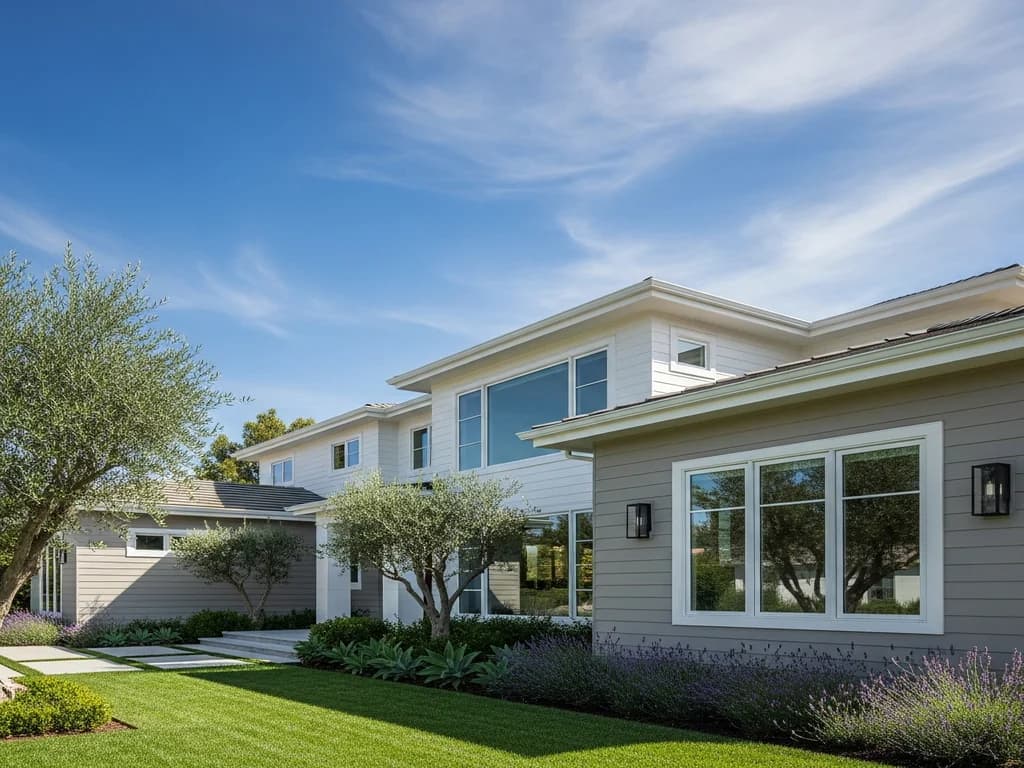
No other Statement color interacts with plants as directly as a green, and in California that interaction changes with the season. Against the gold grass and gray-green oaks of a foothill summer, Mountain Sage looks native — it shares the same dusty green as live oak foliage and coyote brush. Against a bright irrigated lawn or new spring growth, the siding reads grayer by comparison, because saturated plant green makes any muted green look less green. Dark conifers, by contrast, make it look lighter and slightly warmer. Two practical consequences follow. First, if your yard is mostly lush lawn and boxwood, expect the house to read as a gray with a hint of green for most of the year. Second, drought-tolerant planting — lavender, rosemary, salvias, ornamental grasses — tends to flatter Mountain Sage more than turf does, because the plant palette shares its muted range.
Valley, foothill, coast, and Tahoe
In the Sacramento Valley, hard midday sun pushes Mountain Sage toward a pale silvery gray; the green returns in morning and evening light and on shaded elevations. In the Sierra foothills — Auburn, Grass Valley, El Dorado Hills — it's arguably at its best, sitting against oak woodland and granite outcrops. On the fog-prone coast and around the Bay, diffuse gray light softens it further; the color can read nearly neutral on a heavy marine-layer morning, which suits coastal cottage and shingle-style homes. Above roughly 5,000 feet around Tahoe and Truckee, the pairing with pine and snow is natural, though a dark forest backdrop can make it look lighter than the sample suggests, and some mountain owners prefer a deeper body with Mountain Sage as an accent. If you're near the lake, check local design requirements before choosing any body color — our Tahoe Hardie color palette guide covers the regional considerations.
Mountain Sage vs. Light Mist, Pearl Gray, and Monterey Taupe
These are the colors Mountain Sage is most often weighed against, and each answers a different question. Light Mist is paler and reads as a cool greige — choose it if you want lightness first and only a whisper of color. Pearl Gray is a light-to-mid cool gray with no green to speak of; it's the safer neutral when your roof or stone leans blue-gray. Monterey Taupe trades the green for warmth, reading as a muted gray-brown that suits warm brick and brown roofs. Mountain Sage is the one that ties the house to vegetation. A quick way to choose: lay out all four boards in front of your planting. If the sage looks like it belongs and the others look like they're sitting in front of the garden, that's your answer; if the sage looks muddy beside your particular roof, step to Pearl Gray or Monterey Taupe.
The trim plan: what's prefinished and what isn't
When we checked James Hardie's ZIP-level availability for the Sacramento area while writing this guide, Mountain Sage came up on lap siding in both Select Cedarmill and Smooth, on panel, on both HardieShingle edges, and on batten boards. It did not appear among the ten colors offered on HardieTrim boards, and HardieSoffit was listed in just five colors, none of them green. So a sage-on-sage trim scheme requires field-painted trim. Most good Mountain Sage schemes don't want matching trim anyway. Arctic White trim gives a fresh, cottage-like read; Cobble Stone softens it for a quieter, more organic look; Timber Bark or Rich Espresso trim warms it toward craftsman; and Iron Gray or Midnight Black trim makes it modern. Board-and-batten gables in Mountain Sage over a white lap body are another option that keeps the green as an accent. Confirm current trim colors with your supplier at order, since offerings vary by region.
Roofs, stone, wood, and window frames
Mountain Sage works with a wider range of roofs than most colors: charcoal and black composition shingles look crisp above it, weathered-wood blends look rustic, and dark bronze or matte black standing seam looks contemporary. The roof to be careful with is a strongly red or orange tile, which pushes the sage toward olive. For stone, gray granite, mixed fieldstone, and stacked ledgestone with gray and tan both work; very yellow sandstone is harder. Natural wood is the best companion of all — cedar porch ceilings, stained doors, and timber posts warm the gray-green and make the house feel crafted. For windows, black frames sharpen the elevation, bronze reads softer and suits rustic homes, and white frames keep a cottage feel. Stained-wood or deep-red front doors are good accents; a bright blue door competes.
Three ways people misjudge a sage sample
First, judging it indoors: interior lighting usually makes Mountain Sage look greener and warmer than it will outdoors, so the installed house can feel grayer than expected. Second, judging it against the wrong background: a sample propped in a flower bed is being compared with saturated plant green, which makes it look gray; a sample against bare stucco or the existing siding gives a truer read. Third, judging it at noon only: midday sun in the valley flattens the green almost completely, while late-afternoon light shows its full character. Order a board sample in the texture you'll install, look at it at three times of day on at least two elevations, and view it from the street next to Light Mist and Pearl Gray samples. Our guide to ColorPlus versus field paint is worth reading if you're considering field-painted trim to match.
Mountain Sage vs. the neutrals it's usually weighed against (qualitative; verify with samples)
| Attribute | Mountain Sage | Light Mist | Pearl Gray | Monterey Taupe |
|---|---|---|---|---|
| How most people see it | Soft gray-green sage | Pale cool greige | Light-to-mid cool gray | Muted warm gray-brown |
| Color presence from the street | Subtle green | Nearly neutral | Neutral | Warm neutral |
| Best roof partners | Charcoal, black, weathered wood | Charcoal, gray | Gray, charcoal, black | Brown blends, warm tile |
| Prefinished HardieTrim boards (Sacramento-area data, time of writing) | No — batten boards only | No — batten boards only | Yes | Yes |
| Strongest settings | Foothill oak woodland, coast | Valley, coast | Valley, contemporary | Foothill, wine country |
Key takeaways
- Mountain Sage is a soft, gray-dominant sage — it behaves like a neutral and accepts warm or cool pairings
- James Hardie has featured it as its Color of the Year; the finish and warranty match every other ColorPlus color
- Surrounding plants change how green it reads: lush lawn makes it look grayer, drought-tolerant planting flatters it
- Hardie's Sacramento ZIP lookup, as of this writing, showed no factory-finished Mountain Sage trim boards or soffit — so plan a contrasting trim
- Compare it against Light Mist, Pearl Gray and Monterey Taupe in front of your actual landscaping
FAQ
Quick Answers
Most people see it as gray first with a soft green tint. It looks greener in morning and evening light and in shade, and grayer in hard midday sun or beside lush green plants.
James Hardie has featured Mountain Sage as its Color of the Year on its Dream Collection page. It is also part of the current Statement Collection.
Arctic White for a fresh cottage look, Cobble Stone for low contrast, Timber Bark or Rich Espresso for warmth, and Iron Gray or Midnight Black for a modern read. In Hardie's Sacramento-area listing when we checked, every one of those came as a prefinished trim board; Mountain Sage did not.
Yes, when paired with black window frames, dark trim and simple massing. Its gray-heavy character keeps it from looking cottage-like in a modern scheme, especially in Smooth lap or panel.
It suits pine and snow well, though a dark forest backdrop can make it read lighter than the sample. Check local design rules near the lake before choosing a body color, and consider it as an accent over a deeper body.
Light Mist is paler and reads as a cool greige with very little color. Mountain Sage is deeper and clearly gray-green. Choose Light Mist for lightness and Mountain Sage for a connection to plantings.
Sources
Authoritative references
- James Hardie — Dream Collection (nearly 700 made-to-order ColorPlus finishes)
- James Hardie — Statement Collection colors (check your area's availability)
- James Hardie — 2025 National Product Catalog (Statement and Dream collections, trim accessories)
- James Hardie ColorPlus Technology — finish process, 15-year finish / 30-year substrate warranty terms
External links to government, code, and manufacturer sources. Sierra Siding is not affiliated with these organizations; references are provided for verification.