Exterior renovation in Belvedere
Belvedere is a small, exclusive island city on the bay, joined to the Tiburon peninsula and ringed almost entirely by water. That setting makes it unlike any other town we serve in Marin: the controlling exterior stressor here is not fire but salt air and constant marine moisture, working on the walls of estate homes that face the bay on three sides. From the hillside view residences down to the lagoon-side homes on pilings, every wall in Belvedere lives in a corrosive, humid maritime environment. A re-side here is fundamentally a moisture-and-salt durability project carried out to an exacting estate standard.
Why Belvedere siding wears the way it does
Ringed by water on nearly every side, Belvedere fails its walls from the metal in. Salt-laden air attacks fasteners and flashing first, so in a marine setting this severe the hardware that holds the wall together corrodes before the cladding ever does — and the bay-facing and lagoon-side elevations take the worst of the wind-driven moisture and spray year-round. The grand shingle-style and Mediterranean villas here largely wear original wood and ferrous metal that the salt is steadily destroying. Sierra Siding builds for that reality: premium fiber cement, including James Hardie, over a rigorous, drying-capable drainage plane, with corrosion-resistant flashing and fasteners specified as the first line of defense rather than an afterthought, and shingle and clapboard profiles matched so the architecture is preserved while the wall is made genuinely maritime-durable.
Considering an exterior project in Belvedere?
Belvedere housing and architecture
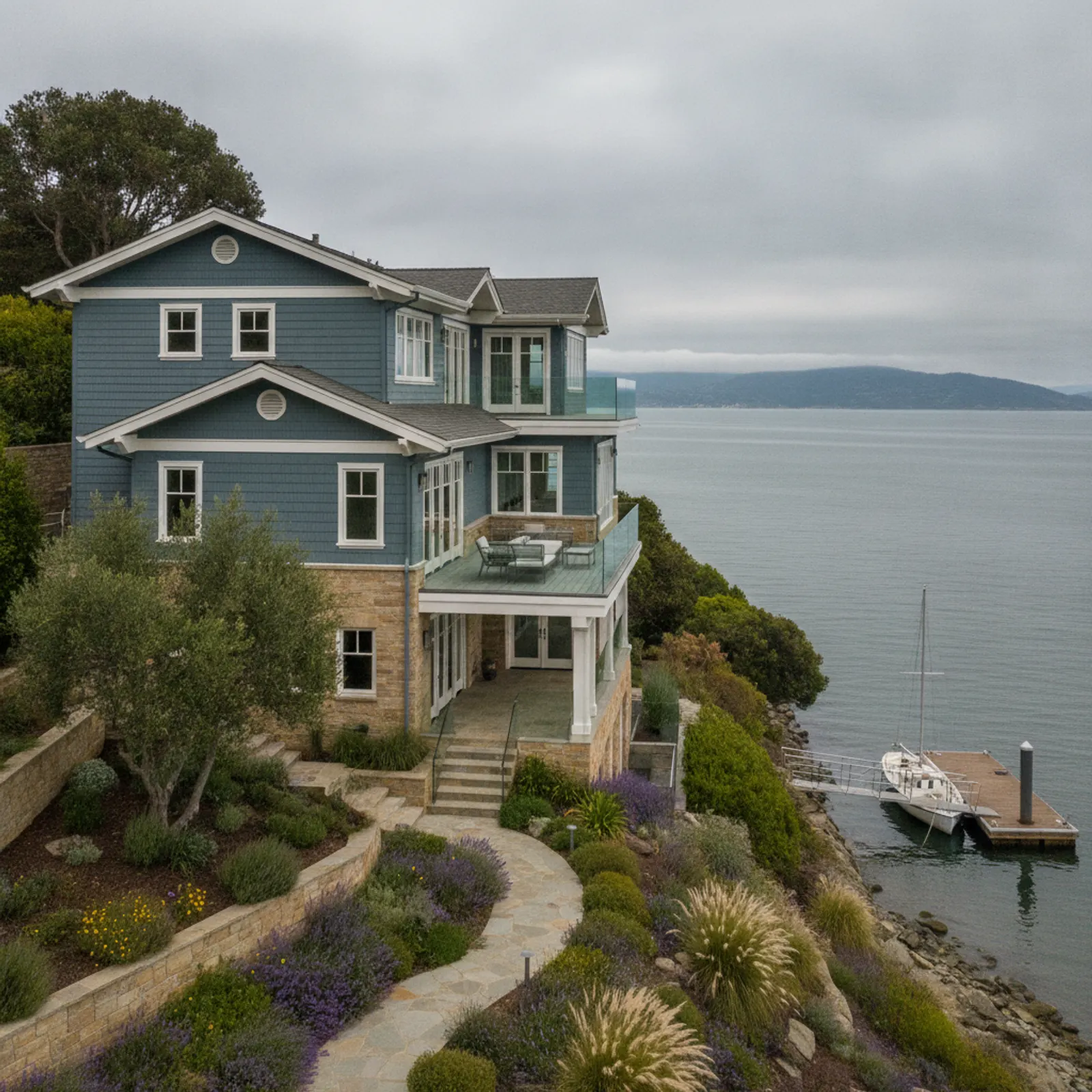
Belvedere's housing stock is among the most valuable in California: grand waterfront and hillside estates, shingle-style and Mediterranean villas, custom view residences climbing Belvedere and Corinthian islands, and distinctive lagoon-side homes built on pilings over the water. Many of these significant homes wear original wood shingle, clapboard, or stucco detailing that demands genuinely period-sensitive, high-finish work. The marine setting is brutal on original wood and ferrous metal, so re-cladding is both a restoration discipline and a serious durability upgrade — the new wall has to read as the architecture intends while surviving decades of salt and fog.
Belvedere's maritime bay climate
Belvedere sits surrounded by the bay, so its walls face persistent marine moisture, frequent fog, and a steady salt-laden air that few inland Marin towns experience. Wind-driven rain and humidity work on every elevation, and the bay-facing and lagoon-side walls take the worst of it year-round. The controlling concern here is corrosion and drying capacity together: the assembly must shed bulk water, resist salt attack on its fasteners and flashing, and still breathe. That puts corrosion-resistant detailing and a rigorous, drying-capable drainage plane at the absolute center of any Belvedere spec, ahead of every other consideration.
Recommended materials for Belvedere
Premium fiber cement, including James Hardie, over a rigorous, drying-capable drainage plane is the core recommendation for Belvedere, because it resists the salt-driven decay that destroys original wood and economy cladding in this environment with no durability trade-off. Just as important here are corrosion-resistant flashing and fasteners — in a salt-air setting the metal that holds the wall together fails before the cladding does, so we specify it accordingly. Durable factory finishes carry the relentless UV-and-fog cycle off the water, and on these significant homes we match shingle, clapboard, and custom profiles so the architecture is preserved while the wall is made maritime-durable.
What an exterior project costs in Belvedere
Belvedere is among the most valuable markets in the state, and pricing reflects the homes and the setting: large estate footprints, intricate architectural trim, custom profile matching, corrosion-resistant detailing upgrades, and the substrate repair that salt-exposed older homes frequently hide. Tight island streets, steep hillside access, and the special staging required for lagoon-side and piling-supported homes can add real access and logistics cost. We provide a written, scoped estimate after an on-site assessment; in Belvedere the corrosion-resistant flashing and drainage detailing are not where we recommend economizing, and the written estimate governs the work.
The waterfront and lagoon-side homes
The homes ringing the lagoon and lining the bay edge take the most punishing exposure in Belvedere — constant salt, wind-driven spray, and the special challenge of structures built on pilings over the water. These elevations are where corrosion-resistant fasteners and flashing, and a drainage plane that can dry, do their most decisive work. Access and staging for piling-supported and water's-edge homes require careful planning, which we work out on site rather than assume.
The hillside view estates
Climbing Belvedere and Corinthian islands, the hillside view estates face the bay on multiple sides and catch wind-driven moisture across every elevation, even where they sit well above the waterline. These are significant, architect-designed homes where the finish standard is uncompromising, so the re-side has to combine salt-and-moisture durability with restoration-level profile and trim matching on every face of the house. The exposure varies by orientation, with the bay-facing and windward walls taking far more punishment than the sheltered sides, so we tune the detailing elevation by elevation rather than uniformly. Steep grades and narrow island streets shape how we stage and scaffold, all of it planned during the on-site scope rather than assumed.
An exacting market and a documented scope
Belvedere homeowners hold exterior work to the highest standard, and the homes carry exceptional value, so documentation and craftsmanship matter at every step. We record the materials and assemblies we install, specify the corrosion-resistant detailing the maritime setting demands, and match profiles with restoration-level care. We scope each estate to its specific exposure — bay-facing, lagoon-side, or hillside — rather than applying a template, because in this market a maritime-durable, architecturally faithful exterior protects both the residence and its considerable value.
City of Belvedere permits, MMWD, and Tiburon Fire Protection
Belvedere is one of California's smallest incorporated cities — roughly 2,000 residents on the Belvedere Island and Corinthian Island parcels connected to the Tiburon peninsula. Building permits go through the City of Belvedere Planning and Building Department, a small operation that enforces the city's careful zoning and design-review expectations. Electric and gas are PG&E. Water is supplied by the Marin Municipal Water District (MMWD), a customer-owned public agency, so any work near a water meter or backflow assembly coordinates through MMWD. Fire response is the Tiburon Fire Protection District, which serves Belvedere alongside neighboring Tiburon. On the permit side, the city's Historic Preservation review applies to designated landmark structures and can shape material, profile, and color decisions on contributing properties. We flag city, utility, and heritage items at the estimate stage rather than at the wall.
HZ10 and Belvedere's low-fire, high-corrosion reality
Belvedere is in James Hardie's HZ10 climate zone despite the fog and salt — HZ10 covers the West's mild coastal areas — and HZ10 is the correct spec for a Belvedere home; installing HZ5 is a documented warranty misapplication. On the fire side, Belvedere's water-ringed island setting keeps essentially all of the city outside high-hazard FHSZ territory under California's 2025 LRA Fire Hazard Severity Zone map — a first comprehensive revision since 2007. The wooded upper slopes of Belvedere Island carry Low or unmapped designations, and the WUI Code does not typically apply on Belvedere parcels. The corrosion-and-moisture spec, not the fire spec, is where the whole game lives here. The code frame itself did change on January 1, 2026, when Chapter 7A was deleted from the Building Code and moved into the standalone WUI Code, but the substantive concern on a Belvedere re-side remains the maritime environment.
Our process in Belvedere
- Step 1
Consultation
We listen to your goals and assess your home on site — exposure, substrate, and architecture.
- Step 2
Design & Proposal
A clear written proposal with the right system specified for your climate and a transparent scope.
- Step 3
Expert Installation
Trained crews install to manufacturer best practices with careful weather-management detailing.
- Step 4
Walkthrough & Support
A final walkthrough, full cleanup, and a clear written record of the scope completed — work we stand behind.
In Belvedere, a re-side is first and foremost a defense against salt air and bay moisture, executed to an estate standard. We specify corrosion-resistant detailing and a drying-capable wall, and we match the home's architecture with restoration-level care. We scope every Belvedere project on site, and your written estimate governs the work.
FAQ
Belvedere — Common Questions
Salt air and constant bay moisture. The marine environment corrodes fasteners and flashing and decays original wood, so corrosion-resistant detailing and a drying-capable wall come first.
Premium fiber cement, including James Hardie, over a rigorous drainage plane with corrosion-resistant flashing and fasteners — it resists salt-driven decay with no durability trade-off.
Low — Belvedere is a water-ringed island enclave, not a wooded interface. Non-combustible fiber cement remains a sound, low-regret choice, but salt and moisture are the real drivers here.
Yes. These homes take the harshest salt and moisture exposure, so we specify corrosion-resistant detailing and a drying-capable assembly, and we plan the special access and staging on site.
Yes. Fiber cement comes in shingle, clapboard, and custom profiles, so we preserve the home's original character while making the wall maritime-durable.
Constant salt air and marine moisture attack both the wood and the metal holding it. We lead with corrosion-resistant detailing and a drying drainage plane so the cause is resolved.
Yes — in salt air the fasteners and flashing often fail before the cladding. Specifying corrosion-resistant metal is essential to a long-lasting Belvedere exterior.
A correctly specified fiber cement system with corrosion-resistant detailing commonly performs 30+ years even in this demanding maritime environment.
Explore
Exterior Services
Helpful Exterior Guides